- Crowdsourcing the Global Nutrition Report.
- Which will not cover the Neanderthals.
- Azolla genome project meets crowdfunding target, gets love from BGI.
- Would that contribute to Evergreen Agriculture?
- I bet breadfruit would, but New Scientist has put an article about that interesting tree behind a paywall. But, see this teaser…
- Some people think the potato bean will.
- Another genebank in Canada. Not crops, though, I suspect.
- Saving the camel in Rajasthan.
- ICRISAT gets a new DG.
- Podcast on the history of American beer. Perfect note on which to wish you all a good rest of the weekend.
Robert Rhoades remembered
It was just over four years ago that Prof. Robert Rhoades, pioneer of agricultural anthropology, passed away. He’s remembered this month in a Special Issue of the journal Culture, Agriculture, Food and Environment entitled Tending the Field.
Prof. Rhoades didn’t just invent the field of agricultural anthropology. Here’s an extract from one of the papers, Long in the Horn: An Agricultural Anthropology of Livestock Improvement, by Tad Brown, one of his students, on the conservation of the Pineywoods cattle landrace in the southern US:
Through my fieldwork, I also located one lone bull descending from a Holt cow in Alabama. It is the offspring of a cross with a Florida Cracker bull. After some deliberation, Rhoades bought that half-bred Holt bull, and he would jokingly threaten to start his own strain (see Figure 2). To Rhoades, a purebred landrace was a bit of a contradiction in terms. Just as cattlemen derived named-strains from the larger population of woods cattle, the division and recombination of family herds was the process by which people and cattle came to inhabit the southeastern pines. As such, the emphasis on genetics and purity of descent in livestock conservation efforts today can be somewhat averse to the social history from which the landrace breeds were derived (R. Rhoades, personal communication).
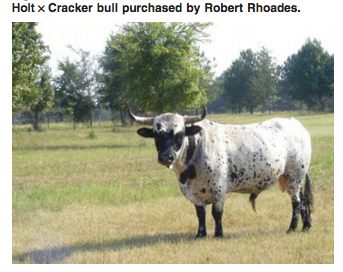 And here’s that Fig. 2. Prof. Rhoades practiced what he preached. How many of us can say that?
Nibbles: Yaks in USA, Sorghum vs maize, Jackfruit mystery, Cassava viruses, Aquculture & gender, G20 ag meeting, CGIAR
- Yak farming. In Arizona?
- Sorghum farming. In Kenya?
- Jackfruit farming. Who’d do it?
- Cassava farming. With all those nasty viruses?
- Fish farming. By Bangladeshi women?
- Global farming. What will the G20 do?
- Farming research. Have you heard of the CGIAR? From the horse’s mouth?
Brainfood: Old flax, Rice in Spain, Rice in Iran, Mozambican cowpea, Agrobiodiversity reserve, Old olives, Georgian livestock, Crowdsourcing fungi
- Harvesting wild flax in the Galilee, Israel and extracting fibers — bearing on Near Eastern plant domestication. The wild stuff was harvested before the Neolithic Revolution.
- Building resilience to water scarcity in southern Spain: a case study of rice farming in Doñana protected wetlands. Better to restore part of the rice fields to natural wetlands.
- Evaluation of rice dominance and its impact on crop diversity in north of Iran. Rice can’t catch a break in Iran either.
- Evaluation of four Mozambican cowpea landraces for drought tolerance. One of them is promising.
- Agro-Biodiversity Spatial Assessment and Genetic Reserve Delineation for the Pollino National Park (Italy). Somewhat gratuitous use of GIS, as far as I can see, but pretty maps.
- A comparative analysis of genetic variation in rootstocks and scions of old olive trees — a window into the history of olive cultivation practices and past genetic variation. Much more variation among rootstocks than scions.
- The diversity of local Georgian agricultural animals. I’d like to see a Megrelian horse one day, they sound cool.
- Crowdsourcing to create national repositories of microbial genetic resources: fungi as a model. Why just fungi, though?
Nibbles: GM bananas, Passenger pigeons, Conference, Diet, Perennial grains, Ugandan mushrooms, Adopting diversity, Indian history
- “Genetically modified bananas grown in far north Queensland and bound for Africa are about to undergo human trials in the United States.” Because … GM!
- More on those passenger pigeons.
- A big old conference on Agriculture and climate change, February 2015.
- Then again, we could all change what we eat to combat climate change.
- Or change what we grow. Report on some perennial grain experiments.
- Mushrooms for Uganda, a new project sees the light of day.
- “The determinants and extent of crop diversification among smallholder farmers” in Zambia. It’s IFPRI, Jake.
- I really just wanted a reason to link to this site, so I searched for millet. I’ll bet there’s more there of more direct interest.