- Sustainability and wildcrafting; not overharvesting frankincense, or anything else.
- Another take on cattle domestication.
- And the spread of ancient grains.
- Everyone wants to take credit for the peanut genome …
- Learn why that’s a good thing courtesy of the Generation Challenge Programme.
- A new website to ensure that seed aid after a disaster is not itself a disaster.
- Ah, the joys of walking the policy tightrope: Higher food prices are good for the poor … in the long run.
- Nice piece from the data nerds at 538: Can Evolution Outrace Climate Change?
- On a related note, can Bioversity outrace the IPCC?
- “The US Agency for International Development (USAID) today announced the launch of its US$100-million Global Development Lab in Washington DC — a move that will elevate the role of science at the agency.” WCPGW?
Nibbles: Rice intensification, Community genebank, Biodiversity & poverty, Borlaug, Deconstructing recipes, Biofortification conference, IPCC, Kenyan agricultural changes, Collecting wild chickpeas, African peanuts, Insurance for herders, Old fields, Millet fairs & diseases, GDP and malnutrition, Yeast evolution
- From SRI to SARI. Rice has never had it so good.
- Look there’s even a guy in Orisha who grows 920 varieties.
- Biodiversity conservation and poverty reduction: Unproven. Doesn’t sound like they looked at agricultural biodiversity though.
- Contrary take on the Borlaug legacy.
- From Map Your Recipe to Compare Your Recipe. h/t Rachel Laudan.
- Follow that biofortification conference in Kigali. Maybe they’ll talk about recipes.
- Guardian Environment blogger breaks down the agricultural bits of the IPCC report for you. Lots of that going around.
- No conceivable reason for growing jatropha in Kenya. One of those times when you wonder whether anyone had predicted this would happen at the time.
- So does anyone know now whether switching from coffee to banana might be a bad idea in the long run? This is your chance.
- Wild chickpea to the rescue.
- The ups and downs of groundnut research in Africa.
- Islamic insurance for herders. Demand, meet supply.
- Celtic fields can still be seen, if you know what to look for.
- Seed fair in Senegal exchanges pearl millet. Could usefully do the same in Namibia, it looks like.
- Does economic growth help in reducing child malnutrition? It depends on whether you plot % malnutrition against GDP per capita or annual change of the first against annual change in the latter.
- The complicated story of yeast, unravelled.
Agricultural biodiversity where you least expect it
Continuing our in-depth treatment of The Economist’s (unwitting?) coverage of agricultural biodiversity, two items in the most recent issue. First, consider this photo:
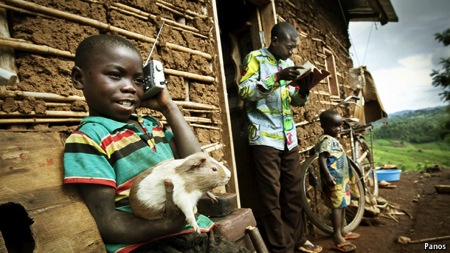
It’s from an article on the BBC World Service, and clearly shows the value of a radio in Africa. But what’s that the listener is holding? Could it be a cavy? I rather think it could, and of course one wouldn’t expect The Economist to mention its origins in the Andes. We, however, still want to know when they arrived, how they got there, and whether they are proving the “indispensable” option they were thought to be.
Then there’s this little table, from an article on price fixing and cartels.
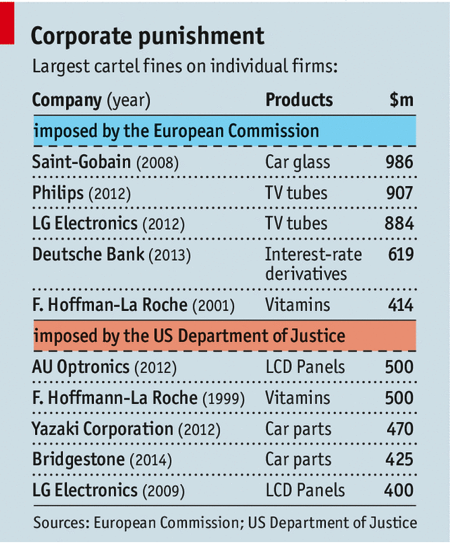
See those innocuous little entries for F. Hoffman-La Roche, labelled Vitamins? Those reflect decisions more than a decade ago by the US and the EU to fine not just Hoffman but a bunch of other pharmaceutical companies for fixing the price of vitamin A supplements, proof enough of the economic value of treating vitamin A deficiency as a simple medical problem requiring a simple (and expensive) medical fix. And most of the time, synthetic supplements aren’t even that useful to the children who get them. How else might you improve vitamin A levels? Well, you could try promoting a more diverse diet. But where’s the profit in that?
p.s. I was slightly saddened to see that while Hoffman remains joint number 1 in the EU, it has slipped to a poor 5th in the US. So I ran the numbers through an inflation indexer, which brings the $500 million up to $705 million in today’s dollars, which at least bumps them up a place.
Brainfood: Sunflower genomics, Omani chickens, Ozark cowpea, Amerindian urban gardens, Thai homegardens, Global North homegardens, African pollination, Ugandan coffee pollination, Use of wild species, Wheat and climate change, Iranian wheat evaluation, Tunisian artichokes, Fig core, Onion diversity, Distillery yeasts
- Genomic variation in Helianthus: learning from the past and looking to the future. Paleopolyploid events, transposable elements, chromosomal rearrangements. Is there anything these plants don’t have? But then these guys would say that, wouldn’t they.
- Assessment of genetic diversity and conservation priority of Omani local chickens using microsatellite markers. Unsurprisingly, the Dhofar (far S) and Musadam (far N) populations are the most different. I collected crops in both places way back when, and I bet you it would be the same for things like alfalfa and sorghum. Or cowpea, which brings me to…
- Just Eat Peas and Dance: Field Peas (Vigna unguiculata) and Food Security in the Ozark Highlands, U.S. Still important after all these years. (I suspect Gary Nabhan would have predicted this, but I can’t even get an abstract of his paper Food Security, Biodiversity and Human Health: Ethnobiology as a Predictive Science.)
- Amerindian Agriculture in an Urbanising Amazonia (Rio Negro, Brazil). Traditional systems survive move to cities just fine.
- Human-Induced Movement of Wild Food Plant Biodiversity Across Farming Systems is Essential to Ensure Their Availability. Just like in Brazil, people move wild species to their homegardens in Thailand too.
- Urban home food gardens in the Global North: research traditions and future directions. Uhm, could maybe Brazilian and Thai homegarden studies guide similar work in the North… Yep, and here’s how.
- Priorities for Research and Development in the Management of Pollination Services for Agricultural Development in Africa. Old and traditional may not mean weak and out of date, but change gonna come anyway.
- Social and Ecological Drivers of the Economic Value of Pollination Services Delivered to Coffee in Central Uganda. No wait, change here already.
- Use it or lose it: measuring trends in wild species subject to substantial use. Wild species which are being used by people tend to be doing better than those that are not. Yeah, but settle down, the data are not that great.
- An assessment of wheat yield sensitivity and breeding gains in hot environments. The successes have been coming from the lower potential material, not the elite of the elite.
- Adaptation Patterns and Yield Stability of Durum Wheat Landraces to Highland Cold Rainfed Areas of Iran. It’s not always about heat. Anyway, in either case, thank goodness for diverse worldwide germaplasm collections.
- Karyological and genome size insights into cardoon (Cynara cardunculus L., Asteraceae) in Tunisia. The wild populations from Sicily and Tunisia are closest to the crop.
- Ex situ conservation of underutilised fruit tree species: establishment of a core collection for Ficus carica L. using microsatellite markers (SSRs). Fancy maths allows Spanish researchers to recover all microsats within a collection of 300 figs in only about 10% of the accessions. So who gives a fig for the rest, right?
- Assessing the genetic diversity of Spanish Allium cepa landraces for onion breeding using microsatellite markers. Alas, all the Spanish Allium cepa landraces fall in the same cluster, so a core could be tricky. These guys really know their onions.
- Biodiversity of non-Saccharomyces yeasts in distilleries of the La Mancha region (Spain). Gonna need some booze to wash down the figs and onions, right?
Nibbles: Agavins, Women in Ag, Teacup shattered, Quinoa, Rice, PGR course, Seeds for Africa, Tomato, Global cookbook, Cover crops, Sheep
- Tequila plant is possible sweetener for diabetics. Talk about a waste of raw material.
- Would you Adam and Eve it? Women do not own 2% of the land. What next for the killer factcheck?
- In related news, teacup pigs are a fraud.
- Quinoa to feed the world, in Spanish.
- The rice warrior! Isn’t that overegging the pudding just a smidgen?
- Learn about plant genetic resources and seeds at Wageningen University.
- African Agriculture Technology Foundation “to avail adequate quality seeds at the right time and affordable price”. You might think some of the folks at the AATF should avail themselves of Wageningen’s course.
- Tough, flavoursome and bug resistant. Not Richard Markham, but a tomato bred specially for the Solomon Islands he’s talking about.
- Kew’s new global kitchen cookbook narrowly avoids being crushed by bandwagon trundling by.
- Cover crops are even more valuable than previously thought shock.
- Indigenous sheep breeds even more valuable than previously thought shock.