- Meaty presentation on how biodiversity in the food system delivers a diverse diet. Could hardly fail to, really, could it.
- What’s a diverse diet ever done for me, asks ancient farmer.
- Vegetables an important part of diverse diets, of course. Especially in urban areas.
- Interesting EU project on the phylogenetics of medicinal plants. Any vegetables in there?
- Improved cowpeas only improved when farmers know they are improved. Wow.
- Some glimmers of hope on adaptation? Maybe.
- Not all livestock bad for climate change. And room for improvement on those that are.
- Yeah, but who cares, global warming is just a giant natural fluctuation, no? No.
- Legalize it, already! Poppy cultivation as a climate change adaptation measure?
- Australian agriculture unprepared for climate change? With all these fancy breeders and access to the world’s genebanks?
- Meanwhile, in China, the focus is on food sovereignty.
- And in Japan on its spaced out cherry tree.
Nibbles: Citrus in Italy, Banana genebank, Post-2015, Wheat Yield Partnership, Kenyan seed company, UC Davis symposium, Dingo genetics
- The history of citrus in Italy.
- The Independent visits the global banana genebank and still doesn’t figure out that there are no seeds there.
- Rome-based UN food agencies come up with post-2015 food security and nutrition targets. Not many people hurt.
- The wheat people have the answer.
- Going where no seed company has gone before.
- UC Davis Plant Breeding symposium to feature CIP genebank stalwart.
- The dingo is different.
Nibbles: Sustainability, Cattle domestication, Grain domestication, Peanut genome, Peanut breeding, Seed systems, Food prices, Climate stuff, Aid
- Sustainability and wildcrafting; not overharvesting frankincense, or anything else.
- Another take on cattle domestication.
- And the spread of ancient grains.
- Everyone wants to take credit for the peanut genome …
- Learn why that’s a good thing courtesy of the Generation Challenge Programme.
- A new website to ensure that seed aid after a disaster is not itself a disaster.
- Ah, the joys of walking the policy tightrope: Higher food prices are good for the poor … in the long run.
- Nice piece from the data nerds at 538: Can Evolution Outrace Climate Change?
- On a related note, can Bioversity outrace the IPCC?
- “The US Agency for International Development (USAID) today announced the launch of its US$100-million Global Development Lab in Washington DC — a move that will elevate the role of science at the agency.” WCPGW?
Nibbles: Rice intensification, Community genebank, Biodiversity & poverty, Borlaug, Deconstructing recipes, Biofortification conference, IPCC, Kenyan agricultural changes, Collecting wild chickpeas, African peanuts, Insurance for herders, Old fields, Millet fairs & diseases, GDP and malnutrition, Yeast evolution
- From SRI to SARI. Rice has never had it so good.
- Look there’s even a guy in Orisha who grows 920 varieties.
- Biodiversity conservation and poverty reduction: Unproven. Doesn’t sound like they looked at agricultural biodiversity though.
- Contrary take on the Borlaug legacy.
- From Map Your Recipe to Compare Your Recipe. h/t Rachel Laudan.
- Follow that biofortification conference in Kigali. Maybe they’ll talk about recipes.
- Guardian Environment blogger breaks down the agricultural bits of the IPCC report for you. Lots of that going around.
- No conceivable reason for growing jatropha in Kenya. One of those times when you wonder whether anyone had predicted this would happen at the time.
- So does anyone know now whether switching from coffee to banana might be a bad idea in the long run? This is your chance.
- Wild chickpea to the rescue.
- The ups and downs of groundnut research in Africa.
- Islamic insurance for herders. Demand, meet supply.
- Celtic fields can still be seen, if you know what to look for.
- Seed fair in Senegal exchanges pearl millet. Could usefully do the same in Namibia, it looks like.
- Does economic growth help in reducing child malnutrition? It depends on whether you plot % malnutrition against GDP per capita or annual change of the first against annual change in the latter.
- The complicated story of yeast, unravelled.
Agricultural biodiversity where you least expect it
Continuing our in-depth treatment of The Economist’s (unwitting?) coverage of agricultural biodiversity, two items in the most recent issue. First, consider this photo:
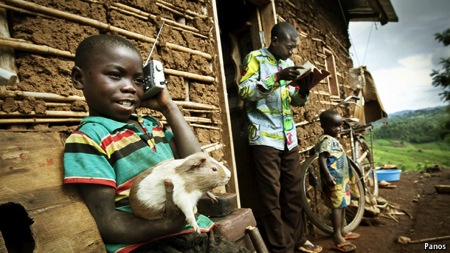
It’s from an article on the BBC World Service, and clearly shows the value of a radio in Africa. But what’s that the listener is holding? Could it be a cavy? I rather think it could, and of course one wouldn’t expect The Economist to mention its origins in the Andes. We, however, still want to know when they arrived, how they got there, and whether they are proving the “indispensable” option they were thought to be.
Then there’s this little table, from an article on price fixing and cartels.
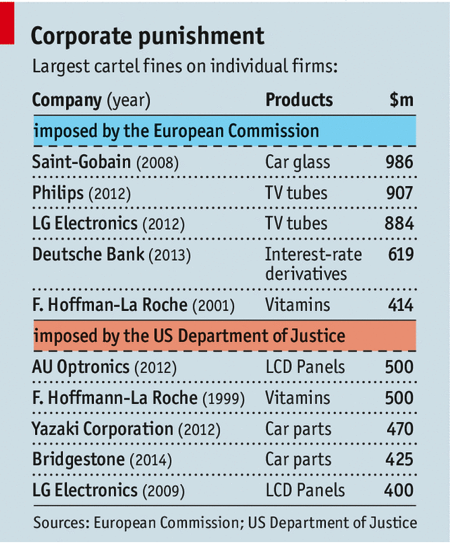
See those innocuous little entries for F. Hoffman-La Roche, labelled Vitamins? Those reflect decisions more than a decade ago by the US and the EU to fine not just Hoffman but a bunch of other pharmaceutical companies for fixing the price of vitamin A supplements, proof enough of the economic value of treating vitamin A deficiency as a simple medical problem requiring a simple (and expensive) medical fix. And most of the time, synthetic supplements aren’t even that useful to the children who get them. How else might you improve vitamin A levels? Well, you could try promoting a more diverse diet. But where’s the profit in that?
p.s. I was slightly saddened to see that while Hoffman remains joint number 1 in the EU, it has slipped to a poor 5th in the US. So I ran the numbers through an inflation indexer, which brings the $500 million up to $705 million in today’s dollars, which at least bumps them up a place.