- When dog was on the menu.
- Going far, and far back, for beer. And indeed yeast. Always worth the effort.
- BBC launches Human Planet, focusing on “man’s remarkable relationship with the natural world.” Which apparently doesn’t include agriculture.
- Mexicans eat many moth species, and not just the larvae.
- Amazing interactive food atlas for the US. wish I had a use for it, but someone surely does.
- Breeding a “better” Jalapeño pepper — to hold more cheese, natcho.
- Food as politics; the tsampa-eaters of the TAR. h/t GOOD.
Nibbles: Genebank, Rice, State of the World, Experiments, Lathyrus, Malaria and lactase persistence, Advice, CWR, Feed
- The Ethiopian Institute of Biodiversity has been up to something, but it is hard to be sure what.
- IRRI is also up to something — Green super rice — but again it is hard to be sure what. Not golden at any rate.
- CIAT picks its favourites from the State of the World 2011 report.
- More than anyone has any right to want to know about the history and future of agricultural experimentation, but fascinating nonetheless.
- The nutritive value and toxicity of grasspea and its relatives.
- Milk may or may not provide some protection from malaria.
- Nutrition advice, filtered for you. Jeremy sez “I like No. 6.”
- Irish launch crop wild relatives website.
- The feed quality of crop residues gets the treatment.
Of cattle and people. And barley
Dienekes, a blogger who specializes in molecular anthropology, has a quick note today on a paper on the molecular genetics of cattle in Europe. The main story is one of distinction between North and South.
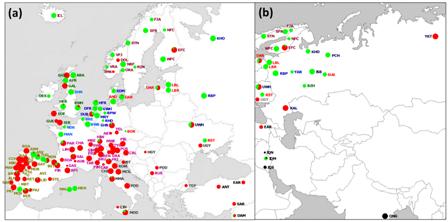
Apparently, the expansion of the dairy breeds have created, or largely maintained, a sharp genetic contrast of northern and southern Europe, which divides both France and Germany. It may be hypothesised that the northern landscapes, with large flat meadows, are suitable for large-scale farming with specialised dairy cattle (Niederungsvieh, lowland cattle), whilst the mixed-purpose or beef cattle (Höhenvieh, highland cattle) are better suited to the smaller farms and hilly regions of the south. However, it is also remarkable that in both France and Germany the bovine genetic boundary coincides with historic linguistic and cultural boundaries. In France, the Frankish invasion in the north created the difference between the northern langue d’oïl and the southern langue d’oc. The German language is still divided into the southern Hochdeutsch and northern Niederdeutsch dialects, which also correlates with the distribution of the Catholic and Protestant religions. On a larger scale, it is tempting to speculate that the difference between two types of European cattle reflects, and has even reinforced, the traditional and still visible contrast of Roman and Germanic Europe.
It doesn’t seem that the strong latitudinal genetic differentiation in cattle is matched by one in human populations. Here the pattern is much more gradual and clinal. 1 However, there may be a similar “sharp genetic contrast of northern and southern Europe” (or at least between the Mediterranean and the rest of Europe) for barley. 2
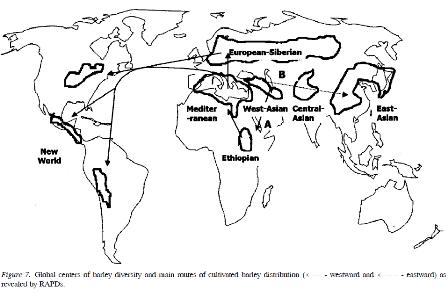
I’d dearly love to have the time to find out whether other livestock and crops show a similar pattern.
Nibbles: Squash etc, Potatoes, Economics, Pharaonic palm, goats, Chickpea
- Native American eating “best museum cafeteria in town”. “Makes up for the museum,” sniffs Jeremy
- Catalog of advanced clones and improved varieties going like hot potatoes.
- The Economic Impact of Bioversity is apparently “a seriously problem-rich, solution-craving topic”. Innovation Investment Journal says so.
- Pharaonic palm not immortal. Medemia argun “critically endangered”.
- Goat lineage diversity delineated. Paywalled.
- Chickpea diversity includes variability in resistance to salinity. Paywalled.
Nibbles: Women, Old Crops, New Crops, Forests, Pavlovsk
- Women and livestock.
- Women are not the solution.
- Hang on, sorry. Women are the solution.
- Traditional crops help improve agricultural sustainability, says scientist.
- Biofortification “is exactly what we need to … improve global health,” says Deputy Coordinator for Development at Feed the Future.
- Grist’s “good news for trees” roundup of 2010.
- Russie : menace sur le jardin d’Eden – that’s Pavlovsk for non francophones — a TV report.