- Are agricultural researchers working on the right crops to enable food and nutrition security under future climates? No. Well, kinda.
- Options for keeping the food system within environmental limits. You need to pursue several. Including those discussed above, presumably.
- Deep Learning for Plant Stress Phenotyping: Trends and Future Perspectives. 3D CNN architectures applied to hyperspectral imaging is the future, apparently.
- Dealing with multi‐source and multi‐scale information in plant phenomics: the ontology‐driven Phenotyping Hybrid Information System. You’re going to need a fancy system to keep track to the data from the above.
- Sweet Sorghum Originated through Selection of Dry, a Plant-specific NAC Transcription Factor Gene. Could be applied to other cereals?
- Repeated domestication of melon (Cucumis melo) in Africa and Asia and a new close relative from India. Once was not enough.
- Paying for Digital Information: Assessing Farmers Willingness to Pay for a Digital Agriculture and Nutrition Service in Ghana. Cheaper is better. There’s a shocker. Oh, and women are more careful with their money.
- Decreases in global beer supply due to extreme drought and heat. 32% decrease in consumption in Argentina, 193% increase in price in Ireland. But clearly the authors have never heard of sorghum beer.
- The role of local adaptation in sustainable production of village chickens. Location, location, location.
- On the Road to Breeding 4.0: Unraveling the Good, the Bad, and the Boring of Crop Quantitative Genomics. Beyond breeding on predicted phenotypes, it’s sort of breeding for predicted environments.
- Maize yields over Europe may increase in spite of climate change, with an appropriate use of the genetic variability of flowering time. You don’t even need Breeding 1.0, if you deploy existing diversity optimally.
- Got forages? Understanding potential returns on investment in Brachiaria spp. for dairy producers in Eastern Africa. Definitely worth a flutter.
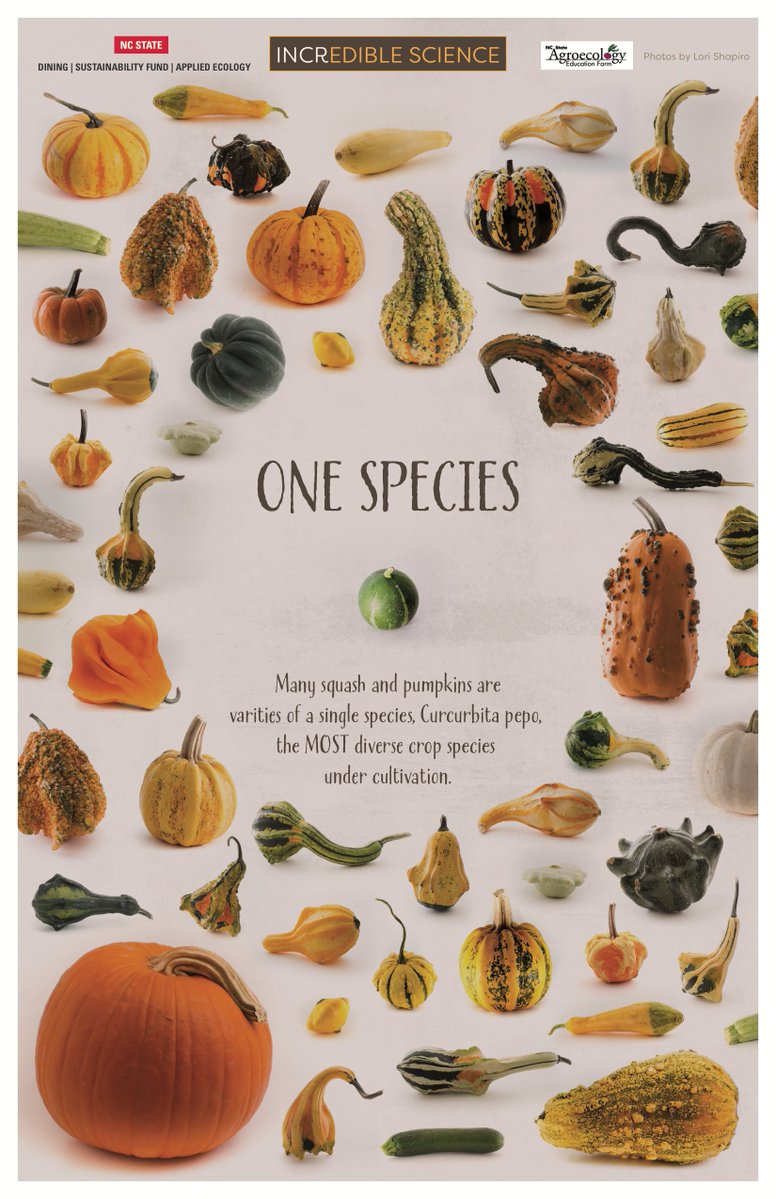
Diversity for Halloween
I’m not sure if I agree with the assertion, but this is a really nice poster.
Free the podcast
I’m sure it’s pure coincidence, but hot on the heels of CIMMYT launching a new podcast, here comes the Open Source Seed Initiative with Free the Seed! Good to see the mainstream trying to catch up with Jeremy.
And this seems as good a time and place as any to celebrate the 20th birthday of the greatest podcast of them all, In Our Time. My work will only truly be done when Lord Bragg asks some pointy-headed boffin to “please develop that a bit” of some arcane recess of agricultural biodiversity.
Nibbles: ITPGRFA, CIMMYT, VIR, Livestock & CC, Vesuvius, Apple pie, Biobanking
- The Plant Treaty tries to enhance itself: the story so far.
- CIMMYT gets a podcast. Here’s one on blue maize.
- The Vavilov collection put to good use. Again.
- “Cow farts cause more climate change than cars.” Not really. Here comes the science, by way of a Twitter thread, of all things.
- The Pompeii eruption: August, or October? Here comes the archaeobotany, among other things, by way of a Twitter thread, of all things.
- It was World Apple Day or somesuch, so here’s two canonical feel-good heirloom apple stories.
- Fancy an open-access special issue of Biopreservation and Biobanking? Too nerdy? It’s on agricultural genebanks… Yeah, I thought you might.
Brainfood: Yak diversity, Wheat pre-breeding, Gene conservation, Genome conservation, Wild lentils, Biodiversity definition, Conservation reviews, Bananas treble, Cotton diversity, Pollinator health, Aurochs DNA, USDA cucumbers, Physalis editing, Tomato re-domestication
- Identification and diversity of Y‐chromosome haplotypes in Qinghai yak populations. 2 paternal lineages but weak genetic structure among the 9 populations and 3 breeds.
- Development and characterization of Triticum turgidum–Aegilops umbellulata amphidiploids. A bridge to bread wheat.
- Variation in total root length and root diameter of wild and cultivated lentil grown under drought and re-watered conditions. Some wild species have longer total root length under drought stress than crops. No word on whether bridges needed.
- The Peril of Gene-Targeted Conservation. Only warranted when said targeted genes are important for viability and have large phenotypic effects. Suspect crop breeders (see above) may beg to differ.
- Conservation of biodiversity in the genomics era. Need to target the whole genome, I guess.
- “What Matters Is Species Richness” — High School Students’ Understanding of the Components of Biodiversity. Must try harder.
- What Conservation Does. The right things, more or less, and not at all badly, so stop complaining.
- Absence of evidence for the conservation outcomes of systematic conservation planning around the globe: a systematic map. It’s not evidence of absence of conservation outcomes, but still. Maybe should get together with the above?
- East African diploid and triploid bananas: a genetic complex transported from South-East Asia. All introduced by Austronesian people, probably via Madagascar, but no longer to be found in Asia (much).
- Molecular and Cytogenetic Study of East African Highland Banana. Focuses on one of the 4 groups discussed in the above (Mutika). All derived from maybe a single hybrid clone.
- Sources of resistance to Xanthomonas campestris pv. musacearum, the causal agent of banana Xanthomonas wilt. Why bother with the above, you ask?
- Genetic diversity of day-neutral converted landrace Gossypium hirsutum L. accessions. Eastern and western hemisphere groups, with US varieties closer to the eastern.
- Crop Domestication Alters Floral Reward Chemistry With Potential Consequences for Pollinator Health. In highbush blueberry, domestication has decreased the chemical diversity of nectar and pollen, possibly increasing infection by bee gut pathogens.
- Ancient DNA analysis of Scandinavian medieval drinking horns and the horn of the last aurochs bull. Aurochs interbred with domestic cattle way back. In other news, you can extract aurochs DNA from medieval Scandinavian drinking horns.
- The USDA cucumber (Cucumis sativus L.) collection: genetic diversity, population structure, genome-wide association studies, and core collection development. Three groups, more or less: India, E. Asia, and everything else. A third of 1200 accessions recovers 96% of variation.
- Rapid improvement of domestication traits in an orphan crop by genome editing. Tomato orthologues in groundcherry mutated for more fruits and better plant architecture.
- Domestication of wild tomato is accelerated by genome editing. Or you can do it with the actual tomato genes. As suggested a couple of years ago.