- SEARICE explains its approach to seed sovereignty and farmer participation.
- Nature on IFPRI’s report on agricultural R&D in Africa. Not pretty.
- Resilience Science on the UN Special Rapporteur’s sustainable intensification thing.
- The Gates Foundation is on a nutritional roll; most of yesterday’s posts are available from this round-up.
- New Mexico gets all protectionist about its chillies.
- IITA explains how it provides healthy germplasm. Various different interesting stories in there, stick with it.
- Farmer conservation power in India.
- How to control invasive species. Eat more weeds.
- Presentation on Trends in global nutrition and health: Local fruits and their potential importance for nutrition and health as seen at Pavlovsk berry meeting.
- Speaking of berries…
- The cerrado (and its crop wild relatives) is in trouble. We talked about this, weren’t you paying attention?
Secrets of Plant Genomes: Corn
A segment produced by the National Science Foundation in the US. Which means that by “corn” they mean “maize”.
Warning: May be too groovy for those of a nervous or academic disposition
Brainfood: Striga, Rice, Fish, Biofortification, Ecosystem functioning, Intercrops
OK, so we’re trying an experiment, siphoning off Nibbles about research, often in peer-reviewed journals, into their own hifalutin cookie jar. We’ll probably publish once a week. And their inclusion here doesn’t mean we won’t revisit them later.
- Genetic diversity of a parasitic weed, Striga hermonthica, on sorghum and pearl millet in Mali. The parasite is diverse, but no differences in parasitized fields.
- Genetic differentiation among Sri Lankan traditional rice (Oryza sativa) varieties and wild rice species by AFLP markers. Four major clusters agree with morphology.
- Genetic variation in farmed populations of the gilthead sea bream Sparus aurata in Greece using microsatellite DNA markers. Farmed are less diverse and less heterozygous.
- Restoration of hay meadows on ex-arable land: commercial seed mixtures vs. spontaneous succession. No difference in long-term diversity, but there are other considerations.
- Bio-available zinc in rice seeds is increased by activation tagging of nicotianamine synthase. It works.
- Soil fauna alter the effects of litter composition on nitrogen cycling in a mineral soil. It’s complex; larger fauna affect N dynamics.
- Dry matter yield, nitrogen content, and competition in pea–cereal intercropping systems. Intercrops are more productive and deliver higher forage quality.
So what do you reckon? Is this worthwhile?
Satoyama in peril?
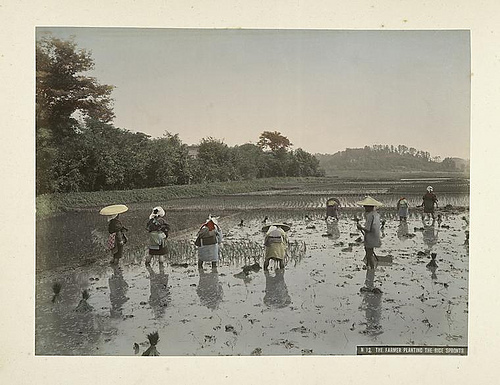
It may not be the thing that’s at the top of people’s agendas in Japan at the moment, but one does wonder what the long-term effect of the tsunami will be on the satoyama of the region, their agrobiodiversity and the people who maintain it. 1 The BBC series on the satoyama from a few years back is no longer available on the BBC’s website, but some of the documentaries can be found elsewhere. 2
Cloven hoofed agrobiodiversity in W1
An intriguing photo by a Flickr contact set off a spate of googling which quickly led to the discovery that there was a “Savile Row Field Day” in October last year, part of a Campaign for Wool. The prime locality in central London was given over to a flock of Exmoor Horn and Bowmont sheep. It’s not exactly groundbreaking (as it were), as far as marketing ploys go, but I wish I’d been there.
http://www.youtube.com/watch?v=r0LtQBwXW1s