- Jonathan Foley, @GlobalEcoGuy, lands well deserved award for his straight-talking on food issues.
- I wonder what he’d say about C4 rice.
- Not sure he’s ever written about fish, but he probably will.
- Sustainable harvesting of Prunus africana maybe not so sustainable after all. Well, I guess that’s science.
- Encomium to the recently-deceased “Father of Sorghum.”
- Shame he missed the round-up on improving abiotic stress tolerance in crops, linked to by AoB Blog.
- Wouldn’t it have been cool if the Father of Sorghum had met the Peanut Man?
- Global production of 10 top commodities has increased 130% since 1960, population by 89%. Draw your own conclusions about world hunger and malnutrition.
The rice in Spain grows mainly for the snails
With the floods in UK perhaps UK research institutes should turn their attention to rice as a crop. Need more rice experts! #UKrice
— GaryFoster (@Prof_GD_Foster) February 20, 2014
I suspect Prof. Foster was being facetious, and in any case would have to fight it out with other researchers working in a different direction, but maybe temperatures in England will soon be as suitable for rice cultivation as the rainfall regime. In Europe (and indeed Japan and New Zealand) the northern limit of rice cultivation seems to be at about 40-45 deg N, which covers the famous growing regions of the Po Valley in Italy and the Camargue in France. However, the very northernmost limit of rice cultivation in the world is at about 53 degrees N, which would put it at the latitude of Liverpool, say. So the south of England may not be entirely out of bounds in the future, if you factor in climate change and clever plant breeding.
Of course, as we read yesterday, temperature is not the only constraint to rice production in Europe. Spanish rice farmers are fighting an exotic snail, which may spread from the Ebro delta, which incidentally is on the 40th parallel N or thereabouts. Although rice has been in Spain since maybe the 8th century, its cultivation in the Ebro is relatively recent.
The first Designation of Origin for rice in Europe was granted to Calasparra rice which is grown in a mountainous area along the river Segura in the region of Murcia, the varieties being Bomba and Balilla X Solana. Both are sold as either brown or white rice. Bomba rice is the best-known of the Spanish varieties. Its grains are rounded but they increase lengthwise by almost fifty per cent during the cooking process and are very absorbent.
Also protected by a Designation of Origin is the rice grown traditionally in the Júcar river basin and in the Albufera, the most famous of the natural wetlands in Valencia where the varieties are Senia, Bahía and Bomba. The rice, mostly Bahía, grown in the Ebro delta in Tarragona (Catalonia) is also covered by a Protected Geographical Indication (PGI).
For the benefit of prospective English rice farmers, Bomba is available from the Spanish genebank, and elsewhere too. No word on whether there is material somewhere resistant to the ravages of Pomacea insularum.
Nibbles: CGIAR priorities, Drought tolerant rice, Agroecology bibliography, Amaranthus seed production video, Ethiopian genebank, Yemeni genebank
- UN Special Rapporteur on food thinks “questions of the 60s are not the questions of today.” Does he think the CGIAR is answering the questions of the 60s? One suspects so, but surely there are points of agreement, e.g. nutrition, food systems, natural resources management…
- Farmers would be willing to pay quite a premium for drought tolerant (DT) rice hybrids, but for DT varieties not so much. That’s an opportunity for public-private partnerships. Or is that a 60s answer to a 60s question?
- Mr de Schutter probably knows all about this bibliography of agroecology in action. Which all seems so much more 60s than hybrid rice somehow.
- How 60s is it to want to produce decent amaranthus seed? It’s totally unfair, but I can’t resist linking to this now.
- Ethiopian genebank, set up in response to the genetic erosion of the 60s, gets nice, long writeup in The Guardian by way of introduction to a bare-bones couple of final paragraphs on some G8 poverty reduction plan. Nice video though.
- There was no Facebook in the 60s for genebanks to strut their stuff on.
A plateful of Camargue Red Rice
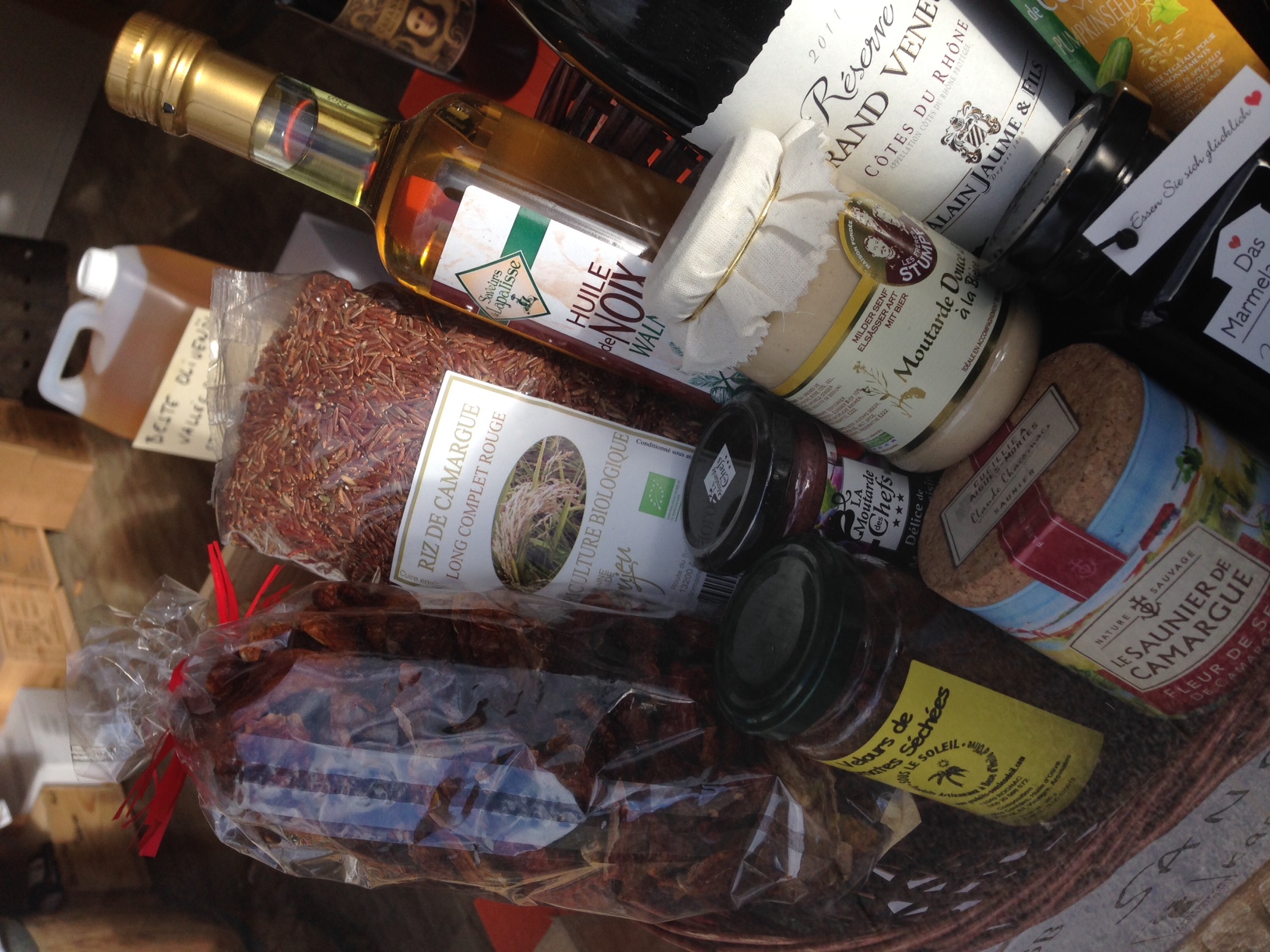 How far back into the mists of time, do you suppose, have the French versions of the fabled gnarled rustics of Sicily been nurturing the equally fabled red rice of the Camargue? The question occurred to me as I walked past a shop window in Bonn recently, and saw this delectable display of various products of that region, including said rice. Well, it turns out that although rice has been grown in the Camargue for centuries, this particular, trendily healthy variety is of somewhat more recent vintage.
A chance cross between the wild rice and a short grain rice was discovered in 1983 by a René Griotto (died 1989.) He found it growing at the foot of the Montmajor Abbey. Development of the cross was pursued in conjunction with the French “Institut national de la recherche agronomique” (INRA.) They’d grow plants, select seed from certain plants, then grow those, till finally they settled on the plant breed known today as Camargue Red Rice.
Wild rice? What wild rice grows in France? I asked my go-to guy for everything Oryza:
Must be weedy rice introduced with a crop. France is way outside the known limits of distribution of wild rice. 100 years ago a red rice introgression would have been rigorously weeded out. In the 1980s Europeans were becoming aware of the health benefits of non-white food. I wonder if they actually thought red rice = anti-oxidants = anti-cancer, which is today’s mantra.
Here’s some more from an FAO publication on weed management:
The seeds of most weedy biotypes of O. sativa and O. glaberrima have a pigmented pericarp resulting from the presence of a variable content of different antocyanins, cathekins and cathekolic tannins (Baldi, 1971).
The red pigmentation is a dominant character and is controlled by more than one gene (Leitao et al. 1972; Wirjahardja et al. 1983)
The red layer of the weed grains harvested with the crop should be removed with an extra milling but this operation results in broken grains and grade reduction (Smith, 1981; Diarra et al. 1985a, 1985b).
Weedy biotypes of O. sativa have been differentiated into indica or japonica types, on the basis of the morphological and physiological traits, isozymes, RFLP (Restriction Fragment Length Polymorphism), RAPD (Random Amplified Polymorphic DNA) and AFLP (Amplied Fragment Length Polymorphism) markers.
According to a study funded by the European Community, weeds collected in Mediterranean rice fields belonging to the japonica group and weeds from Brazil were close to the indica group (Ghesquière, 1999). In this study no specific allele of weeds were found which can serve as a diagnostic marker to easily determine the varietal origin of the weedy forms. Nevertheless, a great deal of evidence would seem to show that the primary origin of red rice can come from distant crosses between indica and japonica varieties.
Vaughan et al. (2001) pointed out that the several samples of weedy biotypes collected in the United States belong not only to the indica and japonica subspecies, but also to the O. rufipogon and O. nivara species.
Anyway, before you ask, I can’t find a reference to the red rice of the Camargue in any of the genebank databases that I know. It’s definitely not in IRRI. There’s no data at all on any rice collections in France on Eurisco, although other countries do have substantial collections of French rice, in particular Russia. WIEWS does list a number of important rice collections in France, but they seem to be international, with only some 9 samples from France itself. GRIN also has significant holdings of French rice, but nothing that I can see on Camargue Red Rice specifically, 1 at least going by passport information. We know INRA have been having trouble with their grape collection. Do they even have a collection of local rices? Or are they relying on those gnarled Camargue rustics, and clever niche marketing to hip, health-conscious foodies of course, 2 to keep them going?
Nibbles: Agroforestry slides, Sub1 slides, Fish slides, Fish in Neolithic, Silver bullets, Carbon credits, Camel domestication, Cuneiform barley
- All of the presentations from the World Congress on Agroforestry.
- Scuba rice in 13 slides.
- You got off easy on that last one. Here’s 55 slides on fish biodiversity and the food supply.
- Not much fish in the food supply of early farmers in Britain.
- New IFPRI book highlights technologies to beat hunger. Includes plant breeding. But no fish?
- Kenyan agroforestry organization gets C credits. Details sketchy though.
- The Bible got it wrong on camels. And that’s all I’m saying about that.
- Cuneiform tablets are so beautiful. Especially when they depict agricultural biodiversity. Via.