- Moroccan almond is a distinct gene pool as revealed by SSR. Ok, now what?
- Molecular markers for late blight resistance breeding of potato: an update. Ok, now what?
- Reconstructing the Maize Market in Rural Mexico. Not so free after all.
- Why agronomy in the developing world has become contentious. Neoliberalism, participation and environmentalism. The answer? Political agronomy.
- Millet and sauce: The uses and functions of querns among the Minyanka (Mali). Form depends on more than just function.
- Landscape pattern and sustainability of a 1300-year-old agricultural landscape in subtropical mountain areas, Southwestern China. If it ain’t broke, why fix it?
- Mathematical optimization ideas for biodiversity conservation. Fancy math works sometimes but not always. Wonder if it would work on the Hani terraces above. Or on Mexican maize for that matter.
- Mitochondrial genome is paternally inherited in Cucumis allotetraploid (C. × hytivus) derived by interspecific hybridization. Not the chlororoplast genome though. Weird. But now what?
- Migrate or evolve: options for plant pathogens under climate change. Or, indeed, both. But we need better models, and a better handle on what human interventions can do. Interestingly, pathogen diversity may well increase in some places.
Nibbles: Biofuels, Edible soybeans, Food policy, Nutrition rules, Seed course, TEK index, Doubled haploids, Pigeon fanciers, Gum arabic, Livestock goods & bads, Spanish genebank, SADC seed law, Heirloom tomatoes
- Big Oil vs Big Corn. The Economist says End the ethanol tax.
- Grow edamame, young farmer.
- Agri experts call for a comprehensive food policy in Pakistan. Not gonna happen. There or anywhere else.
- But is this where it would start?
- Utterly confused by second-hand sources, I’m sending you straight to the horse’s mouth for information on Plant genetic resources and seeds: Community resilience in the face of change, a three week course in November 2013.
- Yeah, but will they teach you about Terralingua’s Vitality Index of Traditional Environmental Knowledge?
- CIMMYT doubles its haploids centrally now, at least in Africa.
- He coulda been a contender, but instead he breeds pigeons. Which is just as good, in my estimation.
- Photo essay on Sudan’s gum arabic industry.
- ILRI spell out the pros and cons of livestock. Always good to have the data.
- Who needs a national seed bank when you can have local ones like this one in Spain?
- Remember that draft SADC seed law RAFI didn’t like yesterday? Well, they’re not alone.
- Remember that Syngenta tomato that won that award yesterday? Well, now try these.
Nibbles: Roman gardens, Gwich’in video, Medicinals, Crowdsourcing, Genomics in general, Genomics in particular, ICARDA strategy, Growing plantains, Fonio, Fancy chocolate
- All nice and rested, we are resolutely back. With the peaceful gardens of Pompeii and Herculaneum.
- With the very different lifeways of the Gwich’in.
- With Cassandra Quave and her quest for medicinal plants. Not among the Gwich’in, alas.
- With Jacob van Etten and his quest for crowdsourcing. Also not among the Gwich’in, who can’t buy a break, it seems.
- With Eve Emshwiller (and others) on the joys of genomics.
- With Mary Ndila and her efforts to get to the bottom of the good cow/bad cow dichotomy. Using genomics, natch.
- With ICARDA’s exhortation to be smart and systematic.
- With CTA’s instructions on how to plant better plantains. Presumably by being smart and systematic? Kinda. Not, apparently, by varietal mixing, though.
- With ICRISAT’s pean to fonio. And now I need another holiday.
- Or a piece of chocolate.
The politics of the language of food
The always stimulating Thinking Allowed on BBC4 devoted last week’s episode to food. There were two interviews. The first was with linguist Guy Cook on his project looking at the specific words and language strategies that the food industry uses to describe its wares. There’s a paper about it too. A number of interesting observations in there, but here’s the one that stuck with me: Prof. Cook’s databases suggest that the word “frankenfoods” is now used much more often by GM enthusiasts to ridicule their opponents than by the green lobby to describe the alleged dangers of playing God.
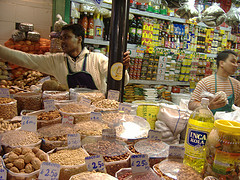
Nowt so queer as folk, and nowt like language to prove it.
Nibbles: Ag research impact, Old foods, GMOs, Barcoding, Palms (well it is Easter), Medicinal plants, Passion fruits, Markets, Livestock, Chaffey, Wine and CC, Coffee culture
- “…for many for many smallholder farmers little has changed over the decades in terms of the methods and tools they use.” Geoff Tansey would seem to agree. Nobody has told ACIAR, though.
- Cherfas favourite spread bog butter among oldest food finds.
- Why it is silly to say that GMOs are always bad.
- The Star Trek tricorder-type DNA widget comes a step closer.
- Which will make it easier to do things like working out the evolution of palms. Before it’s too late. Because of all that nasty agriculture. Anyway, read about it on page 3 of Kew Scientist, along with lots of other stuff.
- Like the taxonomy of herbal medicine, for instance, which coincidentally also comes up in a newspaper article from Australia today. Maybe some of the plants involved will go into the Kimberly Ark, whatever that is.
- Passion fruit is the next big thing in Costa Rica.
- Colombian peasant organizations go to market. Including, I bet, with passion fruits.
- Even in the struggle between man and steer, the issue is uncertain.
- Is it time for Plant Cuttings again? Thank goodness.
- I think I’ll read it with some Danish wine at my elbow. Or maybe Vietnamese coffee.