- An anthropologists speaks about landscapes.
- ILRI says: “Landscapes, I’ve got your landscapes right here.”
- India makes its play for African agricultural landscapes. I hope there will be scorecards and women. And access to Indian genebank holdings…
- Will there be fish though?
- And will India be pushing its mutation-bred varieties in Africa? Not that there’s anything wrong with them.
- Or using climate information?
- Or mining technology for that matter.
- Surely there will be dual-purpose groundnuts.
- Doesn’t India have a satellite?
Meanwhile, CIMMYT is making its own African play. Maybe some of the stuff it is doing there could be useful in India too?Two dead linksAfrica could teach India some other stuff too.Dead link.- Pretty sure this nearly-extinct-onion-rescued story is totally irrelevant to both India and Africa.
- Unlike coffee research.
- I don’t suppose I can interest anyone in a not very nice tasting, disease-prone but historical apple?
- And speaking of historical connections… Well that was quite a journey.
Nibbles: Feeding the world edition
- BBC says we can feed the world through technology. And why not. The Times of India, meanwhile, didn’t get the memo.
- Bill Gates at the IFAD Governing Council will probably say the same thing today. And put his money where his mouth is.
- CIMMYT Director General said the same recently at an Economist conference. Funny how genebanks are rarely among the saviour technologies being touted.
- It’s all about the scaling up, isn’t it?
- Tell that to the Lake Chad fisherfolk who are now turning to farming.
- And, in another universe, sushi seeks protection.
- Buffel vs Rhodes in the Arabian peninsula.
Brainfood: Chicken domestication, Financial crisis and conservation, Cucurbit domestication, Tamarind future, Biofortification via bacteria, Cowpea nutritional composition, Roman bottlegourd, Noug, Rice blast diversity, Pearl millet domestication, Cacao genotyping, Organic ag, Marcela, In situ vs ex situ, Artocarpus roots
- Heritable genome-wide variation of gene expression and promoter methylation between wild and domesticated chickens. Domestication was Lamarckian.
- Global economy interacts with climate change to jeopardize species conservation: the case of the greater flamingo in the Mediterranean and West Africa. Financial crisis leads to closing down of Mediterranean saltpans, which is not good news for flamingo. Climate change doesn’t help. Must be similar examples for plants, Shirley.
- Parallel Evolution Under Domestication and Phenotypic Differentiation of the Cultivated Subspecies of Cucurbita pepo (Cucurbitaceae). C. pepo subsp. pepo and subsp. texana underwent similar genotypic and phenotypic changes during domestication.
- Ecological and human impacts on stand density and distribution of tamarind (Tamarindus indica L.) in Senegal. Climate change will lead to an area of currently low density in the NW being a refugium. Connectivity problems will ensue.
- Biofortification of wheat through inoculation of plant growth promoting rhizobacteria and cyanobacteria. Breeders give up.
- Nutritional ranking of 30 Brazilian genotypes of cowpeas including determination of antioxidant capacity and vitamins. Breeders take heart.
- A short history of Lagenaria siceraria (bottle gourd) in the Roman provinces: morphotypes and archaeogenetics. Out of Asia. And more.
- Functional Properties, Nutritional Value, and Industrial Applications of Niger Oilseeds (Guizotia abyssinica Cass.). It has them, in spades, as this paper summarises.
- Sex at the origin: an Asian population of the rice blast fungus Magnaporthe oryzae reproduces sexually. The Himalayan foothills would seem to be the place where to look for resistance.
- Evolutionary History of Pearl Millet (Pennisetum glaucum [L.] R. Br.) and Selection on Flowering Genes since Its Domestication. Bayesian modelling of 20 random genes supports domestication about 4,800 years ago, with protracted introgression from the wild relative, and selection sweeps suggest flowering related genes unsurprisingly underwent strong selection as the crop spread southward. But a single domestication scenario? Anyway, sounds familiar, doesn’it.
- Genome-Wide Analysis of the World’s Sheep Breeds Reveals High Levels of Historic Mixture and Strong Recent Selection. Much like, ahem, pearl millet. For flowering genes, read horniness genes. The bit about an initially broad sampling of diversity sounds a bit like the horse. Who out there is going to synthesize all this domestication stuff? Not that I’m looking for a meta-narrative, mind.
- Ultra-barcoding in cacao (Theobroma spp.; Malvaceae) using whole chloroplast genomes and nuclear ribosomal DNA. Well, sequence the whole thing and be done with it is what I say, why flaff around with ultra-this and super-that?
- The crop yield gap between organic and conventional agriculture. 20%.
- Marcela, a promising medicinal and aromatic plant from Latin America: A review. Achyrocline satureioides, in the Asteraceae. Yeah, I never heard of it either. But these guys say it’ll make you rich and beautiful.
- Comparative genetic structure within single-origin pairs of rice (Oryza sativa L.) landraces from in situ and ex situ conservation programs in Yunnan of China using microsatellite markers. 2-5 times more unique alleles in the in situ version of various landraces compared to the ex situ version, collected in 1980. But same number of common alleles.
- Mutualism breakdown in breadfruit domestication. More recent cultivars have less abundant and less species-rich arbuscular mycorrhizas.
Nibbles: PGR course, Vegetable seed kits, Maize data, Rice metabolomics, Rewilding, Sheep diversity, Llama economics, Canary flora, Cuba urban ag, Ducks, Cynara, Food sovereignty
- The annual Wageningen agrobiodiversity conservation course is in India this year. Hannes says it’s really good.
- AVRDC’s veggie seed kits are a hit in Orissa.
- CIMMYT swimming in data. Waving, not drowning.
- IRRI not doing badly either. But “quantitative train loci” is a new one on me.
- Australia thinking about introducing elephants. Yeah because that sort of thing has been such a success in the past.
- Well, actually, with sheep, I suppose it has, in a way. And the genetics says breeders have a lot of diversity to play with still.
- Your mama is a llama.
- The Island of Dogs has crop wild relatives. No, not the one in London.
- Cuba goes for new urban crops. And not for the first time, Shirley. But what about the old ones?
- Quick, duck! This piece has been rather a hit for me over on Facebook.
- VII International Symposium on Artichoke, Cardoon and Their Wild Relatives: The (Very Expensive) Book.
- Food sovereignty “started in New England”. Huh? And proponents “want to eat and sell the food they grow free from interference from state and federal regulators”. Huh?
Consolidation in the seed industry
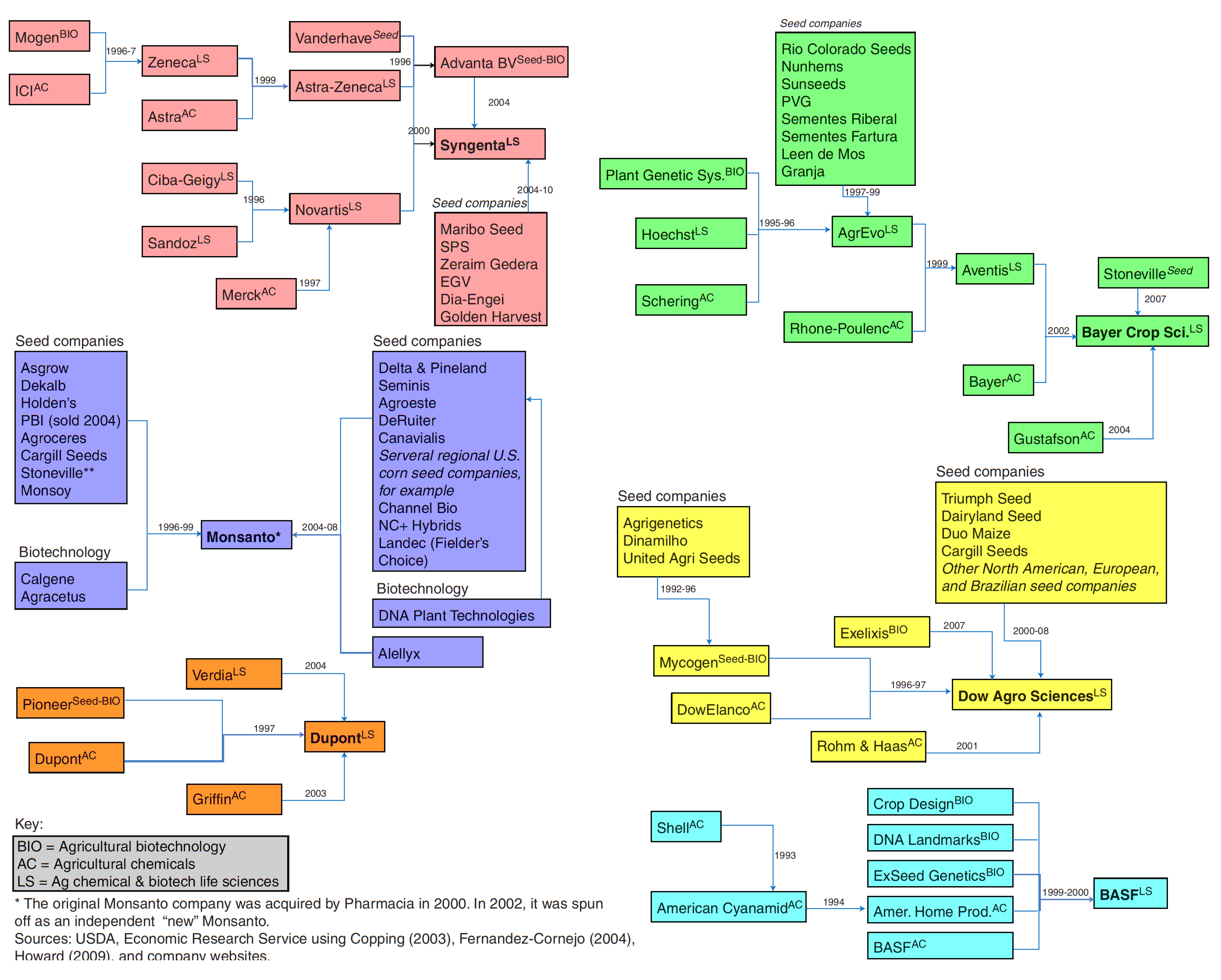
We’ve written before about consolidation in the seed industry making the same tired joke that I want to make again now, that a picture is worth 1000 words. It doesn’t hurt to stay up to date though, which is why I am grateful to Resources Research for finding, and colouring in, the diagram from the USDA report on Research Investments and Market Structure in the Food Processing, Agricultural Input, and Biofuel Industries Worldwide.
The USDA report is not, as far as I can tell, anything to do with the US Department of Justice’s investigation of antitrust practices in the seed industry, announced a couple of years ago. So what has become of that? Anyone know?