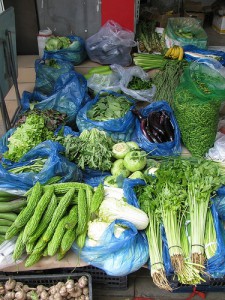
 So, in retaliation for Europe protecting Roquefort, Stilton cheese and Scottish farmed salmon (sic.), among other agrobiodiversity products, the Chinese have slapped Protected Denominations of Origin (PDO) on Guanxi honey pomelos, Shaanxi apples and Longjing tea and a Protected Geographical Indication (PGI) on Liaxian Mashan yams. 1 Well, no, not really, it was all much more amicable than that. And Dongshan asparagus, Jinxiang garlic, Pinggu peach, Yancheng crayfish and Zhenjiang vinegar are waiting in the wings…
Veggie genebank gets its seeds out
The University of California Davis (UC Davis) leads an international effort to help developing countries through improved marketing and production of high-value horticultural crops. Established by the United States Agency for International Development (USAID), the Horticulture Collaborative Research Support Program (HortCRSP) supports projects to improve the livelihoods of the world’s poor and builds on their needs highlighted in the Global Horticulture Assessment.
Oh hum, right? Not so fast. One of the projects being supported is this:
Dr. Ricky Bates, Horticulture Department of Penn State University has received a one-year exploratory grant from HortCRSP to look at methodologies for strengthening informal indigenous seed systems in Northern Thailand and Cambodia.
And it gets better. A genebank is involved. My cup runneth over.
The ECHO seed bank partnership is a very important integral part of this project. Dr. Bates states that, “ECHO has been around for awhile. ECHO is located in Ft. Myers Florida and has been around for at least 20 years. They see themselves more or less as an extension service where they are there to resource and support NGOs and people working all around the world with poor farmers. It is a little like an extension system where they provide information and printed material via online or telephone calls to people who may find themselves perhaps in India with World Vision. ECHO is there as a resource for NGOs that do not have an agricultural background. What grew up with the development of ECHO has been the development of a vey innovative seed bank in Ft. Myers Florida where they sort of specialize in tropical fruits and vegetables. They make these seeds available at low cost or no cost to individuals and NGOs working around the globe in development.
Feria del Elote
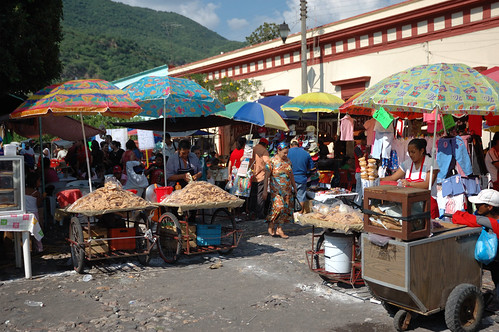
From CIMMYT’s Flickr feed:
Carts selling tacos made with maize tortillas (traditional Mexican flatbreads) in Jala, Nayarit, on the Pacific coast of Mexico, during the town’s annual two-week Feria del Elote, or maize ear festival. Tortillas are a staple food in Mexico, and are commonly filled to make tacos. For more about maize in Jala, see CIMMYT’s August 2007 e-news story “Pride and pragmatism sustain a giant Mexican maize,” available online.
Photo credit: Eloise Phipps/CIMMYT.
Nibbles: CWR, ICRISAT, Fruits, Maize, Symbionts, Tissue culture, Vegetables, Med diet
- ICARDA saves the world.
- No, ICRISAT saves the world.
- You’re both wrong, it’s CIAT.
- No, wait, maybe it’s CIMMYT. Oh I give up.
- Actually it’s fungi.
- Or maybe tissue culture?
- Surely it can’t be five unknown vegetables?
- Could it be that it’s the Mediterranean diet? And that UNESCO will screw it up for all of us?
Brainfood: Introgression, Sorghum and drought, Rice and drought, Carrot evaluation, Wheat breeding, Legume conservation, Wild Tibet soybean, Gezira, Biochar, CA, Grass ecotypes and climate, Organic ag and nutrients
- Alien introgressions represent a rich source of genes for crop improvement. Polyploids such as wheat do it best.
- Characterization of sorghum genotypes for traits related to drought tolerance. There is diversity within the “association panel” of diverse germplasm used. What I want to know is how that is different from a core or mini-core collection.
- Rice near-isogenic-lines (NILs) contrasting for grain yield under lowland drought stress. Small genetic differences can lead to big differences in yield under drought stress. What I want to know is whether doing this on NILs is better value for money than doing it on association panels of germplasm (see above), whatever they may be.
- Towards better tasting and more nutritious carrots: Carotenoid and sugar content variation in carrot genetic resources. European accessions sweeter and more orange than Asian.
- Changes in duration of developmental phases of durum wheat caused by breeding in Spain and Italy during the 20th century and its impact on yield. Fascinating unpicking of just where the genetic changes have their impact.
- Legume genetic resources: management, diversity assessment, and utilization in crop improvement. A lot of characterization, not enough evaluation. Core collections useful, but not useful enough. Crop wild relatives being used, but not enough. Good plug for the importance of geo-referencing.
- Genetic diversity and geographical peculiarity of Tibetan wild soybean (Glycine soja). Low and high, respectively.
- Analysis of agricultural production instability in the Gezira Scheme. Went up for wheat, cotton and sorghum, down for groundnuts, on liberalization.
- Biochar effects on soil biota – A review. It’s complicated but, on the whole, not unpositive.
- A research agenda to explore the role of conservation agriculture in African smallholder farming systems. Basically, it is likely to work least well in marginal conditions. Which is kinda surprising, and not, at the same time.
- Ecotypes of European grass species respond differently to warming and extreme drought. Yeah, but, alas, not in the way one might have wished.
- Comparison of nutritional quality of the crops grown in an organic and conventional fertilized soil. Maybe lower nitrate and N, higher P in organic crops. But really too much variation to be sure.