- An ethnographic exploration of perceptions of changes in dietary variety in the Kolli Hills, India. Cassava cash cropping has had unforeseen effects on dietary diversity.
- Mapping and assessing crop diversity in the irrigated Fergana Valley, Uzbekistan. More crops on the edges.
- An Analysis on Crops Choice and Its Driving Factors in Agricultural Heritage Systems—A Case of Honghe Hani Rice Terraces System. Established for “red rice”, but that’s not enough.
- Prebreeding Using Wild Species for Genetic Enhancement of Grain Legumes at ICRISAT. It’s not easy, but it’s been worth it.
- A Multispecies Collecting Strategy for Crop Wild Relatives Based on Complementary Areas with a High Density of Ecogeographical Gaps. Collecting in Spain in “…top 10 selected complementary areas would allow the capture of 59 of the 88 targeted taxa and 31% of the 683 different taxa-ELC category combinations identified in the ecogeographical gaps.”
- Antioxidant power, anthocyanin content and organoleptic performance of edible flowers. Tycoon Blue will be quite the marketing challenge.
- Diversifying Food Systems in the Pursuit of Sustainable Food Production and Healthy Diets. And nary an edible flower mentioned.
- Cereal price shocks and volatility in sub-Saharan Africa: what really matters for farmers’ welfare? Prices.
Nibbles: Dwarf rice, Ricestoration, Tarostoration, Biorepositories, Sustainable coffee, Cactus wars, Goaty portraits, Spandrels, Potato genebank, Forests and nutrition
- The long and short of Green Revolution rice.
- Restoring historical slave-worked rice fields in North Carolina.
- Kinda similar, but taro in Hawaii.
- There’s a bank for milk diversity.
- Nice review of sustainable coffee production.
- Opuntia: tasty but deadly (to some).
- Handsome goat pix.
- Festoons of fruits at the Farnesina: Jeremy is incensed.
- Great new webpages for the CIP genebank.
- Another report on a report that living close to forests is good for nutritional security, up to a point. But bushmeat?
Brainfood: Wild foods, Maize in Guatemala, Wild lentils, Sorghum gaps, Ethiopian erosion, Chikanda barcoding, Brazil nut systems, Wild carrots, Ancient wild potato use, Wild wheat grains
- The role of wild fruits and vegetables in delivering a balanced and healthy diet. Not great, until they’re domesticated.
- Maize Diversity, Market Access, and Poverty Reduction in the Western Highlands of Guatemala. Forget maize.
- Evaluation of Wild Lentil Species as Genetic Resources to Improve Drought Tolerance in Cultivated Lentil. Environment explained drought response in wild lentils better than molecular classification.
- Geographical distribution, diversity and gap analysis of East African sorghum collection conserved at the ICRISAT genebank. Both Sudans.
- Explaining the Ethiopian farmers’ perceptions on potential loss of traditional crop varieties: A principal components regression analysis. Poor farmers know more, and care more, about loss of traditional landraces.
- High-throughput sequencing of African chikanda cake highlights conservation challenges in orchids. Those are very biodiverse cakes, but not in a good way.
- Revisiting the ‘cornerstone of Amazonian conservation’: a socioecological assessment of Brazil nut exploitation. It’s actually in pretty good shape, but that doesn’t mean it can’t be improved.
- Phylogenetic Prediction of Alternaria Leaf Blight Resistance in Wild and Cultivated Species of Carrots. Look for taller material in clade A.
- Starch granule evidence for the earliest potato use in North America. S. jamesii may have been used for 10,000 years in Utah.
- Genome-Wide Association Study of Grain Architecture in Wild Wheat Aegilops tauschii. Two genetic lineages, with big differences in grain width and weight.
Vote for African veggies!!
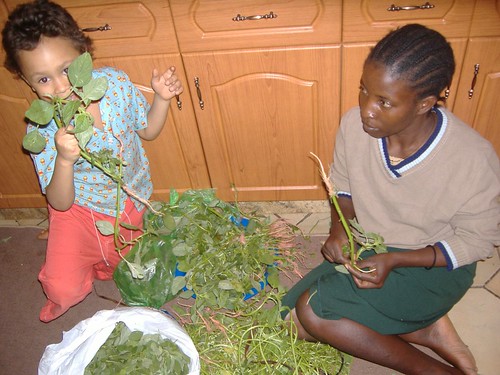
Great to see a project on African Leafy Vegetables in western Kenya in the running for the Farming for Biodiversity prize at Solution Search. Here’s what they say about return on investment:
The ROI is 39%. The budget was US $150,000 for 2 years. Returns from the sale of ALVs amount to $52,200 per season, for 4 planting seasons. The biggest return, however, is the farmers renewed sense of empowerment. “I never imagined I could go out and find a market for my veggies” said Ms. Joyce Okwara from Busia, as well as improved nutrition in schools and clinics. Funds supported a feasibility workshop to discuss limits and opportunities of linking farmers to institutional markets, the development of a farmer business school and its subsequent rolling out, the acquiring and distribution of certified ALV seed to farmers and nutrition education in local schools and clinics. Additional funds would allow the scaling-up of this model.
Good luck to the Sustainable Income Generating Investment Group (SINGI) in Busia! Vote for them!
Brainfood: Banana GWAS, MGIS, Commodification and racialization, Native tree seeds, Tea in China, Potato in China, Indian eggplant, Rapid phenotyping, Ag & environment
- Trait variation and genetic diversity in a banana genomic selection training population. You can use easy-to-measure traits as proxies for important but difficult-to-measure traits. Both of which will hopefully end up in…
- MGIS: managing banana (Musa spp.) genetic resources information and high-throughput genotyping data. Very cool. So when can we expect the data in Genesys?
- Heirloom rice in Ifugao: an ‘anti-commodity’ in the process of commodification. Calling a landrace a “heirloom variety” is just another form of capitalist oppression.
- Race, Status, and Biodiversity: The Social Climbing of Quinoa. Not to mention racist.
- To what extent are genetic resources considered in environmental service provision? A case study based on trees and carbon sequestration. Clean Development Mechanism (CDM) afforestation/reforestation project design documents are often unrealistic about the chances of sourcing sufficient quantity and quality of seeds of indigenous species.
- Diversity analysis on catechin genetic of wild tea plant from Yunnan province. They determine whether a variety is used for green or black tea.
- Genetic differences between potato strains introduced from International Potato Center (CIP) and domestic potato resources by SSR molecular markers. The CIP varieties are quite different to the Chinese ones. But we kinda knew that.
- SSR marker analysis points to population admixture and continuum of genetic variation among Indian landraces of brinjal (Solanum melongena L.). Brinjal gets moved around a lot.
- A high-throughput, field-based phenotyping technology for tall biomass crops. Estimate plant height and stem diameter in sorghum, say, without leaving the office.
- Comparative analysis of environmental impacts of agricultural production systems, agricultural input efficiency, and food choice. Better for environment to change dietary habits than production systems.