- Dr Roland Bourdeix is the new COGENT Coordinator.
- Early American hunter-gatherers ate maize.
- Dogfish Head crowdsources a new beer. And it’s got NUS. Rejoice.
Protecting Armenian vivifying tea
The Mesrop Mashtots Institute of Ancient Manuscripts, commonly referred to as the Matenadaran, is well worth visiting in Yerevan. Some of the manuscripts on display are quite stunning. But apparently there’s more to the place than (very) old books. I bought this Vivifying Flower Tea in the gift shop, and the label refers to a Research Center for Medieval Armenian Medicine.
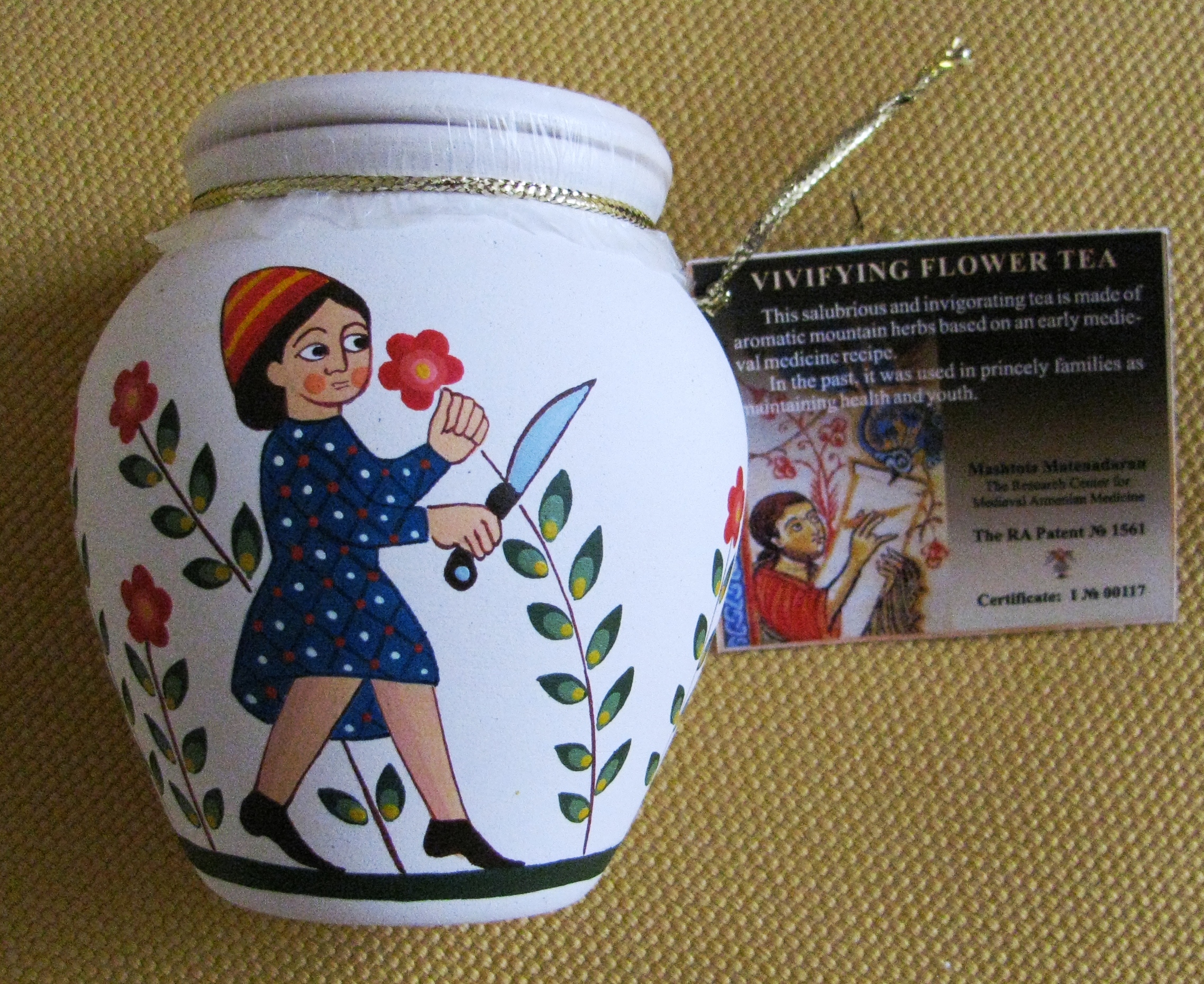
Unfortunately, there’s nothing online about this research center, but there’s clearly a lot of work around on Medieval Armenian medicine, and the role of plants in it. It’s interesting that the concoction I bought is actually protected by a patent (see the label). That’s a different route to the one taken by India, for example. The tea was in fact pretty good, if a bit expensive, though not, if I am honest, especially vivifying. I wonder if any of takings from the gift shop filters back into conservation, of either the tea’s constituent plants or the manuscripts which hold the secret of its manufacture. I suspect not.
Nibbles: Compost, Breeding, Tree grower, Diseases, Seedsperson, Cordyceps, Illicium verum, Maize size, Microfauna, Participatory research, Art
- Compost can boost yields, save water shock.
- Tom Wagner shows off new tomatoes and potatoes.
- Our pal Neil tells one tree man’s story: Maurice Kwadha: farmer, entrepreneur, and climate-smart.
- The UK has a policy on animal and plant diseases in the 21st century. Doesn’t everyone?
- NPR nips at our heels, with stories on heirloom seeds and that Chinese zombie insect fungus Cordyceps.
- What to do with star anise.
- Size matters; corn ear edition.
- Soil microfauna really diverse everywhere shock.
- How scientists should work with indigenous people (in the Arctic).
- “On the matter of seeds.” Art meets PGR. Danny, this one’s for you.
Nibbles: Vigna umbellata, Afghanistan wheat catalogue, Pingali, Camptotheca, Water stress, Organic Farming for Health and Prosperity
- Crops for the Future finds a nice ricebean project.
- The wheats of Afghanistan.
- A former ICRISAT intern speaks. The world listens.
- Collecting the Happy Tree of China.
- Global water stress maps. Does CCAFS know? Or care?
- Rodale hearts organic.
Brainfood: Rice yield, Carrot evaluation, Caper chemistry, Rice fortification, Range shifts, Baobab, Tunisian thyme, Drought-tolerant rice
- Rice yields and yield gaps in Southeast Asia: Past trends and future outlook. If average farmers became like best-yielding farmers that would meet 2050 needs, except in the Philippines, where some more structural stuff is needed.
- Method of evaluating diversity of carrot roots using a self-organizing map and image data. The sound you hear is that of butterflies being broken on wheels.
- Bioactive compounds from Capparis spinosa subsp. rupestris. Are pretty much the same as those in subsp. spinosa.
- Constitutive Overexpression of the OsNAS Gene Family Reveals Single-Gene Strategies for Effective Iron- and Zinc-Biofortification of Rice Endosperm. So that’s a good thing, right?
- Analysis of climate paths reveals potential limitations on species range shifts. Corridors not the answer. Or not the only answer. Or not the full answer.
- An updated review of Adansonia digitata: A commercially important African tree. Do baobab scientists not sometimes long for the Time Before Reviews, when they actually, you know, did stuff?
- Genetic diversity, population structure and relationships of Tunisian Thymus algeriensis Boiss. et Reut. and Thymus capitatus Hoffm. et Link. assessed by isozymes. Dad, what’s an isozyme? Ah, son, it’s a thing people used in the Time Before DNA. The two species are different, they need to be managed in different ways.
- Potential Impact of Biotechnology on Adaption of Agriculture to Climate Change: The Case of Drought Tolerant Rice Breeding in Asia. Kinda pointless: “in severe drought both the [drought tolerant] and the conventional varieties were either not planted or, if planted, did not yield”.
