- Hang on, there’s a “revised and updated” Global Strategy for Plant Conservation. When did that happen?
- Gary Nabhan on following in Vavilov’s footsteps. You can hear him in person in Rome this Friday.
- Can you protect both agriculture and wildlife? Apparently so.
Nibbles: Allanblackia domestication, Rampion census, Mali reforestation, Indian sacred groves, Oysters, Seaweeds, Breeding organics, EMBRAPA, Fisheries bycatch, Writing NUS proposals, Nutrition mag, Biofortification
- Boffins trying to domesticate Allanblackia for its oil.
- Phyteuma spicatum must be saved, British folklore depends on it. How about domesticating it?
- Farmers replanting forest in inland Niger delta. Sort of domesticating the forest, you mean?
- And here’s another domesticated forest, this time in Kerala.
- Are oysters domesticated? And seaweeds? Lots of uses for seaweeds, after all.
- Why plant breeding is incompatible with organic agriculture. Eh? First of a trilogy.
- Management of plant genetic resources in Brazil deconstructed.
- Oh dear, now boffins say avoiding bycatch may not be good after all.
- CTA calls for research notes in preparation for proposal writing workshop on neglected and underutilized plants.
- New Sight and Life magazine is out, with interesting discussions of Vitamin A supplementation in newborns and HIV patients.
- While at Scidev.net HarvestPlus defends biofortified crops against charge of medicalizing micronutrient deficiency.
Nibbles: CIAT, Apples, Poverty, Protected areas, Honey, Juniper, Irish oak
- Learn about CIAT’s reseach via the posters they put on slideshare. Couple on their beans and cassava genebank.
- Trying to speed up apple breeding.
- Biodiversity interventions find it difficult to fight poverty. How about agrobiodiversity interventions?
- More bad news: protected areas don’t work anyway. At least for trees in Burkina Faso.
- Boffins trying to spot contraband honey. There’s contraband honey?
- Gin drinkers told to start worrying.
- Forest of Belfast project to wind up, but not before finding really old oak.
Recognizing World Malaria Day
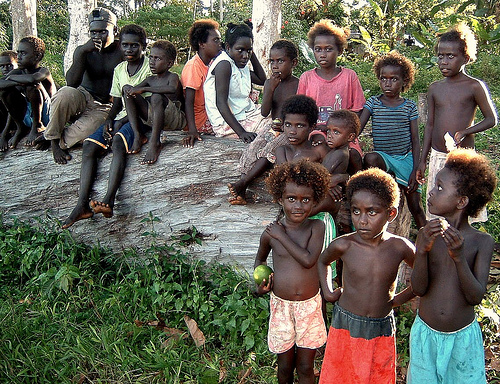
As a victim, I am particularly happy to recognize World Malaria Day and hail the Cinchona tree, source of quinine. Artemisia is the new Chinchona, of course. I dread to think how many of the kids in this picture I took in the Solomons, where I picked up the disease, will get malaria, or have already had it. Thanks, Kew.
Nibbles: Heirloom store, Leaf miners, Mongolian drought, GPS, Coca, Ag origins, Aquaculture, Lice, Bud break in US, IFAD livestock, biofuels, Pig history
- “Housed in the towering old 1926 Sonoma County Bank, it’s hard to miss the Seed Bank.” And who would want to anyway.
- Of apples, leaf miners and bacteria. Great story.
- Best synthesis and analysis of the Mongolian dzud story so far.
- Visualize your GPS data! Not agrobiodiversity, I know, but I don’t have another blog.
- Coca myths debunked. Sniff sniff.
- “Crop domestication and the first plant breeders” book charpter online.
- Rebranding Asian carp. Hard row to hoe. Thanks, Don.
- 190,000 year old clothes had lice. 190,000 year old humans had clothes?
- More citizen science stuff, this one on effect of climate change on plant phenology in the US.
- IFAD publishes bunch of livestock-related papers. ILRI, are you listening?
- “It’s 36 percent more efficient to grow grain for food than for fuel.” Good to have a number.
- Boffins do their aDNA thing on Chinese pigs, find continuity, multiple domestication, sweet and sour sauce recipe.
- Soil Association begs to differ on that whole
UKworld-needs-to-double-food-production thing.