- Genetic Resources of Cannabis sativa L. in the Collection of the Gene Bank at INF&MP in Poznan. I’d pay money to see this in the field at evaluation time.
- Specific median flour particle size distribution of Japanese common wheats; Comparison with Chinese common wheats. Japanese diversity is a small fraction of Chinese diversity. Also, can you really have semicolons in titles?
- Association and Validation of Yield-Favored Alleles in Chinese Cultivars of Common Wheat (Triticum aestivum L.). And among Chinese wheats, the modern cultivars are a small subset of the diversity in the mini core collection.
- Diversity among maize landraces in North West Himalayan region of India assessed by agro-morphological and quality traits. I like it when specific accessions are highlighted as being special in some way. But will breeders around the world have access to them?
- Genetic Diversity and Population Structure in Aromatic and Quality Rice (Oryza sativa L.) Landraces from North-Eastern India. More than just basmati. But will breeders around the world have access to them?
- African Indigenous Cattle: Unique Genetic Resources in a Rapidly Changing World. At least 150 breeds, many endangered, all important.
- Sustainable Sourcing of Global Agricultural Raw Materials: Assessing Gaps in Key Impact and Vulnerability Issues and Indicators. We don’t know the vulnerabilities well enough.
- Can the sustainable development goals reduce the burden of nutrition-related non-communicable diseases without truly addressing major food system reforms? No.
- Suitable Days for Plant Growth Disappear under Projected Climate Change: Potential Human and Biotic Vulnerability. Tropical areas are screwed.
- A versatile phenotyping system and analytics platform reveals diverse temporal responses to water availability in Setaria. Fancy equipment picks out differences among genotypes.
Beans With Benefits – but no address
In collaboration with national partners, AVRDC-The World Vegetable Center has released a number of improved varieties like ‘Zilola’, ‘Marjon’, ‘Durdona’ and ‘Turon’ to date. However, as salinity and heat are commonplace in the country, more new varieties are needed.
This is the goal of a new project funded by Germany’s Federal Ministry for Economic Cooperation and Development and implemented by AVRDC-The World Vegetable Center. Aptly titled “Beans with Benefits”, the project will run until March 2018, and aims to integrate improved mung bean as a catch crop into the dryland systems of South and Central Asia to increase smallholder farmers’ income and establish more sustainable production systems.
Sounds very worthy, and as I do not normally associate mungbean with Central Asia, I of course determined to find out where these new varieties are likely to come from. It did not go entirely smoothly.
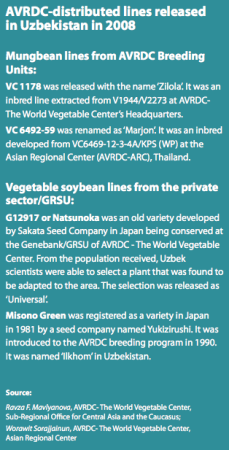 The first step was to try to find out what Zilola, say, might have been called before it was released in Uzbekistan. A Google search led me, eventually, to the PDF of a flyer with the additional information reproduced on the left here. So, Zilola is VC 1178, which is an “inbred line extracted from V1944/V2273 at AVRDC HQ.” VC 1178 has form, as it features in A Catalog of Mungbean Cultivars Released Around the World (p. 10) as a parent of a variety (Chainat 60) released in Thailand in 1988.
Searching AVRDC’s genebank database online confirms that. But, again, it wasn’t straightforward. The database records a plethora of different numbers: vegetable introduction number, crop accession number, temporary number, donor identification number, PI number… Which type of number is VC 1178? Your guess is as good as mine. And the problem is, it looks like you have to know what type of number it is, before you search for it:
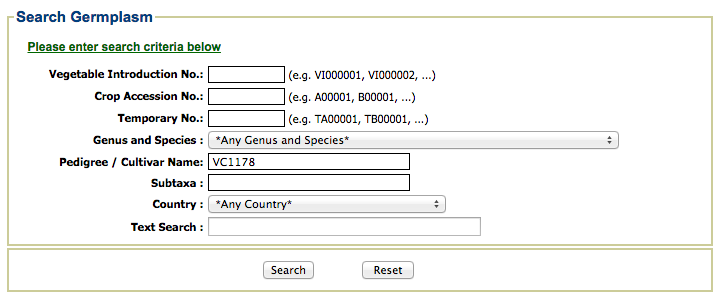
Well, actually it’s not that bad, because of the text search facility, though you then have to watch out for the space between the VC and the 1178. Anyway, long story short, it’s a cultivar name (sic.), and you get four hits when you try it (for some reason, only two in Genesys).
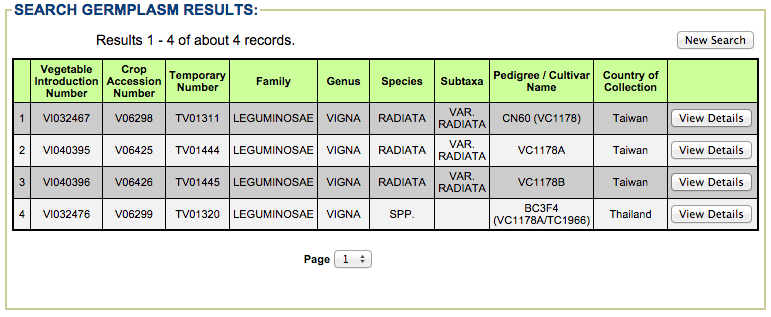
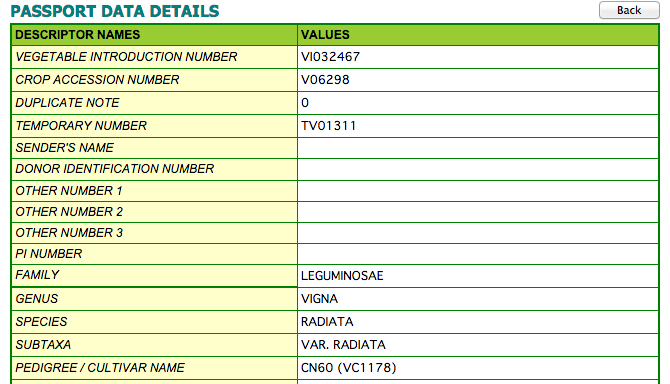
And, if I understand the results correctly, the closest thing to the “original” VC 1178, whatever that might be exactly (more on that anon), is the first on the list. Which has a whole raft of additional numbers to confuse the potential user.
But what about the V1944/V2273 from which VC 1178 was extracted? Well, after fiddling with the spaces etc., you get two hits, both with the note “VC LINE FROM MUNGBEAN BREEDING”, which is not very helpful in ascertaining where the damn thing is from. Country of collection is given as Taiwan, but I’m not at all confident that this means anything more than that the line was developed at AVRDC HQ in Taiwan.
So, if the Uzbeks and other Central Asian partners in the Beans With Benefits project really like Zilola, and want more from where that came from, I’m not sure they’ll get much help from the information that’s available online. 1 You want benefits? Think of the benefits from having a clear idea of where exactly a promising variety came from, and how it got there.
Nibbles: Monocultures redux, Seedless watermelons, Red kiwifruit, Herbaria problems, Forest foods, Sorghum beer, SIRGEALC, Chinese veggies, Organic tomatoes, Andean women, Rise origins, Fermentation
- Deploy your cover crop diversity in time rather than space. But deploy it.
- Triploid goodness.
- Searching for a red kiwi.
- Herbaria on the rack.
- Let them eat non-timber forest products.
- Sorghum spurts in Kenya. Because beer.
- Sign up for SIRGEALC 10.
- Knowing your 菠菜 from your 西洋菜.
- 400 tomato varieties. No pesticides. No water. No problem.
- Women are conserving Andean crops. Sure, though with some occasional help from genebanks.
- The Rice Origins Wars continue.
- Sauerkraut changed the world.
Nibbles: Organic research, Plant models, Tabasco peppers, Andean shepherds, Weird pigs, Wild rice harvesting, Heritage ducks, Nutrient content
- An investment in organic research. At last.
- Plant models go online. Not those kinds of models.
- Where the peppers for Tabasco sauce come from.
- Apparently, “[w]hite alpacas have been overbred.” But not that kind of breeding, I think.
- Pigs are weird.
- Learn how to make poles. Yes, those kinds of poles.
- Even ducks can be heritage.
- Higher carbon dioxide bad for nutrition.
Brainfood: Nigerian fruit & veg, South African veggies, Veggies in home gardens, Standardizing phenotyping, Potato diversity, Triploid chamomile, Chocolate chip, Fungi & oils, Melon diversity, CC and grasslands
- Promoting food security and enhancing Nigeria’s small farmers’ income through value-added processing of lesser-known and under-utilized indigenous fruits and vegetables. It’s the infrastructure, stupid.
- The role of wild vegetables in household food security in South Africa: A review. No, it’s the information, stupid.
- Indigenous wild food plants in home gardens: improving health and income — with the assistance of agricultural extension. Nope, it’s the extension, stupid.
- Towards recommendations for metadata and data handling in plant phenotyping. It’s the standardization, stupid.
- Cytoplasmic diversity in potato breeding: case study from the International Potato Center. It’s a genetic bottleneck, stupid.
- Towards breeding of triploid chamomile (Matricaria recutita L.) — Ploidy variation within German chamomile of various origins. It’s the triploids, stupid.
- Making a chocolate chip: development and evaluation of a 6K SNP array for Theobroma cacao. Oh, very clever, now everybody and their uncle will be able to breed cacao, stupid.
- Arbuscular mycorrhiza differentially affects synthesis of essential oils in coriander and dill. It’s not just genetics, stupid.
- Comparative transcriptional profiling analysis of developing melon (Cucumis melo L.) fruit from climacteric and non-climacteric varieties. It’s the sugar metabolism, stupid.
- Climate-driven diversity loss in a grassland community. It’s the increasing aridity, stupid.