- Wow! Just wow. Big Picture Agriculture has launched an incredibly useful website.
- Chromosomes, crops and superdomestication, a slideshare presentation by Pat Heslop-Harrison.
- Cats, domesticated? Not as far as I’m concerned. Still, Ancient Chinese cats ate rats, leading to their domestication.
- Independent plant breeders, a conference just for you.
- Great ammunition for the lazy gardener.
- IBPES told to “tap the wisdom of indigenous peoples”.
- Kenyan policymakers told to consider the potato.
- Basque vineyards of a millennium ago.
- A new strain of UG99 wheat rust? But this time, the world is ready.
- Variable diets linked to variable emissions shock.
- scidev.net reports that ants protect cacao trees from fungal diseases. (Yes, I’m taking short cuts here.)
- Palaeolithic people preferred nutrition-rich places.
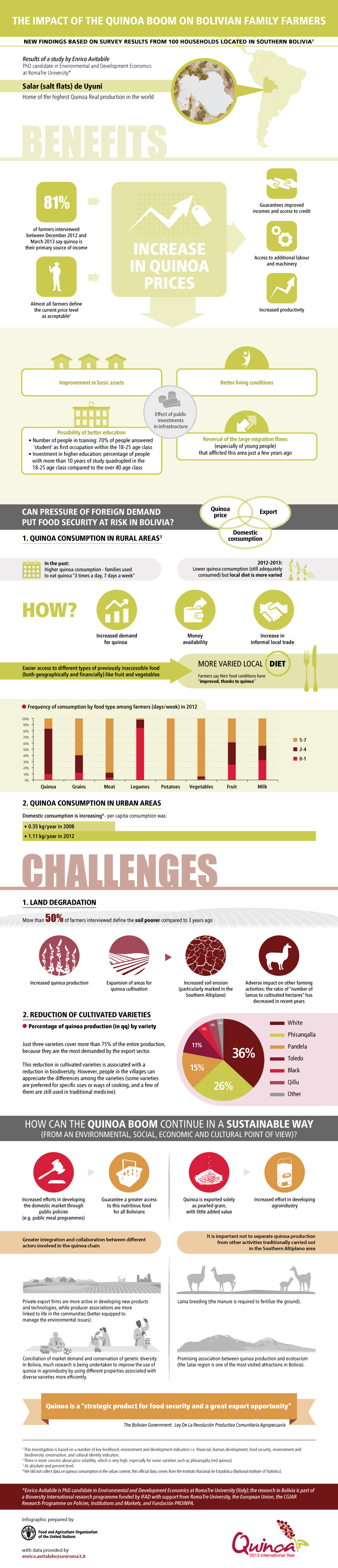
- And quinoa remains as confusing as ever.
- Tokyo’s local honey.
- Although agriculture barely features in a paean to urban biodiversity. It should.
- The holly and the coffee: The Botanist in the Kitchen does Yerba Maté
- Ready for the inevitable ennui of next Christmas, a taxonomy of conifers.
Brainfood: Tea flower transcriptomics, Ag origins, Hunan rice, ITPGRFA & CBD, Mycorrhiza, Sugar beet breeding, Agronomy, Molecular domestication, Cactus domestication, Rice yield gene
- Floral Transcriptome Sequencing for SSR Marker Development and Linkage Map Construction in the Tea Plant (Camellia sinensis). Neat, to be sure, but not entirely clear why the transcriptome of a part of a crop that is not economically exploited should be of more than academic use to anyone. But no doubt someone will set us right on this.
- Emergence of Agriculture in the Foothills of the Zagros Mountains of Iran. Eastern Fertile Crescent just as important as western.
- Analysis of main agronomic characteristics and utilization status of rice resources in Hunan Province. Hunan has a provincial genebank with more than 12,000 accession, “repetition eliminated.”
- The comparison of the International Treaty on Plant Genetic Resources for Food and Agriculture and the Nagoya Protocol. Like the above, this is in Chinese, except for the abstract, which recommends ratification of both relevant instruments. I hope someone is listening.
- Biodiversity of Arbuscular Mycorrhizal fungi in Agricultural crops of western Himalayas. Everybody’s at it. Well, almost.
- Assessment of breeding progress in sugar beet by testing old and new varieties under greenhouse and field conditions. It has been steady and is set to continue. At least in Germany.
- Why crop yields in developing countries have not kept pace with advances in agronomy. Let them eat German sugar beets. But seriously: agronomist says it’s about the agronomy.
- Molecular mechanisms involved in convergent crop domestication. It’s mutations at orthologous loci, and it can be copied.
- Differential survival and growth of wild and cultivated seedlings of columnar cacti: Consequences of domestication. Gotta wonder if mutations at orthologous loci were involved.
- NAL1 allele from a rice landrace greatly increases yield in modern indica cultivars. But it came from a tropical japonica landrace from Indonesia, and works its magic via pleiotropic effect on plant architecture.
Brainfood: Chinese heritage sites, Chinese farmer coops, Seasonal foods, Agroforestry markets, Quinoa roadmap, Swedish pseudo-coffee, Barley phylogenetics, Switchgrass diversity, Italian maize composition, European forest vulnerability
- Conserving agricultural heritage systems through tourism: Exploration of two mountainous communities in China. Hopes of benefits are high. And will no doubt be cruelly dashed. What all this means for crop diversity is anyone’s guess.
- Farmer cooperatives in China: diverse pathways to sustainable rural development. Hopes of benefits are high. And will no doubt be cruelly dashed. What all this means for crop diversity is anyone’s guess.
- Seasonality and dietary requirements: will eating seasonal food contribute to health and environmental sustainability? Maybe, but other things are more important.
- Collective action to improve market access for smallholder producers of agroforestry products: key lessons learned with insights from Cameroon’s experience. It can work, and it helps if there is fun to be had.
- Quinoa biodiversity and sustainability for food security under climate change. A review. We’re going to have to move beyond Quinoa Real. Here comes the model.
- Swedish coffee (Astragalus boeticus L.), a neglected coffee substitute with a past and a potential future. It could be revived, and here’s how, but why would anyone want to?
- Phylogeny of ten species of the genus Hordeum L. as revealed by AFLP markers and seed storage protein electrophoresis. Breaks down into Old and New World species.
- Genetic Structure of Remnant Populations and Cultivars of Switchgrass (Panicum virgatum) in the Context of Prairie Conservation and Restoration. Have to be careful using cultivars in the restoration of natural populations. Not because they are lower in diversity than natural populations, but because they are different.
- Carotenoids, Phenolic Compounds and Antioxidant Capacity of Five Local Italian Corn (Zea Mays L.). Kernels. Roccacontrada Rosso could be marketed as a functional food. But you lost me at that capital M.
- Vulnerability of dynamic genetic conservation units of forest trees in Europe to climate change. By 2100, about half of the species in the conservation units will be at the edge of or outside their climate niche.
Nibbles: Banana bionformatics, Banana problems, Dietary diversity indicator, SoD meet, MSSRF & millets, Intercropping tree crops, Ecosystem management, UNEP atlas, Pacific ABS, Seed theft
- Data geeks tuck into bananas.
- Will it help the Filipino smallholder, though?
- Dietary diversity suggested as an indicator of welfare at national level. Wow.
- Seeds of Discovery discovers it has made progress.
- Celebrating a potato breeder. We should do more of that.
- Beer-fueled conservation. Not what you’re thinking.
- Milling minor millets means more money.
- CIRAD breaks down intercropping rubber. And nutmeg?
- Better forest governance by the numbers. How about savannas
- Arab region gets an environmental atlas. Also in Google Earth.
- The Pacific learns about the ITPGRFA. Not for the first time…
- I guess these guys didn’t know about MTAs.
Nibbles: IK, Magi, Yield gap maps, ICRISAT DG, Maize and drought, Phenotyping workshop, Clone epigenetics, Root & tubers, Botanical social networking, Mexican archaeobotany, LOTW
- Intergovernmental Platform on Biodiversity and Ecosystem Services documents examples of how indigenous people’s knowledge conserves biodiversity, including of the agricultural kind.
- The truth about frankincense and myrrh. Talk about traditional knowledge.
- Can global crop production meet future demands? The Story Map.
- What ICRISAT is doing about the above, from the horse’s mouth.
- Progress in Achieving and Delivering Drought Tolerance in Maize — An Update: “Germplasm collections are assuming greater importance if gains from native genes are to be sustained. Efficient and accurate field phenotyping remains essential for genetic progress.”
- Workshop in Field-based High Throughput Phenotyping. Next April, in Arizona, you maize people.
- A clone is a clone is… no wait.
- Root and tuber people already planning their next big shindig, in October 2015. Meanwhile, they’re getting down to work in the Pacific.
- AoB Blog on plant science on Facebook. Also on Facebook.
- Solanum expert Dr Sandy Knapp on the of Global Plants Initiative.
- Archaeological remains of agriculture found in Nuevo Leon are oldest for that Mexican state.
- Legumes (genera) of the world now online, thanks to Kew.