- Oh, bloody hell, you mean there’s an International Farmer Innovation Day, and it was yesterday? I suppose agroecology is a form of farmer innovation? And here you can hear the very voices of innovative farmers.
- Sometimes farmers don’t innovate enough.
- And sometimes they need a helping hand from the media. Or ACIAR. Or WFP.
- Sometimes, though, they just go it alone, ploughing a lonely furrow like Rhizowen Radix.
- Kew seed bankers visit the Caribbean. Nice gig if you can get it. Any CWR?
- Wonder if they’ve read CTA’s new dossier on seed systems. Start here.
- The Jess & Jeremy Show goes on the road. All food security and nutrition, all the time.
- Is this why Jess blogs?
- I wonder if Jess would agree with Jo Robinson on wild foods. Probably.
- Whatever, as long as it’s perennial!
- CIAT gets its climate-smart cacao work in Ghana into The Economist.
- Well of course you need sugar in your cocoa.
Brainfood: Latvian tomato heirlooms, Sinai desert gardens, Orange silkworms, Indian pony breeds, Korean radishes, Anthophagy, Hybrids and diversification, Oregano oils, Chinese peanuts, Ethiopian sorghum, Wild rice crosses
- Latvia’s Tomato Rebellion: Nested Environmental Justice and Returning Eco-Sociality in the Post-Socialist Eu Countryside. The Man tries to enforce the European Common Catalogue, Latvians rebel.
- Traditional agricultural gardens conserve wild plants and functional richness in arid South Sinai. Wild plants survive in gardens, which thus combine diversity and utility.
- Analysis of a silkworm F1 hybrid with yellow cocoon generated by crossing two white-cocoon strains: Further evidences for the roles of Cameo2 and CBP in formation of yellow cocoon. What, are we expected to eat this thing now, what with its high carotenoid content and all?
- Genetic diversity and bottleneck studies in endangered Bhutia and Manipuri pony breeds. Bottleneck? What bottleneck?
- Analysis of the genetic diversity of radish germplasm through SSR markers derived from Chinese cabbage. New Korean radish varieties not same as old Korean radish varieties.
- Ethnobotanical study of anthophagy culture in mountainous area of Wenzhou. It pays to eat flowers.
- Enabling adaptation? Lessons from the new ‘Green Revolution’ in Malawi and Kenya. Adopting hybrids, and thereby escaping the “low maize productivity trap” is no guarantee that your thoughts will turn to crop diversification.
- Phytomorphological and Essential-Oil Characterization in situ and ex situ of Wild Biotypes of Oregano Collected in the Campania Region (Southern Italy). Both nature and nurture play a role. Look for high glandular and stomatal density.
- Diversity characterization and association analysis of agronomic traits in a Chinese peanut (Arachis hypogaea L.) mini-core collection. Can it really be down to just 15 alleles?
- Assessment of molecular diversity and population structure of the Ethiopian sorghum [Sorghum bicolor (L.) Moench] germplasm collection maintained by the USDA–ARS National Plant Germplasm System using SSR markers. High diversity, no structure, much duplication, little passport data.
- Crossability patterns within and among Oryza series Sativae species from Asia and Australia. Some easy, some difficult, all interesting.
You say Kartoffel
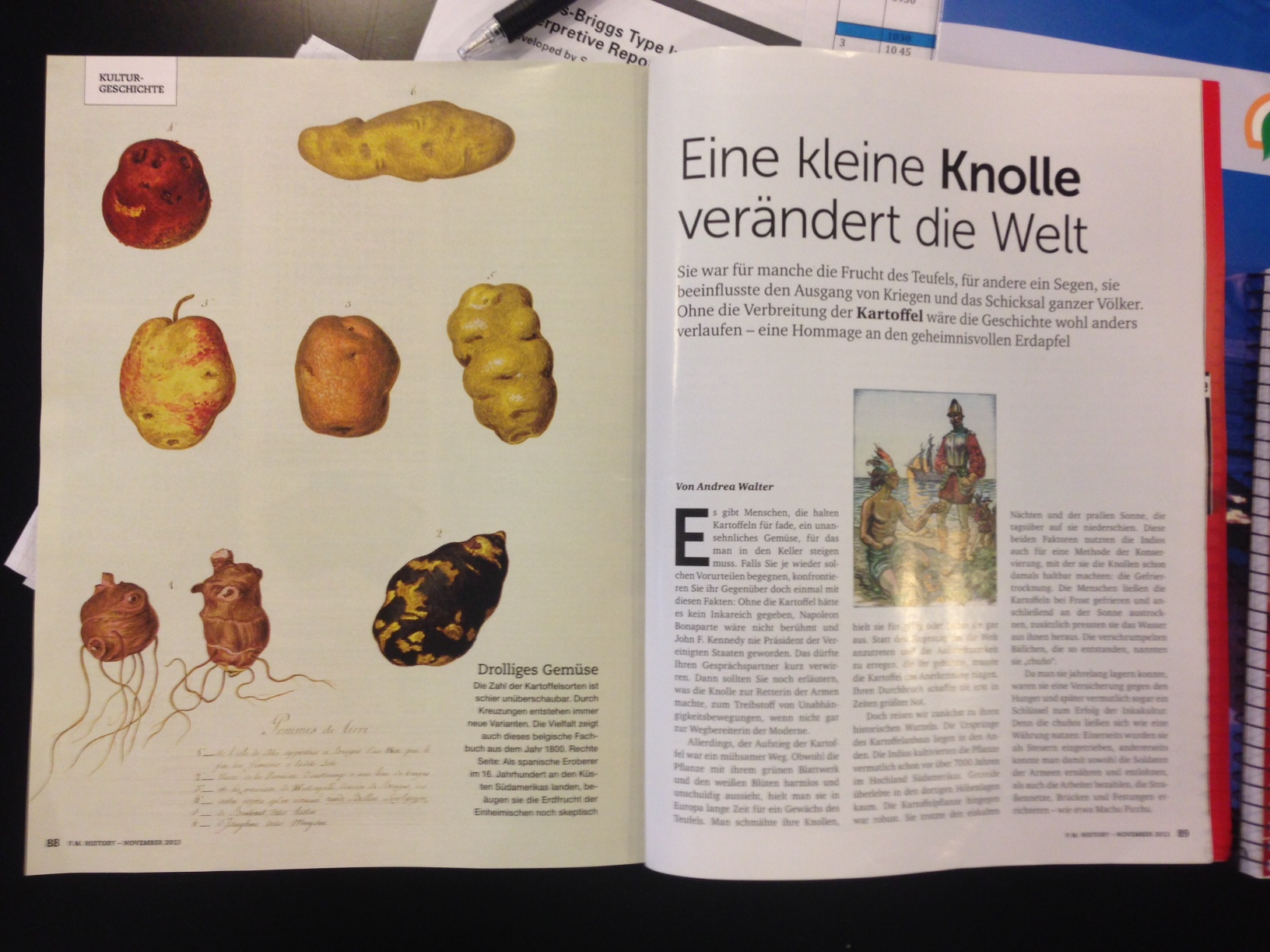 Let’s be fair. The inability to distinguish the potato from other Andean roots and tubers is not entirely confined to National Geographic. Take, for example, the November 2013 edition of the German magazine P.M. History. I don’t think it is online, but there’s an article in there entitled “Eine kleine Knolle verändert die Welt,” or “A small tuber that changed the world.” The first couple of pages are reproduced here. Clearly, it’s about the potato.
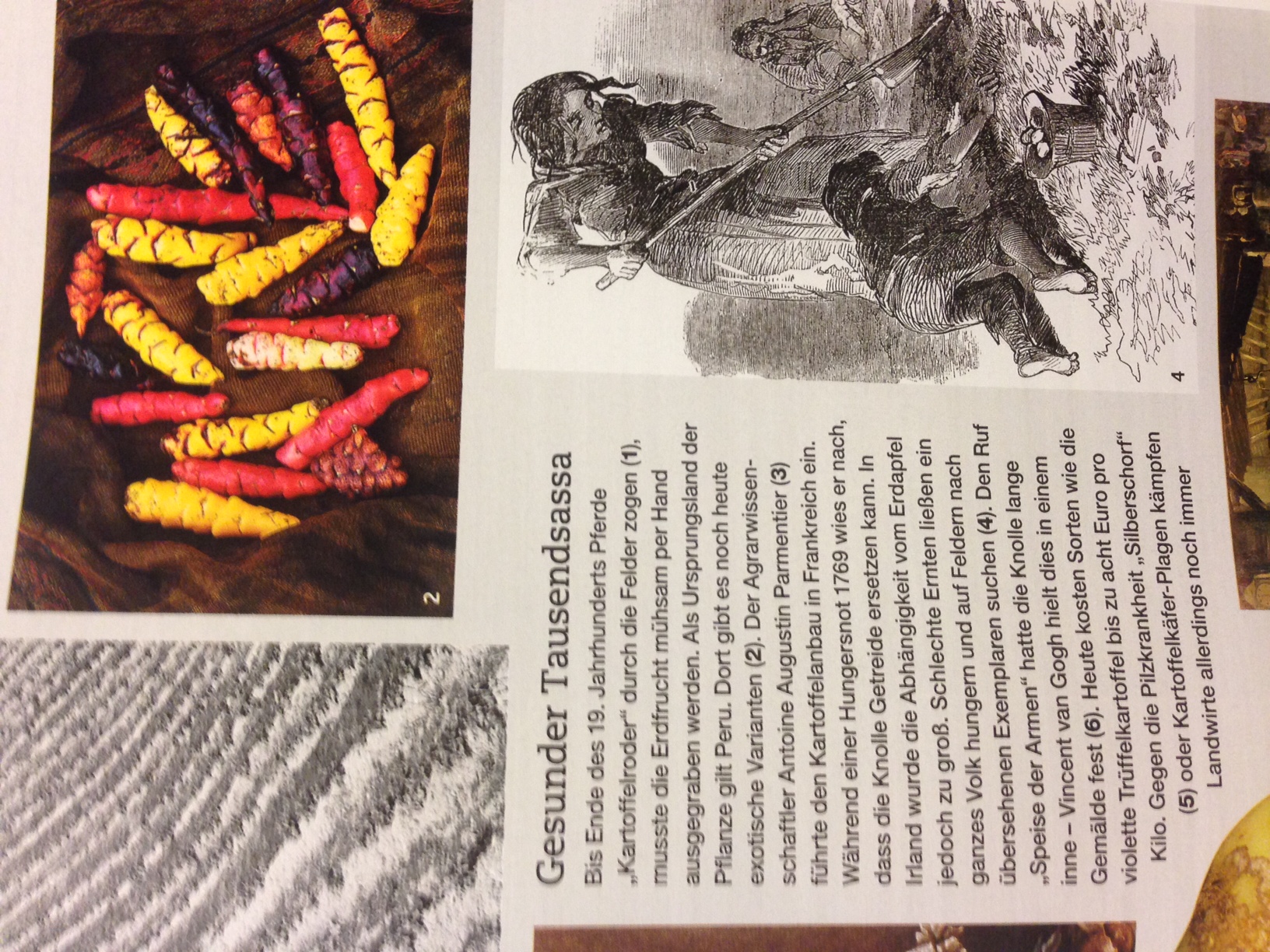 Ah, but wait, for a little further on one comes across a photo of what are clearly not potatoes. Unless of course all is explained in the caption, but somehow I doubt it.
Chenopods!
Spare a thought for those fortunates slaving over a hot stove today to give thanks for their good fortune. And if you’re not in the kitchen, consider these Thanksgiving Genomes.
Nibbles: Papaya relatives, Agrobiodiversity monitoring, Orange breeding, Corn mutant, Cashew processing, Pecan pie, Communications history, Wheat research video, Agroforestry, Breeding, AG research in USA, Philippines typhoon, Eating insects, Indian blog, Open data, Microbes & wine, European databases, Afro-Indian Millet Alliance
-
As Jerry Seinfeld famously once said, I’m getting a little backed up here. Travel and work and, well, life, have conspired to keep me away from Nibbling for the past week and more, so apologies if what follows proves a little difficult to digest.
- The closest relative of the papaya looks nothing like a papaya. But will it be monitored, along with the rest of agrobiodiversity?
- We might have to look further afield than near relatives to save the orange. But closer to save corn.
- Cashews are bad? Say it ain’t so. And as for pecans…
- CGIAR comms guys (and it is all guys) reminisce about the good old days of agricultural research. And here’s an example, using wheat, of what they’re up to now. Nice shoutout for breeding and genebanks. Though of course it’s not just about the breeding.
- Crop improvement is one of six ways of feeding the world. Just. CGIAR comms guys probably on it. Barbara Schaal certainly is.
- IRRI maps rice areas affected by the recent typhoon. I did ask, and farmers there apparently mostly grow modern varieties. FAO provides more context.
- More insectivorous hijinks.
- Great new blog on chai wallahs.
- Big, open ag data will save us all. That sound you hear is the zeitgeist catching up. And the CGIAR is on it.
- You say terroir, I say microbes.
- Report on a descent into Genebank Database Hell, European Chapter. Ah, but it’s open.
- India reaches out to Africa, millets in hand.