- A Population Genomics Perspective on the Emergence and Adaptation of New Plant Pathogens in Agro-Ecosystems. Crop diversity affects fungal diversity as much as the other way around. Actually more so, as fungal genomes are incredibly plastic.
- Teosinte as a model system for population and ecological genomics. Genetics of speciation, hybridization, various evolutionary questions: all can usefully be looked at in the maize-teosinte system with cheap next-generation sequencing. Oh, and that can help us with crop improvement.
- Does organic farming reduce environmental impacts? –- A meta-analysis of European research. Per unit area, yes. Per unit product, not always. Need to mix and match. Good luck with that.
- “Healthy,” “diet,” or “hedonic”. How nutrition claims affect food-related perceptions and intake? If you tell people something is healthier, they believe it is, in fact, well, healthier.
- Guanaco management by pastoralists in the Southern Andes. They can coexist with cattle.
- Earthworms promote the reduction of Fusarium biomass and deoxynivalenol content in wheat straw under field conditions. Earthworms protect crops from pathogens.
- Screening of pea germplasm for resistance to powdery mildew. 14 accessions from 10 countries are promising. That’s out of 700. Hard row to hoe.
- Sources of high tolerance to salinity in pea (Pisum sativum L.). Out of some 780 accessions, China seems to be a hotspot, but the most tolerant accession was from Greece. Any overlap with the previous results?
- A rare case of natural regeneration in butternut, a threatened forest tree, is parent and space limited. In situ is not enough. Not if you don’t help it along, anyway.
- Relationship between survival and yield related traits in Solanum pimpinellifolium under salt stress. 2 accessions among a subset of over 90 from over 300 in the AVRDC collection show high survival and yield under stress. Would be interesting to know if the 90 were indeed well-chosen in the first place.
- Climate warming could shift the timing of seed germination in alpine plants. Spring emergence will shift to autumn, but the bad effect will be on the seedlings.
- Medieval emergence of sweet melons, Cucumis melo (Cucurbitaceae). Lexicography suggests that there were sweet melons in Central Asia early on, but they didn’t get to Iberia until the late 11th Century, and to the rest of Europe until the 15th. Climate and the clash of civilizations to blame, as ever.
- Tibet is one of the centers of domestication of cultivated barley. The other being the Fertile Crescent. Some Chinese hulless and six-rowed barleys in particular are similar to Tibetan wild material. But are the authors stretching the data?
- A map of rice genome variation reveals the origin of cultivated rice. Or origins. Japonica first domesticated from O. rufipogon in the middle Pearl River in Southern China, and indica is a hybrid of the first cultivars with local wild rice in South East and South Asia. But have we not heard this before? Ah, but this paper has more, better markers, no doubt. Anyway, compare and contrast with maize and barley above.
- Lessons on the relationship between livestock husbandry and biodiversity from the Kenya Long-term Exclosure Experiment (KLEE). Livestock and wildlife can coexist, but you have to work at it. Bit like the guanaco thing, then?
- Modeling plant species distributions under future climates: how fine-scale do climate projections need to be? Doesn’t matter for total extent, but actual locations of stable climates vary with scale. On average, “270 m is fine enough,” but it really depends on the species. Probably safest answer is “as fine as possible.”
- Fertilisers and insect herbivores: a meta-analysis. Fertilizers good for insect numbers. Which means bad for plants? But insect diversity? Wonder what they do to those earthworms and fungi above…
All about baobab fruit powder, and then some
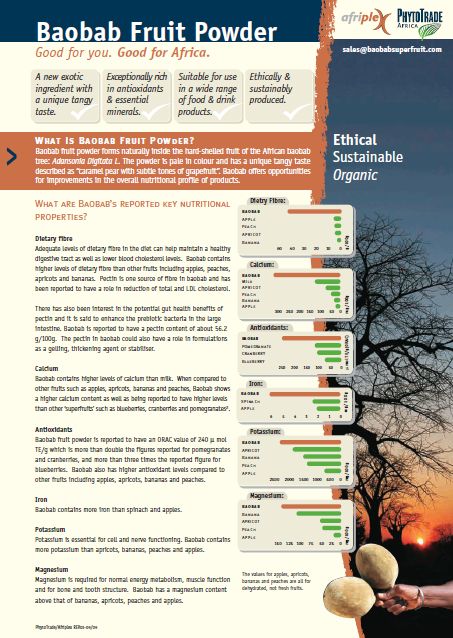 And you thought the world was safe from another baobab fact-sheet. Thanks, Ben Bennett.
Nibbles: Meta-blogging, NUS scholarships, Insects & plant diversity, Commons, Trees and diet, Thyme, ABS
- Why they blog. At the Agriculture and Ecosystems Blog Agriculture and Ecosystems Blog that is. Can’t help thinking that the media should perhaps be alerted.
- Scholarships available at the Crops for the Future Research Centre.
- Yes, ok EurekAlert!, we get it , insects are really important to plant diversity.
- Yes, ok policy wonks, we get it, it’s really useful to see plant genetic resources as global commons.
- More tree cover means more diverse diet in Africa.
- Thyme, gentlemen, please.
- FAO Commission on Genetic Resources for Food and Agriculture Ad Hoc Technical Working Group on Access and Benefit-sharing for Genetic Resources for Food and Agriculture debates, well, access and benefit-sharing for genetic resources for food and agriculture. In Svalbard, of all places.
Nibbles: Ames genebank, G20 meet, European bison, Genomics training, Old words, Roadside Salvia
- Yet another USDA genebank in the news. This time it’s maize.
- G20 Agriculture vice-ministers recommend to “Support the development and promotion of a global information sharing system on plant and animal genetic resources.”
- Bison returns to Germany.
- Learn population genomics of crops and livestock.
- Ebony is a pretty old word.
- How Salvia got around.
Nibbles: Cacao breeding, Specialy crops, Taihu pigs
- Breeding cacao in Ecuador.
- Supporting specialty crops in the US.
- Tasty Chinese piglets.