- Palestinian rooftop gardens. Including crucifers, no doubt.
- Brits support work with rice and wheat wild relatives. Among other things. They’ll probably use some of these genomics things.
- Aussies support sweet potatoes. HarvestPlus rejoices.
- That new Australian genebank. Will it have any sweet potatoes?
- The agricultural legacy of Thomas Jefferson. It doesn’t say here, but I bet he was into sweet potato.
- Hawaiian menus. What, no sweet potato?
- Forget biotech, the road to sexy agriculture is via the supermarket. Where you can buy sweet potato. Maybe even of the organic persuasion.
- Or maybe better tree seeds. Even in the Nordic countries. Or the US. Is cacao a tree?
- Plans for special edition of Sustainability on neglected crops. Like amaranth?
- Geographic targeting reaches roots/tubers. Using this newfangled atlas? Or no?
- Treaty and Consortium love-in filmed. Thanks for sharing. It’s all part of this CGIAR perestroika thing, no doubt.
- What that Kew coffee extinction paper really said.
- Protected areas need work. Especially for coffee (see above).
- Yeah but protected areas is not the only way to go, and Europe now has a bunch of biodiversity indicators for farmland. I guess it’s all part of some big plan.
- Policy brief on sustainable use of PGR. Or, as we used to call it, on farm conservation.
- Which you can kind of see happening here.
Nibbles: SOWF, Pollinators, Bamboo, Policy, Cupuaçu, Salak, Pomegranate
- State of the World’s Forests 2012 is out. Save some trees by downloading the PDFs.
- More from FAO: Potential Effects of Climate Change on Crop Pollination. Stick that in your crop model.
- And then there’s climate change and bamboos — of interest to more than pandas?
- Bioversity policy wonks call for New strategies and partnerships for the sustainable use of plant genetic resources. What was wrong with the old ones?
- Kew says The taste of the Amazon is Cupuaçu. A name I recognized only because I recently spent half a lifetime on Wikipedia’s entry for Theobroma.
- Smithsonian says The taste of Indonesia is salak, a name I didn’t recognise even when told it is snakefruit. Or Salacca zalacca, a name to really conjure with.
- Cynthia says, the taste of love is pomegranate. Let us go to the vineyards to see …
Taro in the Levant
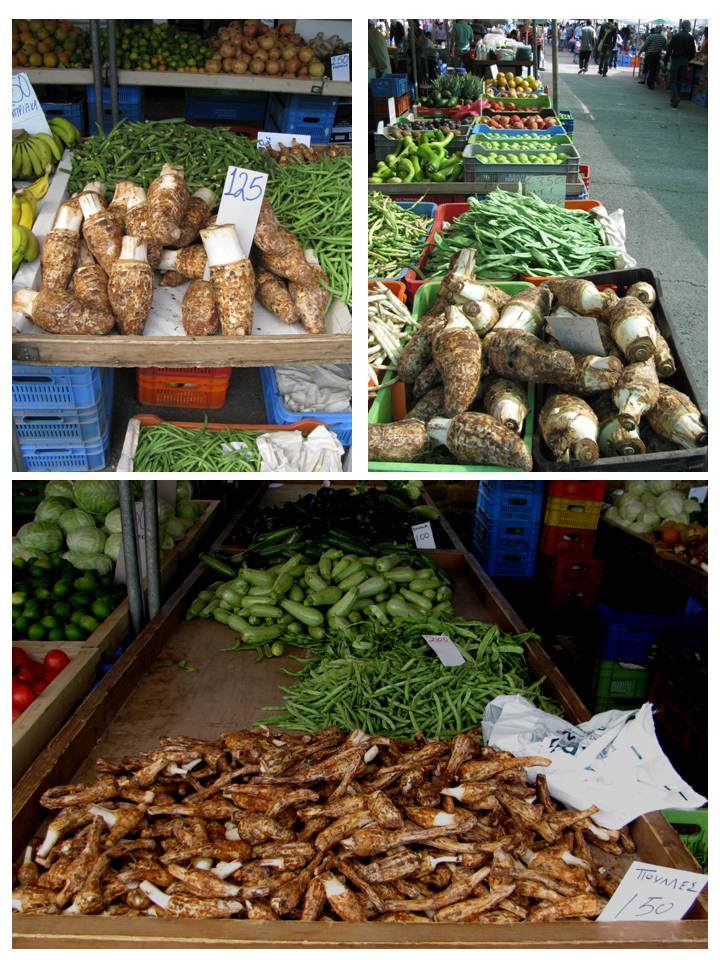 I was reminded during a recent trip back to Cyprus (my first visit in 20 years after living there for quite a while) of the curious fact that taro is a staple of traditional Cypriot cuisine, something of an outlier in the Mediterranean. Called kolokassi, the tuber is prepared in a number of ways, and the young offshoots, or suckers, are also taken fried. You can see these in the photo, labelled “poulles.”. Peter J. Matthews has this to say in his “Genetic Diversity in Taro, and the Preservation of Culinary Knowledge“:
In Cyprus only one cultivar of taro is grown, but there are at least nine distinct ways of preparing taro (skhara, vrasto, souppa skourdalia, tiganites, kappamas, yiakhni, psito, moussakas, Matthews 1998a) (Figure 4). The fermentation of taro starch, and the edibility of leaves (petioles and blades) are not known in Cyprus. All the methods recorded use heat to reduce acridity — by simmering, boiling, stewing, frying, roasting, grilling, and baking (steaming was not reported). For each named dish, the details of preparation varied from person to person and village to village. The range of dishes is not large, compared to the range in Japan (Matthews 1995), but does involve a greater range of methods for applying heat.
You can find out more in the book “The Global Diversity of Taro: Ethnobotany and Conservation,” in which Dr Matthews has also had a hand. Poulles are not mentioned, which makes me think their consumption may be a relatively recent innovation.
It’s not clear where that one Cypriot cultivar may have come from, though Matthews says that the crop “is likely to have reached Cyprus in ancient times from India or Africa, via the Levant or Egypt.” That makes sense, but will be difficult to verify, as there is precious little in the way of germplasm collections in the region between Europe and India. I would imagine Egypt in particular would be fertile territory for a bit of collecting. I wasn’t able to find any ancient Egyptians representations of the plant, but I wouldn’t be surprised if they exist.
Nibbles: Biodiversity economics, ICARDA social network, Beyond food miles, Heirlooms on BBC, Cannabis, Research funding, Cacao diversity, Agriculture from the air, Sustainable intensification example, Research whine, Japanese botanic garden visit, European PGR network, Tribal Glycene, Youth in agriculture
- Oxford Review of Economic Policy has special volume on biodiversity economics. Not much ag, though, settle down.
- ICARDA announces on Twitter the existence of a new Facebook page which looks a bit like the old one.
- It’s the fertilizer miles, stupid.
- Great British Food Revival does heirloom carrots. Oh and beer.
- Good news for a particular agricultural biodiversity subsector from Amsterdam and Colorado. The Dude unavailable for comment. For obvious reasons.
- If you’re from Ghana, Nigeria, South Africa, Tanzania and Uganda and are doing research on Neglected and Underutilized Species you’ll be interested in this call or research proposals from ISF.
- Bioversity deconstructs that paper on the spatial analysis of Theobroma diversity. I still don’t quite get why they didn’t do the gap analysis.
- Farming from the air. And more along the same lines. Or polygons, I suppose I should say. Can you estimate diversity from the air? I bet you can.
- Sustainable intensification in (sort of) action.
- Damn rice farmers not playing ball.
- Oxford botany geeks visit Japan, identify wood of bench in noodle bar.
- 13th meeting ECPGR Steering Committee. All the documents you’ll need. And then some.
- Soybean as a vegetable. Possibly an acquired taste.
- How to keep young people on the farm? “Perhaps the first point to recognise is that the evidence base on which to build policy and programmes is frighteningly thin.”
Ex-pat wasabi flourishing
Luigi’s indefatigable quest for all the truth there is to be had about wasabi (Wasabia japonica) reminded me that long ago and far away, I entertained thoughts of growing the stuff commercially. Luigi alluded to the reason when he said “there is imitation wasabi on the market”. Amen to that. In fact, there’s almost nothing else on the market. Practically all the wasabi you, a mere mortal, are ever likely to try outside Japan (and much inside) is the wrong stuff. The right stuff commands a hefty price tag, the reason I was entertaining those thoughts to begin with. A little digging, however, persuaded me that the plant was far too persnickety and capital intensive to be worthwhile, so I gave up on it. Silly me.
Turns out wasabi is not nearly as hard to grow as people imagine. Richters, a reliable seed company that supplies the plants, says
[W]asabi will grow quite happily in any moist, organic-rich soil where there is shade and protection from the summer heat; running water is not required. After 18-24 months the rhizomes are harvested, washed, peeled and grated for fresh use.
Nothing there about no sharkskin.
Companies in the US and New Zealand are apparently making a decent fist of growing it on a commercial scale. At which point, I nearly gave up on wasabi again. But one more Google brought me to a suitably gushing piece in The Daily Telegraph less than a month ago. Talk about the wasabi zeitgeist! That too pushes the “wasabi is really difficult” trope, and more power to the plucky lads at The Watercress Company who pulled it off. Now to see whether I can get some of the real thing for a proper taste test.
No point trying to grow it here. Like watercress, which I miss terribly at times, the need to stay cool in summer probably dooms it. I expect it would do OK in northern Germany.