- Tequila plant is possible sweetener for diabetics. Talk about a waste of raw material.
- Would you Adam and Eve it? Women do not own 2% of the land. What next for the killer factcheck?
- In related news, teacup pigs are a fraud.
- Quinoa to feed the world, in Spanish.
- The rice warrior! Isn’t that overegging the pudding just a smidgen?
- Learn about plant genetic resources and seeds at Wageningen University.
- African Agriculture Technology Foundation “to avail adequate quality seeds at the right time and affordable price”. You might think some of the folks at the AATF should avail themselves of Wageningen’s course.
- Tough, flavoursome and bug resistant. Not Richard Markham, but a tomato bred specially for the Solomon Islands he’s talking about.
- Kew’s new global kitchen cookbook narrowly avoids being crushed by bandwagon trundling by.
- Cover crops are even more valuable than previously thought shock.
- Indigenous sheep breeds even more valuable than previously thought shock.
Nibbles: CG diversity pix smackdown, ARTs in Bolivia, Fruits in Central Asia, Terra-i, FAO land use data, Agroforestry, Nagoya, Microwaves, Taxonomist Day, Spring!, Right to Food, Pacific food
- Some fabulous photos of maize diversity from CIMMYT. (IRRI says, I see your diverse maize, and raise you diverse rice.)
- Hope neither goes the way of that of some Andean roots and tubers in Bolivia. Or fruits in Central Asia. Though neither is doing terribly, in truth.
- And too bad you can’t monitor that the way you can forests. Or land use in general for that matter.
- World Agroforestry Centre calls for more, er, agroforestry. Will Defra listen?
- Maybe it’s too busy consulting on the Nagoya Protocol. Wonder how good that will be for agroforestry.
- I don’t care what anyone says, I like microwaves.
- Wait, we missed Hug a Taxonomist Day?
- And Persian New Year?
- De Schutter’s final report. Main message not lost on the Pacific island countries.
Nibbles: Genebanks trifecta, Marley Coffee, Sorghum noodles, Biofortification Q&A, African oils, Cow diversity, Coffee course, Fructose deconstructed, Vanuatu chocolate, Candy bar phylogenies, Japanese copycats, Charger beer
- CIP’s genebank in the limelight.
- Egypt’s genebank in the limelight.
- Australia’s genebank in the limelight. Limelight fast running out…
- Ah, but genebanks not the only ones with cool videos: farmers in the limelight.
- Yeah, it’s not just about the genebanks. Markets can help, I suppose. Especially if you have a famous name.
- As with coffee, so with sorghum. Biofortified or not. All we need now is an agribusiness incubator, and here it is, courtesy of ICRISAT. But what will Japanese farmers think?
- Same again for assorted African oils?
- The diversity of cows has been driven by markets too.
- Coffee 101 at UCDavis. Maybe they’ll invite Mr Marley to teach.
- You want fructose in that coffee? No, probably not.
- Maybe you prefer chocolate. From Vanuatu, natch. Looks like high quality stuff too, but even crap chocolate has its uses, like teaching taxonomy for instance.
- No, you’re more a Japanese bourbon person, aren’t you? Wait, do you need barley for that? I’m sure those young Japanese farmers will be all over this.
Globalized diets paper globalizes
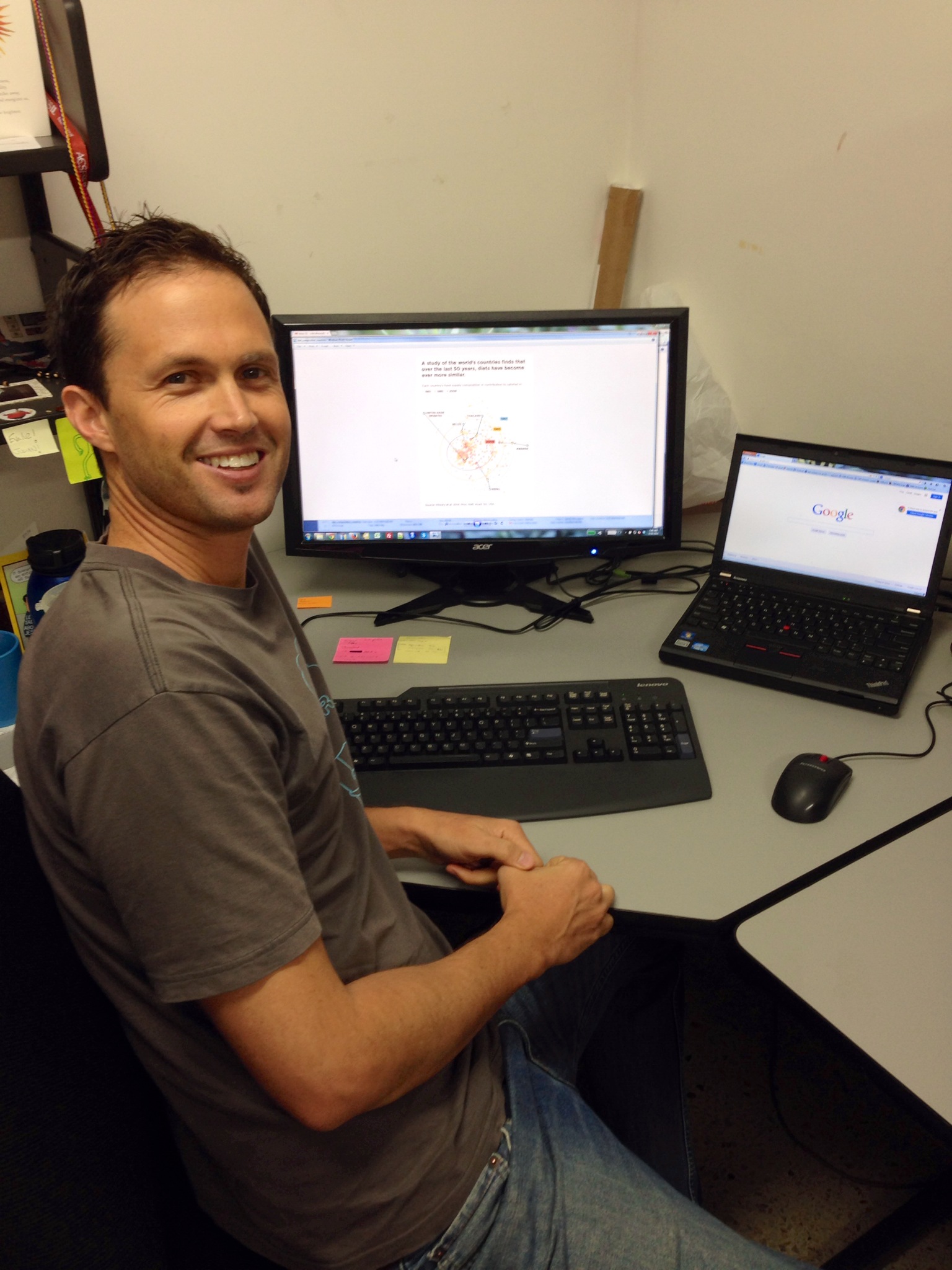 You may, unless of course you’ve been visiting Mars, have come across in the past couple of weeks coverage of Colin Khoury’s (along with co-authors) paper on “Increasing homogeneity in global food supplies and the implications for food security.” That’s Colin to the left in his office at CIAT, when I visited him last week. The paper has really caught the imagination of the media, and is now one of PNAS’s most attention-grabbing articles ever, in the top 5% of all articles in fact. One of the better write-ups was in NPR, but there’s lots, lots more, in multiple languages. Including a brief mention by World Bank VP Rachel Kyte and CGIAR Fund Council Chair at a Wageningen University event. But where did the idea for the study come from? Well, we are not prone to boasting here at the Agricultural Biodiversity Weblog, but please forgive us on this occasion if we point out that it is a post by Colin in these very pages about four years ago that marks the beginning of his journey to superstardom. From little acorns…
And let us not forget that we can do something about these trends.
Brainfood: Sturgeon semen, Wheat biofortification, Wild barley future, Pest numbers, Wild potatoes, Mishan pig drift, Microbial models, Paspalum genomics, Chinese peanuts
- Improvement in wild endangered Persian sturgeon, Acipenser persicus (Borodin, 1897) semen cryopreservation by 2-hydroxypropyl-beta-cyclodextrin (HβCD). Hey, stop sniggering, it’s good to know there’s an ex situ option.
- Biofortification of wheat grain with iron and zinc: integrating novel genomic resources and knowledge from model crops. Your jetpack is here, sir.
- Genetic Diversity and Ecological Niche Modelling of Wild Barley: Refugia, Large-Scale Post-LGM Range Expansion and Limited Mid-Future Climate Threats? As ever, the answer is yes.
- Economic and physical determinants of the global distributions of crop pests and pathogens. More crops, more pests, but not as many as there would be if more money were available for observation.
- Wild potato species (Solanum section Petota Solanaceae) in the Tunari National Park, Andean Region of Cochabamba, Bolivia. Four species, but not very morphologically variable.
- Impact of Genetic Drift on Access and Benefit Sharing Under the Nagoya Protocol: The Case of the Meishan Pig. Current Meishan pigs in the US have become differentiated from the ones originally imported from China in the 1980s.
- Investment into the future of microbial resources: culture collection funding models and BRC business plans for biological resource centres. Services must include capacity building and the promotion of links to research collections and users. That can’t be done on basis of full cost recovery from sales. Will need a combination of government, commercial and project support. Can crop collections learn anything from this?
- Gene Discovery and Molecular Marker Development, Based on High-Throughput Transcript Sequencing of Paspalum dilatatum Poir. Important forage grown in apomictic monoculture now has genomic resources that should allow better breeding. And perhaps some diversification.
- Genetic Diversity and Population Structure of the Major Peanut (Arachis hypogaea L.) Cultivars Grown in China by SSR Markers. The northern cultivars are different to the southern.