- Provincial Indian university gets a genebank.
- Nutritionists go all ecological on us.
- But does that include taking into account human variation in taste perception? I’m betting no.
- The case against GM salmon.
- Going crazy in Austin’s market.
- Amaranth touted in Kenya. Sorghum and local millets unavailable for comment.
- Take a virtual trip around Nepal’s herbarium.
- Society for Ecological Restoration opens online Early Registration for the 4th World Conference on Ecological Restoration, to be held in August in Mérida, Mexico. You guys need a blogger?
Nibbles: Whiskey fungus, Ecological imperialism, Value chains, Mexican blog, Mexican maize and gender
- Newly-named urban extremophile fungus survives on angels’ share.
- 1493. An oldie but goodie. And the book version is on its way.
- AVRDC lists the 6 principles of food value chain research.
- El cuexcomate, un nuevo blog en español, acerca de “agricultura, plantas útiles, etnobotánica, comida … desde México.” Bienvenido!
- Women more interested than men in better-tasting maize. Maybe El cuexcomate will comment.
Food Desert Locator smackdown
We expressed some doubts about the Food Desert Locator a few days back. Now it’s Gary Nabhan’s turn.

Nibbles: Cassava, Biopiracy, Neolithic, Potato history, Pollinator conservation
- The pros and cons of biofortified cassava rehearsed for the nth time.
- Scientists accused of biopiracy for the nth time.
- nth genetic study of ancient farmers. Men moved, in a nutshell, women not so much.
- Traditional healers: nth example of a group hard hit by climate change.
- In all above cases, n is a large positive integer.
- Potatoes responsible for about 25% of Old World population increase between 1700 and 1900. Nice maths.
- Learn how to conserve pollinators. If you’re in Rhode Island. But there is an online Pollinator Conservation Resource Center with lots of resources.
Causation sought between seed banks and vitamin D deficiency
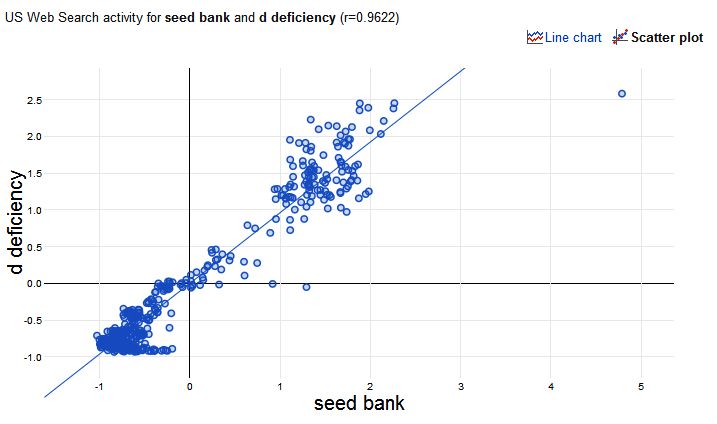 Google has a new thing where you put in a search term and it tells you what other terms showed a similar pattern of search over time since 2004, at least in the US. So of course I played around with it for way too long, but pretty much nothing of interest turned up. Except for one, strange thing. It seems that the time pattern shown by searching for the term “seed bank” is very highly correlated with a number of permutations of the search for “vitamin D deficiency.” Any idea why that should be?