- Ah, summer and its funny medieval holidays.
- Making bread in Tajikistan.
- Making pizza in Sussex.
- Making cheese in (one village in) Sweden.
- Diversifying bananas in Queensland.
- Diversifying banana products in Kenya.
- Diversifying with trees in China.
- Better diversify coffee.
- I see your responsible soy and raise you responsible oil palm.
- Cocks of the walk.
- I’m so annoyed the New Scientist article on breeding less bitter veggies is behind a paywall that I won’t even link to it. Google it, if you must.
SDGs recognize agrobiodiversity and genebanks
The final version (pdf) of the Post-2015 Development Agenda was posted online about a day or so back after an all-nighter in New York.
For those who are just waking up, read the final version of the Post-2015 Development Agenda here http://t.co/c9PHgLvHCE #SDGs #Post2015
— UN DESA Sustainable Development (@SustDev) August 1, 2015
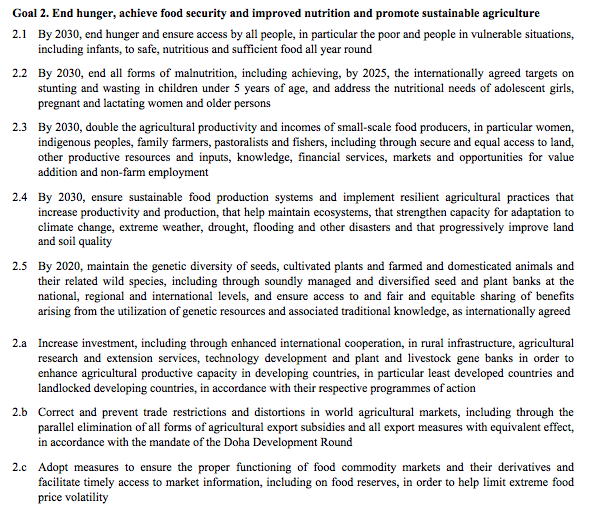
I’m glad to say Target 2.5, which highlights the importance of agricultural biodiversity, has survived intact. This includes a specific reference to genebanks, as also does an additional target (2.a) on funding. Here is the full text:
2.5 By 2020, maintain the genetic diversity of seeds, cultivated plants and farmed and domesticated animals and their related wild species, including through soundly managed and diversified seed and plant banks at the national, regional and international levels, and ensure access to and fair and equitable sharing of benefits arising from the utilization of genetic resources and associated traditional knowledge, as internationally agreed
2.a Increase investment, including through enhanced international cooperation, in rural infrastructure, agricultural research and extension services, technology development and plant and livestock gene banks in order to enhance agricultural productive capacity in developing countries, in particular least developed countries and landlocked developing countries, in accordance with their respective programmes of action
This should make it a lot easier to raise money for genebanks in the future. To see how these particular targets relate to the overall goal of ending hunger and improving nutrition, here’s the full set of targets agreed under Goal 2:
Nibbles: Sustainable database, Strawberry breeding, Breeding rice, Nutrition champion, Camel milk, Mike Jackson, Feed the Future, Quinoa prices, Small is beautiful
- A database of how you do sustainable intensification.
- Building a better strawberry.
- New lab helps Bangladesh with high-zinc rice.
- Maybe those guys are you nutrition champions.
- They’re right, camel milk is good, and good for you.
- Useful list of Mike Jackson’s publications.
- Pres. Obama learns about maize in Ethiopia.
- Increased quinoa supply leads to lower prices shock.
- Silly season roundup: tiny watermelons (no, not really), tiny pineapples.
Nibbles: Malagasy double, Sandwich photos, Middle way, NUS comms, Fishpocalypse, Cali palms, Home on the range, Heirloom rice, Potato genomes, Old watermelons
- Madagascar: Vintage photos, not-so-vintage photos.
- More photos, this time of state sandwiches. Yes, sandwiches.
- “The solutions to the problem of feeding people and protecting the planet are endlessly and irredeemably gray.” Pretty much the same argument I made recently, not quite so rudely.
- Training course on communicating the awesomeness of neglected species. How difficult can it be though, right?
- Keeping cats happy has a cost.
- Nifty vintage photos of California palms. The trees, people, the trees.
- Cowboys ain’t what they used to be. But only just.
- Gleaning deconstructed.
- IRRI opens exhibit on heirloom seeds, no doubt through gritted teeth.
- Ten potato genomes in the offing. Wait, doesn’t rice have like 3,000? Get it together, potato people.
- Renaissance watermelons looked really crappy. Probably tasted of something, though.
Nibbles: Native American foods, Responsible soy maps, Ocean blue, Social academics, Kenyan vendors, Coffee pix, Local food takedown, Ancient horses, Kava bar, Plantae, Root fungi
- Traditional foods fight Native American obesity.
- Round Table on Responsible Soy makes some nice maps.
- The Decade for African Seas and Oceans is off to a blue start.
- Face it, academics, social media are good for you.
- You think Pres. Obama checked out some Nairobi street food?
- Pics of coffee value chain. Wow, that makes it sound really boring.
- Calling bullshit on farm to fork.
- A day in the life of an archeologist of Iron Age horses.
- Kava reaches NYC hipsters.
- Plantae is coming!
- Rice plants colonized by mychorriza express different genes and have more lateral roots.