- Latest scaremongering about disappearing foods. French fries? Really? And more.
- Ah, wait. Here comes the science.
- Daguerreotypes of heirloom veggies.
- Pat Mooney sets out the history of PGR conservation in ten minutes.
- The beauty of traditional diets.
- Something philosophical for the weekend? Does something count as local if it didn’t come from the local soil, but was instead grown inside a greenhouse that happens to be near where you’re eating it?
Nibbles: Canadian genebank, Indian women farmers, Coconut videos, Willow catalog, Crop models & CC, Next GR, Caviar of Cantaloupes, Wild Bactrian, Dog history, Top 100 development questions
- Video of the Canadian genebank.
- First video in series on Indian women farmers: Bowing to No One, by Sarah Khan.
- Whole bunch of coconut videos. See what I did there?
- Good news for cricketers: willow variety catalog out.
- The skinny of what crop models say about the effects of climate change. Spoiler alert: it ain’t good.
- The latest call for a new Green Revolution.
- Safe to say cantaloupes won’t feature much in that, which is a pity.
- Maybe some other weird plants will, though.
- Wild camels are pretty tough. And since we’re on the subject, what’s a heritage animal breed?
- Wait, they solved dog domestication?
- Top 100 development research questions for our SDG world, including ten on food security and agriculture.
Climate change, food systems and nutrition: what’s to be done?
The Global Panel on Agriculture, Food Systems and Nutrition has come out with a Statement on Climate Change, Food Systems and Nutrition, in the run-up to a side event at COP21 in Paris. Nothing particularly surprising there, but I just wanted to highlight two things. First, I was impressed by how the problem was set out:
Climate change is expected to push down global farm output by 2% per decade between now and 2050. Demand for food is expected to rise substantially during that same period.
Yes, those fancy IPCC synthesis diagrams (see below) are cool and everything, but there’s a lot to be said for the directness and starkness of those two sentences. Sometimes a few well-chosen words are better than a picture.
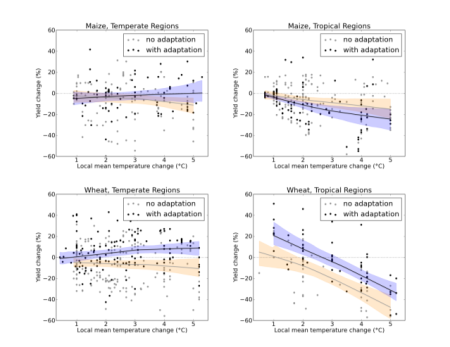
Then there are the policy recommendations:
1. Include diet quality goals with adaptation targets proposed for climate action.
2. Diversify agricultural investments, factoring in the local realities of ecological sustainability and comparative advantage.
3. Support greater food system efficiency so that outputs per unit of water, energy, land, and other inputs are optimised and the footprint of agriculture and non-farm activities are better managed to meet both food demand and higher-quality diets.
4. Integrate measures to improve climate change resilience and the nutritional value of crop and livestock products along the value chain, from production to marketing.
5. Protect the diet quality of the poor in the face of supply shocks and growing food demand through social protection, for example.
6. Promote the generation and use of rigorous evidence on appropriate investments along food value-chains, which are resilient to climate change and also deliver positive dietary outcomes and support improved nutrition.
And it’s striking how agricultural biodiversity in one way or another could be argued to underpin all of these.
Nibbles: CC & crop diversity, Agrobiodiversity newsletter, Foley blog, Heirloom pepper, ITPGRFA PPT, Gobble gobble, Ancient DNA, Sunflower relatives, Leafy greens
- FAO has guidelines for making sure climate adaptation plans include crop diversity.
- A new agricultural biodiversity newsletter for your reading pleasure.
- And a new blog of global sustainability issues from Jonathan Foley.
- The Beaver Dam pepper back from the brink.
- Nice set of slides summarizing the Plant Treaty.
- The traditional Thanksgiving save-heirloom-turkeys story.
- Farming changed people.
- Crop elders?
- Women speak out about traditional African veggies.
Genebank questions in Parliament
So I spent yesterday afternoon in somewhat unusual surroundings, at least for me. I was in the House of Lords, of all places, helping to make the case for genebanks to a joint meeting of All-Party Parliamentary Group on Agriculture and Food for Development together with All-Party Parliamentary Group on Agroecology.
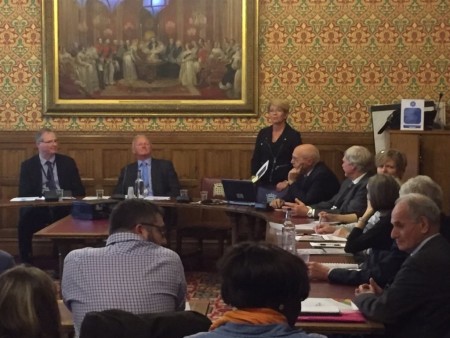
Sitting under the painting are the chairs, Ewen Cameron, Baron Cameron of Dillington and Jeremy Lefroy MP, who both seemed very receptive to the arguments. 1 It was actually a very knowledgeable and engaged audience all round, with astute questions on how genebanks can help farmers directly, on whether breeders are ever satisfied with the service they’re getting, and on the role of the private sector in ensuring the conservation of crop diversity, among others. Let’s see to what extent the interest, of which there is plenty at the highest level in the UK, translates into financial support for the cause of genebanks.