- Push-pull pulls in prize.
- Which is more than can be said for the Millennium Villages Project. I wish someone would occupy them.
- You can have too much good breeding. If you’re a horse.
- Nice aerial pics of rice cultivation. And a sort of information service on that cereal called Rice 2.0, which unaccountably lacks an RSS feed.
- WorldFish invites entrepreneurs to get together and discuss investing in aquaculture. Here’s hoping diversity won’t be left in the dust.
Nibbles: Taiwan seedbank, American agroforestry
- Taiwan should establish a national seed bank. It says here. But will it be a genebank?
- Agroforestry in the USA and in the ancient Maya lands.
Conservation status of European crop wild relatives assessed
The latest IUCN assessment of the conservation status of European biodiversity is out, and is making the news. The bit on plants is co-authored by Melanie Bilz, Shelagh P. Kell, Nigel Maxted and Richard V. Lansdown and, unsurprisingly perhaps given their track record, includes, I believe for the first time, extensive discussion of crop wild relatives as a distinct class. 1 The authors, which coordinated input from dozens of experts, conclude that out of a total of 591 CWR species:
Within the EU 27, at least 10.5% of the CWR species assessed are threatened, of which at least 3.5% are Critically Endangered, 3.3% Endangered and 3.8% Vulnerable – in addition, 4.0% of the species are considered as Near Threatened. One species, Allium jubatum, is Regionally Extinct within Europe and the EU; it is native to Asiatic Turkey and Bulgaria, but has not been found in Bulgaria since its original collection in 1844.
It does not even seem to be available from botanic gardens, according to Botanic Gardens Conservation International’s database. I don’t know what has caused its disappearance in Bulgaria, but currently the main threats to CWRs seem to be intensified livestock farming, tourist development and invasives:
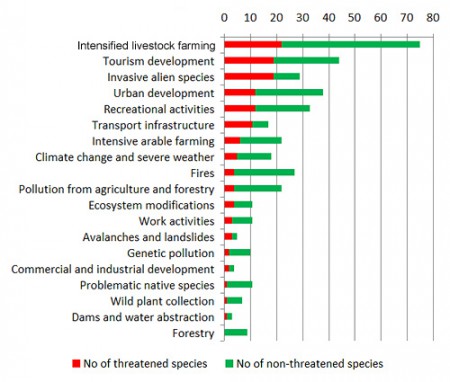
And there are maps 2 of both the distribution of overall CWR species richness and of the most threatened species:
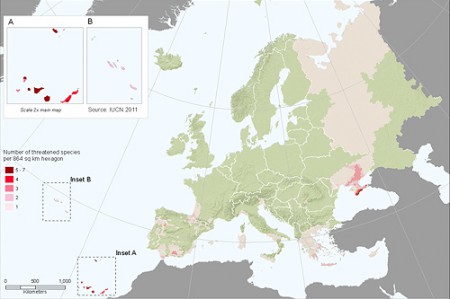
An extremely useful review is provided of previous work assessing the extent to which CWRs are conserved in genebanks, botanical gardens and protected areas in Europe. But here perhaps I would like to quibble with the authors. Although their listing of existing conservation efforts seems to me thorough and comprehensive, there is no attempt made to synthesize the results of all the different initiatives and come up with a list, however preliminary, of high priority plants for immediate conservation intervention. Surely it would not have been particularly difficult to cross-reference their list of threatened species with listings of accessions in Eurisco and the BGCI database, for example. Maybe this was beyond the scope of this particular exercise and is the focus of parallel work. Perhaps Nigel or Shelagh will respond here.
This is a very important contribution to raising the profile of CWRs within the biodiversity conservation community. Let us hope that it will translate into increased support for their conservation, both ex situ and in situ, along the lines so usefully set out by the authors in their recommendations.
What OSP do and do not do
Amid all the brouhaha surrounding the publication of the paper “A large-scale intervention to introduce orange sweet potato in rural Mozambique increases vitamin A intakes among children and women” in the British Journal of Nutrition, it is worth reminding ourselves what the study did and did not find.
Adoption of 6 orange-fleshed sweet potato (OSP) varieties and their displacement of white and yellow varieties in the diet of the people in the study area led to significant, important change in vitamin A intake in vulnerable groups:
…the net change in mean vitamin A intakes of the intervention groups relative to the control represented increases by 63, 169 and 42% among reference children, young children and women, respectively. These net increases were equivalent to approximately 74, 118 and 55% of the corresponding EAR for vitamin A(26) for the same groups, representing a substantial increase in dietary vitamin A.
The study also found that “estimated prevalences of inadequate vitamin A intakes by these groups commensurately decreased.” All of which is of course great. But the authors cannot be said to have found any change in the vitamin A status of people. That’s because this wasn’t measured. As the authors themselves admit:
…it is not possible to predict the impact of these increases in vitamin A intake on change in vitamin A status.
But they were not guessing wildly, of course:
One of the main reasons for not including vitamin A status indicators in the present study was that a similar but smaller-scale study in the same area serving as a precursor to the present one had already demonstrated a positive impact on children’s serum retinol concentrations following increased intake of vitamin A from OSP and other vitamin A sources.
So the argument is not entirely tied up, though it does seem pretty solid. Evaluation of nutritional and health impacts is hard.
Just a final word about diversity. Six OSP varieties were introduced and adopted, and as we’ve seen seem likely to be having a significant health impact. But are they also having an impact on the diversity of the local production systems? The authors suggest that they might: “OSP is an acceptable, local food source of vitamin A that can easily replace currently grown white or yellow sweet potato varieties.” And in fact it does seem they did:
OSP accounted for 47–60% of all sweet potatoes consumed in the … [study] groups across ages, indicating a moderately high degree of substitution for other varieties. In the control groups, 20–24% of all sweet potatoes consumed were OSP.
Again, paralleling the vitamin A story, this is replacement in the diet, not necessarily substitution in the fields. But it is an alarm bell nonetheless to a conservationist. Genesys shows a worrying situation for sweet potato conservation in Africa, though that’s because it does not yet pick up some very significant national and regional collections, including Mozambique’s own. Hopefully that will change. But as we’ve mentioned here before, it is important for such projects to survey the local diversity before they introduce their own new, no doubt “better” diversity, and make sure the local stuff is placed in genebanks, if it is not there already. I don’t know if that was done in this case. I hope so. Those “currently grown white or yellow sweet potato varieties” may not be much good for vitamin A intake this year in Mozambique, but they may well be very good for something else, next year, somewhere else. And maybe even in the very farms in which they have been replaced.
Nibbles: Bangladeshi rice, Ugandan seeds, Indian policy
- The Daily Star of Bangladesh waxes lyrical about old rice varieties, and asks “Who knows how many of these homegrown varieties will soon dwindle into being sheer memory?” We know the answer to that one: 75%
- Professor Sir Gorden Conway hymns Josephine Okot, woman seed entrepreneur.
- Part 2 of a look at whether India’s city-centred policy is justifiable. Not on diversity grounds.