- Ancient DNA from an Early Neolithic Iberian population supports a pioneer colonization by first farmers. People, not just crops, moved.
- Genetic consequences of using seed mixtures in restoration: A case study of a wetland plant Lychnis flos-cuculi. After a few generations of use for seed production, it’s best to abandon ex situ stocks and go back to the wild populations.
- Creative Commons licenses and the non-commercial condition: Implications for the re-use of biodiversity information. It’s complicated. I wonder if the multi-headed hounds who guard the gates to GBDBH are aware of this. Here’s a blog post.
- Is diversification history of maize influencing selection of soil bacteria by roots? Kinda.
- A horizon scan of global conservation issues for 2012. Perennial cereals make the cut.
- How pristine are tropical forests? An ecological perspective on the pre-Columbian human footprint in Amazonia and implications for contemporary conservation. It doesn’t matter.
- Genetic diversity of carrot (Daucus carota L.) cultivars revealed by analysis of SSR loci. Western and Asian groups, the latter more diverse, because of landraces. But 88 accessions does seem a bit few. And no wilds.
- Mapping of earthworm distribution for the British Isles and Eire highlights the under-recording of an ecologically important group. 28 species! But many gaps. No diversity map. Will send them DIVA-GIS for Christmas.
Nepal refuses hybrid maize aid, blames International Treaty
Where’s a Treaty lawyer when you need one? SciDev.net reports that a joint USAID/Monsanto project to introduce farmers in Nepal to the benefits of hybrid maize varieties has run into a brick wall because civil society organizations in Nepal say it:
“could replace local varieties, increase Nepal’s dependence on imported seed and pave the way for the introduction of genetically modified (GM) crops later because of weak biotechnology regulation.”
As a result of a meeting in November, neither USAID nor the Government of Nepal will say whether the project is to go ahead. Fair enough, I reckon. Countries should be free to refuse “aid” if it doesn’t suit their other policy goals. But here’s the bit that doesn’t make sense, a quote from Hari Dahal, a spokesman for the Nepal Ministry of Agriculture.
“Mass importation of hybrid seed goes against our obligations under the International Treaty on Plant Genetic Resources for Food and Agriculture,” he told SciDev.Net. “If the partnership seeks to improve our own hybrid seeds, then an agreement is possible.”
A senior ministry official told SciDev.Net on the condition of anonymity: “If we import hybrid seed our local varieties will disappear. The rights of the farmers will be in the hands of private companies.”
Can that be right, that importing hybrid seeds goes against International Treaty obligations by putting the rights of the farmers “in the hands of private companies”? Or is that just a face-saving reason to turn down the generosity of USAID and Monsanto? I wish SciDev.net had asked someone.
Nibbles: Plant conservation, AnGR training materials, ICTs in agriculture, CWR and GIS
- Don’t understand the Global Strategy for Plant Conservation? Fear not, help is at hand.
- Don’t understand livestock genetics? Fear not, help is at hand.
- Don’t understand how ICTs could assist agricultural development? Fear not, help is at hand.
- Don’t understand how climate change affects vegetable genetic resources. Fear not, do this postdoc at Wageningen and you will.
Nibbles: Pre-Columbian ecology, Huitlacoche, Nutrition, COP17, Walnuts, Custodians, Price Volatility, Kenyan farmers, Education, Peach pests, Unhappy Talk
- Special Journal issue on Environmental changes and pre-Columbian human influence in the Amazon region.
- Porn on the cob. A smut story with a headline so good, I’m sure to steal it.
- A practical field manual cum guide to Improving nutrition with agricultural biodiversity.
- Ag researchers “speak with a single voice” to “call on climate negotiators to endorse a work programme for agriculture”. We shall see.
- And will it come in time to Save the Walnut?
- New book on “Custodians of Biodiversity“.
- Brussels Briefing on Food Price Volatility. Today! Soon!
- China hears how Kenyan farmers can benefit from traditional vegetables.
- “Are plants like us?” It depends …
- A minor increase in biodiversity protects peaches from nematode pests.
- Climate change in the Pacific: The problem, according to the Aussies. The solution, according to the ADB.
The business of bananas and apples
Quite by chance, two items that give insights into the backstory behind the No. 1 and No. 2 fruits in the world.
The always intriguing Nicola Twilley takes her class (Artificial Cryosphere) on a tour of New York’s biggest banana handler. Sure, we all know that the banana is the industrial fruit par excellence, but I guarantee Nicola’s report will open your eyes. And give you a million conversation stoppers, should you ever need them. Did you know, for example, that a recently gassed banana ripening room smells “like a wine-soaked carpet, the morning after”?
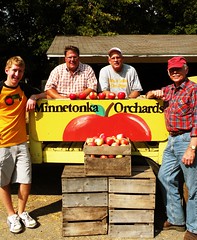 Next up, the patented, “managed variety” apple SweeTango®. I heard an interview with journalist John Seabrook at NPR, although unfortunately the New Yorker article that got him invited to talk about SweeTango® in the first place is not available for free. Among several fascinating elements in the story, I was struck by the control that the University of Minnesota is exercising over SweeTango®, which has its own website. Farmers cannot just sell direct to supermarkets or wholesalers. They have to sell back to a consortium established by the University, which aims to keep quality standards high. I wonder how much the University will make on the deal. I also wonder whether, like some of the DOC wines here, excess apples might be found for sale, unlabeled, at the side of a Minnesota county road. And it looks like there’s a lot more to Seabrook’s article than SweeTango®, about apples and apple breeding in general.