- “Beginning in the late 1990s, Kock travelled throughout Ontario collecting twigs of seemingly healthy mature elms, in what amounted to an elm dating service.”
- “…a curated inventory of miscellaneous interestingness” lands on the Millennium Seed Bank. Hilarity ensues.
- What do hopscotch, architecture and maize have in common?
- Zebras good for cattle.
- The fig deconstructed.
- “Improve yields through crop diversity…” ??? Who are these people?
- Crops for the Future bemoans the loss of “a spineless variety of Solanum quitoense.” Someone, somewhere must still have it, surely.
- Mangos: Haiti’s new best friend?
- Home-bred eggplants. Or aubergines.
- “Urban agriculture in Japan, cultivating sustainability and well being.” Again? Still?
- West Africa to get bunch of specialist biotechnology centres for crop improvement. No word on where the existing national genebanks fit in. Nor, ahem, what role IITA, ICRISAT and the other CGIAR Centres are going to play in all this.
Nibbles: Collecting, US heirlooms, Sequencing NUS, Nutrition strategies, Potatoes and climate change, Italian genetics
- NSF re-invents the genebank wheel. No, that’s unfair, they’ve given much-needed money to evolutionary scientists to go out and collect seeds of 34 species in a really pernickety way.
- Heirlooms being lost (maybe) and being re-found in the US. Thanks to Eve (on FB) for both.
- A Cape tomato by any other name…
- Gates Foundation has a new nutrition strategy. Gotta admire the chutzpah of summarizing the thing in basically half a side of A4. Compare and contrast, both as to content and presentation, with the CGIAR. Unfair again, I know, but that’s the kind of mood I’m in. Jess unavailable for comment.
- Very complicated, very pretty maps about potatoes and climate change.
- “I failed to notice substantial contributions to discussions or presentations from breeders or seed organizations, the end users of so much of the research discussed.” Pat Heslop Harrison calls ’em like he seems ’em.
Nibbles: Baobab, Plant cuttings & carnivalia, Apples, Fodder, Range management, PNG blog, Cattle breeding, Food security questions
- Baobab: your favourite nutritious neglected species for the next 10 seconds.
- Nigel Chaffey’s fresh selection of Plant Cuttings is up.
- Which reminds me; don’t forget to submit to Berry go Round.
- Searching for lost apples in the Scottish Highlands. A job for mountain rescue?
- Why feed my cow? A more interesting question than it seems.
- Rangeland scientists take photos of their study sites shock. Applications for crop wild relatives? Bound to be.
- Glad to give my friend Seniorl Anzu at NARI in PNG a plug for his new(ish) blog, PNG-Agrinews.
- Wageningen solves that cow burping problem.
- Cambridge says I see your cow burps and raise you food security.
Nibbles: Polyculture, Melons, Cheese 2011, Australian medicinals
- Do polycultures have a role in modern agriculture? Well, do they? h/t The Scientist Gardener.
- Texas breeders go for better melons.
- “Children from the city who try this yogurt don’t like it, but they’re not healthy like my children!”
- Hotspots for Aboriginal traditional medicinal plants mapped to within an inch of their lives, thanks to GBIF.
The price of hoes in Kenya
This post is not really about agricultural biodiversity, but I think it is worth stretching a point on some occasions. Take a look at the caption for this photograph. It’s the last in a gallery from The Guardian which goes with a nice write-up of what sounds like a very worthy Farm Africa project.
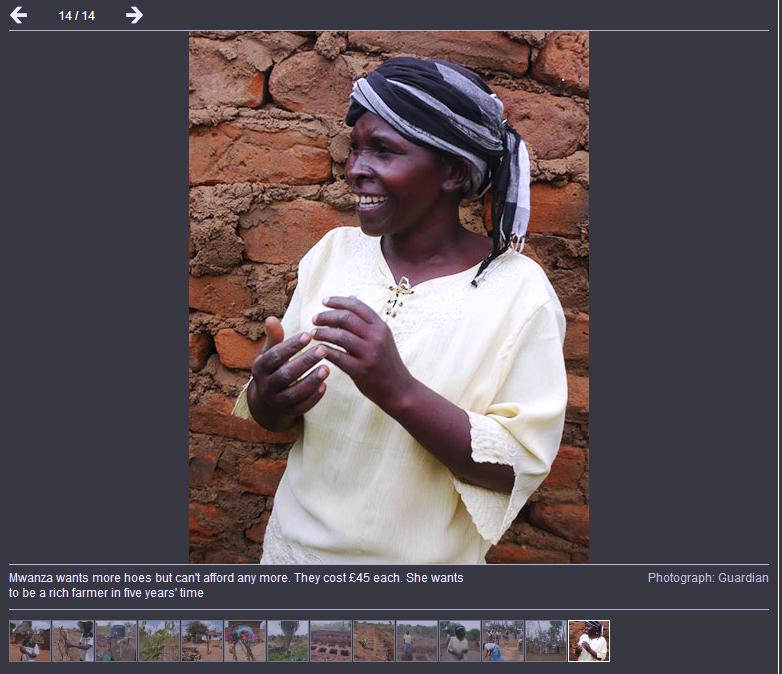
Forty-five pounds for a hoe? Forty-five pounds? I must say I’d missed that when I first went through the photos, but when Jeremy pointed it out I had to admit that seemed a bit steep for a hoe.
Well, is it just us? What do we know about the price of hoes in Kenya, right? Internal evidence in the article suggests that £45 is a lot of money, but a fair price for a hoe.
But low-tech can still be costly. Mwanza says she would like more hoes, but at £45 a hoe, it is far more than she can afford. The simple brick house she lives in with one of her children is no bigger than a small bedroom.
But googling comes up with a much cheaper price in Uganda:
“A hoe is a very cheap thing. It costs Shs 7,500 each and when I buy one it can last more than two years,” Nyakoojo said.
That would be about £1.70. And when the wife sent text messages to everyone she could think of in Kenya she got back figures closer to the Ugandan than The Guardian. A very fancy hoe goes for about KSh 1,200, or £8, we were told.
So what’s going on? Normally, I’d probably just dismiss it as a misplaced decimal point somewhere. Or perhaps a misunderstanding about what exactly the tool involved is. But it appears that this “hoe” is the weapon of choice in the Manichean fight against GMOs.
Small African farmers such as Mwanza stand on the frontline in the battle for higher productivity and agricultural development, a struggle being fought not with tractors and GM crops but with hoes, wheelbarrows and indigenous drought-resistant crops: cowpeas, pigeon peas, green grams, sorghum and millet.
So I think we should all be extra clear about what one costs. Starting with The Guardian. And the Gates Foundation.