- Bioversity promotes a fund-raiser for forgotten fruit trees.
- Seed crisis in Bangladesh. It’s complicated. Really complicated.
- Belatedly, mirthful report on mead.
- “…during the advent of agriculture … early farmers may have at first come together in communal activities, prior to congregating in villages.”
- USDA’s fruit genebank at Corvallis in the news.
How to give agrobiodiversity an even break
 Our friends at Bioversity have meta-done it again. After a milestone contribution a few years ago on the patterns of landrace diversity in farmers’ fields, now arrives a monumental review of the kinds of things that can be done to keep it there. 1 It comes as part of a special issue of Critical Reviews in Plant Sciences entitled “Towards a More Sustainable Agriculture.”
It’s a long and complex article and impossible to do full justice to here, but the motivation behind it is simple enough: “to understand better the nature and contribution of traditional varieties to the production strategies of rural communities … and the ways in which they are maintained and managed.” That landraces still make such a contribution, despite expectations to the contrary in many quarters, 2 is undeniable. As the authors admit, there is a lively ongoing debate about whether this can, or indeed should, continue. The superior adaptation of landraces to marginal conditions, the stability of their performance over time, the socio-economic conditions of small-scale farmers, and growing concerns about reducing agriculture’s dependence on inputs would all seem to point to a continuing, significant role in livelihoods strategies, at least in specific situations. But if so, why do they need help, as the authors also concede?
The problem is that lots of external factors work against landraces being all they can be, from dysfunctional seed systems to short-termist government policies. The diagram in Fig. 1 makes this clear (clearer still if you click on it):
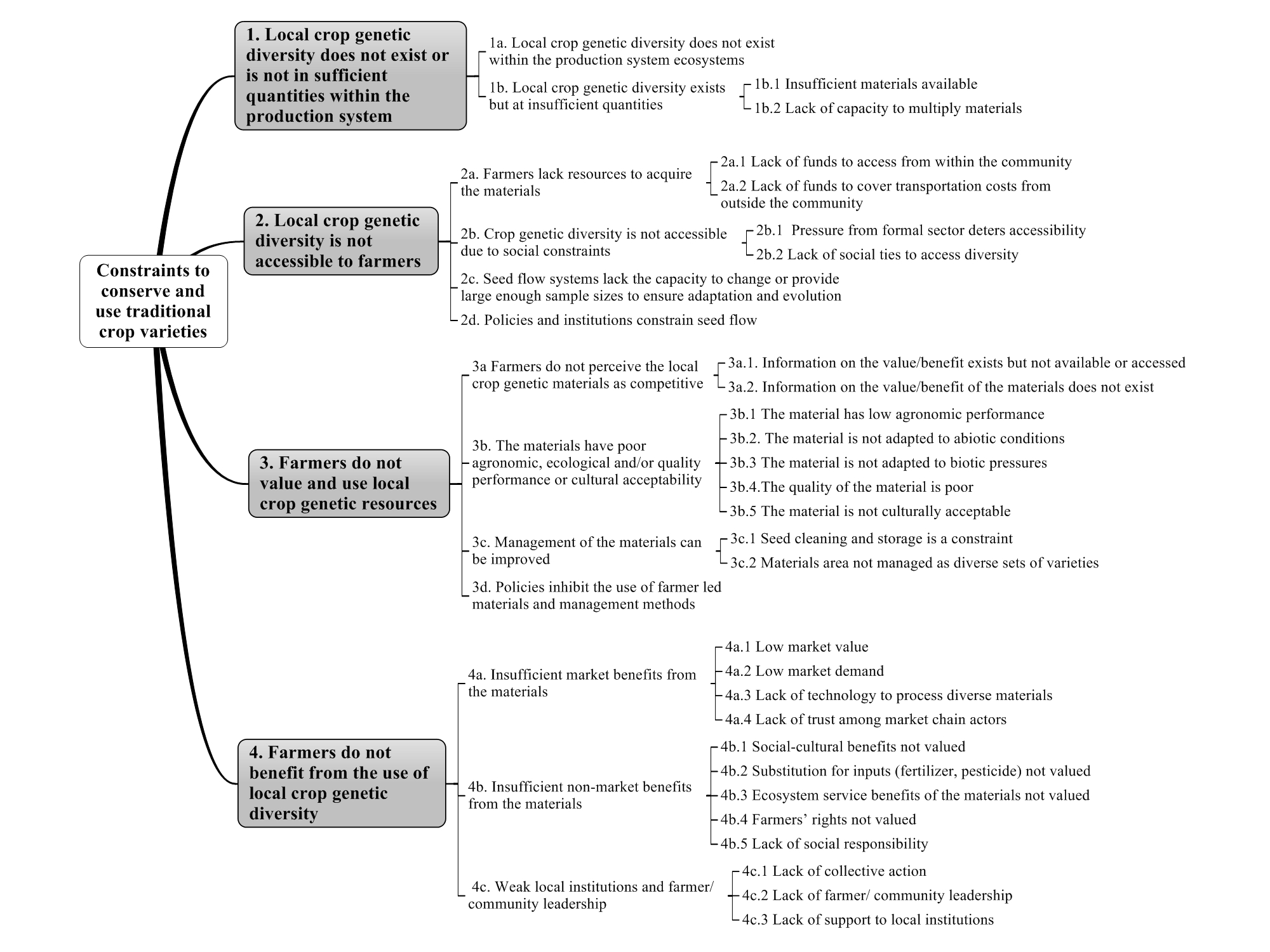
The paper is really about what can be done to make it a more even playing field for landraces, by overcoming these multitudinous constraints. To that end its centrepiece, Table 1, is a huge list of the sorts of specific actions that have been undertaken around the world over the years in support of landrace management on farm.
So, for example, re-introducing landraces from a genebank (be it international or community), based on local adaptation and farmer preferences, would address constraints 1a and 2a, which have to do with the lack of sufficient planting material. Getting breeding programmes to use more landraces and farmer selections would be great for 2d, 3a, 3b, 3c, 3d, 4a, 4b and 4c (which incidentally seems pretty good value for money). Enabling farmer groups to develop a marketing strategy for landrace products would take care of 3a, 4a and 4c. And so on, and on, for 16 pages. The list of potential interventions is nothing if not exhaustive, and each is in turn exhaustively documented with references.
This is, like the previous review, a tour-de-force. If anything is missing from the discussion, it is perhaps a sense of what the best bets might be. That is, having identified a particular constraint or set of constraints, what are the things that are likely to be most effective in different contexts, for different crops? For that, a rearrangement of Table 1 summarizing and prioritizing interventions for each constraint would have been a useful start. Thus, if you find specific constraint X, you can do A, B and C, and B is what has worked best in the past in similar situations. Another area that could have been explored in more detail is how interventions work — or fail to work — when implemented together. But all this would be no more that tinkering with the masses of data that have been put together, which is perhaps already going on in Bioversity’s Maccarese eyrie.
The next major analytical step, surely, is to work out, or document if the information is already available, what these interventions actually cost. That would allow some calculation of possible returns on investment. Whether, and to what extent, any of the things that are so comprehensively described in this paper are ever done on a large scale in support of landrace conservation and use on farm will probably in the end be down to that. After all, those pushing the “alternatives” have already done their sums.
Imagined nostalgia or invented future?
Strange to have two long articles surface over the weekend that in some respects negate one another and yet that both seem to point to a different future for food security. The Des Moines Register points not merely to perennial grains, a favourite topic here, but specifically to perennial maize. The piece is packed with all that one might expect, including a couple of doses of reality. Who will do the research?
Perennial crops … have little appeal to today’s agribusiness, including seed giants like Pioneer Hi-Bred and Monsanto.
“They depend on selling a lot of seed every year,” said Bill Beavis, interim director of Iowa State University’s Plant Sciences Institute. “I’m not sure the perennials ever catch up [sic] just because they don’t have the resources” in terms of research funding, he said.
What funding would it take?
The USDA has asked Congress for $1 million in fiscal 2012 for perennial grain or sunflower research at its own labs, a slight increase over this year’s funding. In 2009-10, the department provided about $1.5 million in grants for perennial grains research at the Land Institute and a few universities, including Iowa State.
A serious effort to breed perennial corn crops would require spending $1 million to $2 million for five years to identify the genes necessary for perennialism, [Ed Buckler, an Agriculture Department scientist at Cornell University in New York] said. After that, $10 million to $20 million a year and dozens of scientists would be needed to breed a perennial corn that could eventually be commercialized, he said.
One beauty of perennial grain crops would be that they don’t need ploughing. Does that mean, then, that the burgeoning hoof-power movement will lose traction? The benefits are many.
[A]s diesel prices skyrocket, some farmers who have rejected many of the past century’s advances in agriculture have found a renewed logic in draft power. Partisans argue that animals can be cheaper to board and feed than any tractor. They also run on the ultimate renewable resource: grass.
Ploughing, of course, is just a part of it. Aside from other tasks around the farm, those perennial grains will still need to be harvested and processed,
Some young farmers are developing a hybrid practice, using oxen to supplement, rather than replace, tractors. Some use them just to log and plow, while others have their teams haul machines with engines. Even this can be energy efficient.
“If you use animals to pull a motorized hay-baler,” Mr. Roosenberg [the founder of Tillers International, a 430-acre farm learning center in Scotts, Mich] said, “you can bale hay pretty fast with about one-third the gas.”
I remember reading, ages ago, about engineers who were working to give farmers in developing countries options to adapt efficient machinery so that it could be used with draft animals. It may have been something like this — I honestly don’t remember — and there seems to be lots of good information on draft animal power for farming at the website of the National Sustainable Agriculture Information Service in the US. And yet, at the Open Source Ecology movement, which aims to offer blueprints for 50 essential items needed “to build a sustainable civilization with modern comforts” I couldn’t see anything about better animal-powered agriculture.
Maybe it is all just a form of eco-dreaming sustainable agro-tourism that couldn’t possibly feed the world.
Nibbles: #Agchat, AGree, Tree genebank, Potato genebank
- Straws in the wind or portent of change? Why Farmers Are Embracing Social Media: the #AgChat Story
- Straws in the wind or portent of change? AGree (geddit?) Transforming Food and Ag Policy. See also Marion Nestle’s commentary and comments therein.
- More on the medicinal trees genebank in Nairobi.
- And just look at the new website of the International Potato Center genebank. Part of a complete makeover.
H.R. Clinton favours increased crop diversity shock
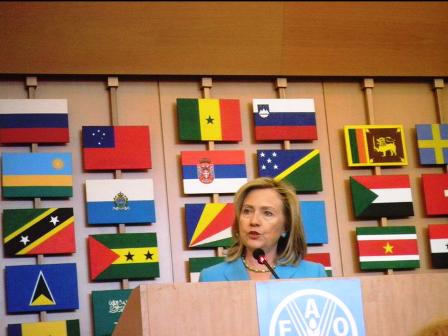
This just in from our colleague with the FAO building pass. (Photo hacked from IFAD’s Facebook page.
Just went and heard Hillary at FAO. She was brilliant and spoke very sensibly about food security.
She said we need higher quality seeds (more nutritious, more drought tolerant and disease resistant), we need to connect farmers to local markets and local markets to global markets. She also said we need to increase crop diversity!!
Hopefully the full transcript will be available on the FAO website at some point – she spoke very quickly!
She ended by saying that in spite of all the current headlines, she keeps her eye on the ‘trendlines’ and that we need to make advancing food security a cause for our time and deal with it now, or else we may never catch up.
LATER: Here’s the audio.