- Unlocking the genetic diversity of the undomesticated rice relative Oryza longistaminata. Natural hybrids discovered in IRRI genebank can accelerate breeding.
- Evidence for mid-Holocene rice domestication in the Americas. Another rice domestication?
- Evaluation and strategies of tolerance to water stress in Paspalum germplasm. A species for every purpose.
- Evaluation of Cassava Germplasm Accessions for High Tuber Yield and Starch Content for Industrial Exploitations. Watch Me681 take over. At least in India.
- Does intercropping enhance yield stability in arable crop production? A meta-analysis. Yes.
- Collection, Evaluation and Utilization of Cotton Germplasm. Over a thousand accessions!
- Treasure in the vault: The guardianship of ‘heritage’ seeds, fruit and vegetables. “Treasure” is a loaded term.
- Will the same ex situ protocols give similar results for closely related species? Yep.
- Global Hotspots of Conflict Risk between Food Security and Biodiversity Conservation. Madagascar is particularly worrying.
- Genetic diversity assessment of a set of introduced mung bean accessions (Vigna radiata L.). Germplasm from USDA genebank could be useful in China.
- Database of European chestnut cultivars and definition of a core collection using simple sequence repeats. Not sure you can call it European when 96 of 118 accessions are from Spain, but anyway.
- Genome of wild olive and the evolution of oil biosynthesis. Two genes explain all that oil…
- Did Greek colonisation bring olive growing to the north? An integrated archaeobotanical investigation of the spread of Olea europaea in Greece from the 7th to the 1st millennium BC. …which would have been intensely interesting to early Bronze Age elites.
- The draft genome of tropical fruit durian (Durio zibethinus). “Transcriptomic analysis showed upregulation of sulfur-, ethylene-, and lipid-related pathways in durian fruits.” You don’t say. Let’s engineer them into olives. Paleopolyploidizations here too, as in olives.
Brainfood: Hot seeds, Diet diversity double, Finger millet GxE, Botanical gardens, CWR prebreeding double, Pathogen spread, Dog genomics, Cryo calculations, Biodiversity & productivity double, Movies & conservation
- High-temperature stress during drying improves subsequent rice (Oryza sativa L.) seed longevity. Up to 45°C, because it triggers a stress protection mechanism.
- Agricultural diversification and dietary diversity: A feminist political ecology of the everyday experiences of landless and smallholder households in northern Ghana. Production diversity at the farm level is necessary for dietary diversity, but not sufficient.
- Critical review of the emerging research evidence on agricultural biodiversity, diet diversity, and nutritional status in low- and middle-income countries. Production diversity at the farm level has a small but consistent positive association with dietary diversity.
- Exploiting Genetic Diversity for Adaptation and Mitigation of Climate Change: A Case of Finger Millet in East Africa. Some varieties are good everywhere, others only good in some places.
- Ex situ conservation of plant diversity in the world’s botanic gardens. A third of all known plants, and half of endangered ones, are to be found in botanic gardens, but the tropics are under-represented.
- Prebreeding Using Wild Species for Genetic Enhancement of Grain Legumes at ICRISAT. It’s a drag, but someone has to do it.
- Wide crosses of durum wheat (Triticum durum Desf.) reveal good disease resistance, yield stability, and industrial quality across Mediterranean sites. Not such a drag after all.
- Quantifying airborne dispersal routes of pathogens over continents to safeguard global wheat supply. Incredibly fancy maths says Yemen is the key.
- Demographic history, selection and functional diversity of the canine genome. There’s a lot here, in particular the genes that were involved in early phenotypic differentiation from wolves, and evidence of continuous geneflow with wilds canids. But the thing that really got me is that humans and dogs show parallel evolution in the ability to process complex carbohydrates, associated with agriculture.
- Probabilistic viability calculations for cryopreserving vegetatively propagated collections in genebanks. One Excel spreadsheet to rule all cryo.
- Biodiversity effects in the wild are common and as strong as key drivers of productivity. Meta-analysis of observations in nature supports results of experimental work.
- Biodiversity promotes primary productivity and growing season lengthening at the landscape scale. “…a large species pool is important for adaption to climate change.” An example of the above.
- Considering connections between Hollywood and biodiversity conservation. Conservationists need to get out more.
Botanical gardens need to look to the tropics
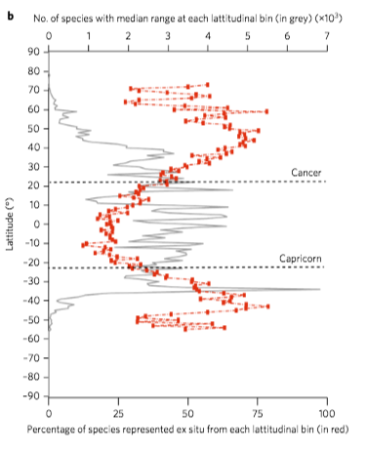 A monumental study of the plant species conserved in botanical gardens has just been published, and is getting quite a lot of traction in the media. The headline numbers are impressive: “botanic gardens manage at least 105,634 species, equating to 30% of all plant species diversity, and conserve over 41% of known threatened species.” It is worrying, however, that three quarters of the species that are absent from botanical gardens collections are tropical in origin. Lots of hot, sweaty work still do be done.
Nibbles: Millets galore, Human diversity & ag, Super farmers, Extinction is forever, Indian nutrition maps, Future Food competition, Banana viruses, Cassava in Brazil & Africa, Sugar book, Fairchild & Irma, Vegetable ROI, Embrapa beans, Certified coffee, Legal pot, Native American foods
- Today’s new genome is pearl millet. The most climate-smart of crops? Now, to process it more easily.
- Finger millet is not too bad either.
- Agriculture was good for human diversity, at least in Papua New Guinea. Elsewhere, maybe not so much.
- Julio Hancco Mamani grows 400 potato varieties up in the Andes (but how did it all start?). And Rahibai Soma Popere “15 varieties of rice, nine varieties of pigeon pea and sixty varieties of vegetables, besides many oil seeds” in Maharashtra.
- “West Bengal government encourages cultivation of extinct rice varieties.” Wait, what?
- Presumably not extinct like silphium.
- India’s first nutrition atlas will maybe tells us where more Rahibai Soma Poperes are most needed.
- Future Food includes seeds.
- Cleaning up bananas.
- Would love to have been on the “Brazilian Cassava Learning Journey.” Tanzania next?
- The bitter side of sugar.
- Fairchild Tropical Botanic Garden damaged by Irma.
- Research on vegetables really pays off, vegetable researchers say.
- Brazilian bean catalog launched.
- Certifying coffee seeds.
- Pot next?
- Closely followed by Navajo tea.
Brainfood: Baobab nutrition, New wild cucumber, Strawberry diversity, Sahelian threats, MTAs, CC & yields
- Nutritional variation in baobab (Adansonia digitata L.) fruit pulp and seeds based on Africa geographical regions. Malawi has the most nutritious types.
- A valid name for the Xishuangbanna gourd, a cucumber with carotene-rich fruits. Cucumis sativus L. var. xishuangbannanensis Qi & Yuan ex S.S.Renner, var. nov., if you must know.
- Population genetic analysis of a global collection of Fragaria vesca using microsatellite markers. The Icelandic are different from the other European populatons.
- Spatially explicit multi-threat assessment of food tree species in Burkina Faso: A fine-scale approach. All species threatened everywhere, but especially by climate change.
- Use and Misuse of Material Transfer Agreements: Lessons in Proportionality from Research, Repositories, and Litigation. Horses for courses.
- Temperature increase reduces global yields of major crops in four independent estimates. “Without CO2 fertilization, effective adaptation, and genetic improvement, each degree-Celsius increase in global mean temperature would, on average, reduce global yields of wheat by 6.0%, rice by 3.2%, maize by 7.4%, and soybean by 3.1%.”