- Species flying poleward.
- FAO unveils pulse infographic. No word on whether any are harvestable by machine.
- Potato farmer adds value the old-fashioned way.
- Talking of old, here’s a really old horse.
- And the oldest evidence of fermentation for food preservation. But you’ll need a strong stomach.
- KitKat is certified crap.
- How (and Why) Farmers Maintain Crop Diversity: The Book. Some reviews.
- And here’s a specific example from India.
- And here, courtesy of Bioversity’s Ann Tutwiler, is why farmers need some help sometimes.
- Oh and here’s another one. People visit ICRISAT genebank in Niger, see stuff they like.
Rebuilding the ICARDA collection
You’ll probably remember this statement four months ago from ICARDA’s Director General, Dr Mahmoud Solh. It was, after all, everywhere:
ICARDA requested some of its stored material in Svalbard in order to reconstitute the active collection in both Morocco and Lebanon in large bulks to meet requests for germplasm from the collections we have to meet the challenges facing dry areas globally. Once we multiply these varieties, ICARDA will return part of it to Svalbard as another duplicated set.
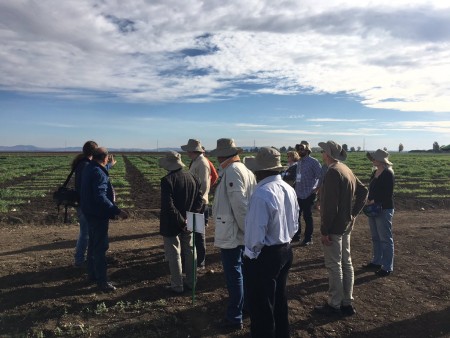
The seeds were duly retrieved by ICARDA genebank staff, and the work of multiplication is now in full swing, in both Morocco and Lebanon. Here’s the evidence, thanks to a picture tweeted by ICARDA durum wheat breeder Dr Filippo Bassi earlier today:
Nibbles: History edition
- No, I don’t think the history of potatoes is at an end, but I know what they mean.
- The history of rubber in pics.
- The history of the wheat dwarfing gene.
- Svalbard makes history.
- Sicily goes back into its history for its daily bread.
- Another foothold in history for Gary Nabhan.
- History, shmistory, we need to look forward. Biohacking is the future of food. Say twelve year olds.
Brainfood: Animal genomics, Konjac diversity, New wild cassava, New wild cowpeas, Saline breeding, Land sparing, Sorghum diversity
- The impact of whole genome sequence data to prioritise animals for genetic diversity conservation. Relationships from whole genome sequence data were better than SNPs at preserving rare variants when selecting individuals for inclusion in a genebank.
- Genetic variation in wild populations of the tuber crop Amorphophallus konjac (Araceae) in central China as revealed by AFLP markers. Diverse, endangered, somewhat isolated populations, with some geographic structuring.
- Manihot allemii sp. nov. (Euphorbiaceae s.s.) with entire and unlobed leaves from northern Brazil, with notes about foliar anatomy. It never ends.
- Novel Genetic Resources in the Genus Vigna Unveiled from Gene Bank Accessions. Japan sorts out its genebank. It really does never end.
- Uncoupling of sodium and chloride to assist breeding for salinity tolerance in crops. We’ve been breeding for exclusion of Na+, but we should be breeding for tolerance to it.
- How can higher-yield farming help to spare nature? By making sure that lower prices and/or higher profits don’t encourage agricultural expansion.
- Seed exchange networks, ethnicity, and sorghum diversity. Culture drives diversity.
Brainfood: Lima bean cyanide, Hybrid powdery mildew, Amaranth core, Cotton core, Tibetan sheep, Water buffalo history
- Herbivore damage induces a transgenerational increase of cyanogenesis in wild lima bean (Phaseolus lunatus). Lamarck lives.
- Hybridization of powdery mildew strains gives rise to pathogens on novel agricultural crop species. Hybrid crop gives rise to hybrid pathogen.
- Trait-specific Amaranth Germplasm—Potentialities to Combat Climate Change. From 5,804 accessions to 623 really useful ones.
- Genetic diversity of the two commercial tetraploid cotton species in the Gossypium Diversity Reference Set. 100 SSRs on 2000 accessions yield really confusing results.
- Genetic diversity estimates point to immediate efforts for conserving the endangered Tibetan sheep of India. Only 250 individuals, but still some genetic diversity. But for how long?
- Water Buffalo Genomic Diversity and Post-Domestication Migration Routes. Two domestications, and some unexpected migration routes.