Too busy to go through the latest IPCC report and extract the nuggets relevant to agriculture (including crop wild relatives)? Fear not, we’re not. Here’s three figures which pretty much tell the story, and the relevant bits of text from the report to go with them. There’s lots of commentary and opinion out there on the report. We thought you’d like to hear it straight.
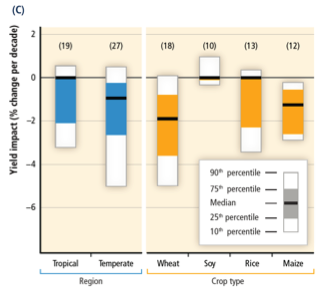
Based on many studies covering a wide range of regions and crops, negative impacts of climate change on crop yields have been more common than positive impacts (high confidence). The smaller number of studies showing positive impacts relate mainly to high-latitude regions, though it is not yet clear whether the balance of impacts has been negative or positive in these regions (high confidence). Climate change has negatively affected wheat and maize yields for many regions and in the global aggregate (medium confidence). Effects on rice and soybean yield have been smaller in major production regions and globally, with a median change of zero across all available data, which are fewer for soy compared to the other crops. Observed impacts relate mainly to production aspects of food security rather than access or other components of food security. See Figure SPM.2C. Since AR4, several periods of rapid food and cereal price increases following climate extremes in key producing regions indicate a sensitivity of current markets to climate extremes among other factors (medium confidence).
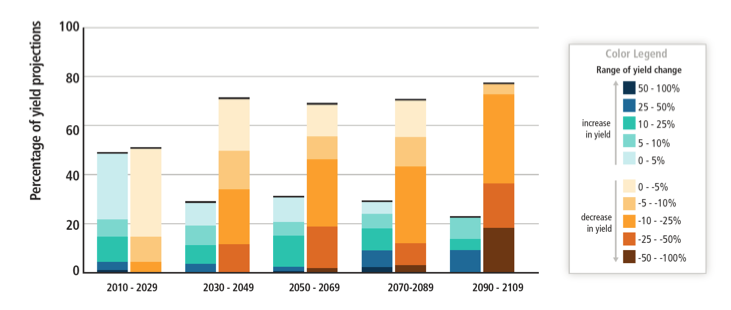
For the major crops (wheat, rice, and maize) in tropical and temperate regions, climate change without adaptation is projected to negatively impact production for local temperature increases of 2°C or more above late-20th-century levels, although individual locations may benefit (medium confidence). Projected impacts vary across crops and regions and adaptation scenarios, with about 10% of projections for the period 2030-2049 showing yield gains of more than 10%, and about 10% of projections showing yield losses of more than 25%, compared to the late 20th century. After 2050 the risk of more severe yield impacts increases and depends on the level of warming. See Figure SPM.7. Climate change is projected to progressively increase inter-annual variability of crop yields in many regions. These projected impacts will occur in the context of rapidly rising crop demand.
All aspects of food security are potentially affected by climate change, including food access, utilization, and price stability (high confidence). Redistribution of marine fisheries catch potential towards higher latitudes poses risk of reduced supplies, income, and employment in tropical countries, with potential implications for food security (medium confidence). Global temperature increases of ~4°C or more above late-20th-century levels, combined with increasing food demand, would pose large risks to food security globally and regionally (high confidence). Risks to food security are generally greater in low-latitude areas.
Distribution of impacts: Risks are unevenly distributed and are generally greater for disadvantaged people and communities in countries at all levels of development. Risks are already moderate because of regionally differentiated climate-change impacts on crop production in particular (medium to high confidence). Based on projected decreases in regional crop yields and water availability, risks of unevenly distributed impacts are high for additional warming above 2°C (medium confidence).
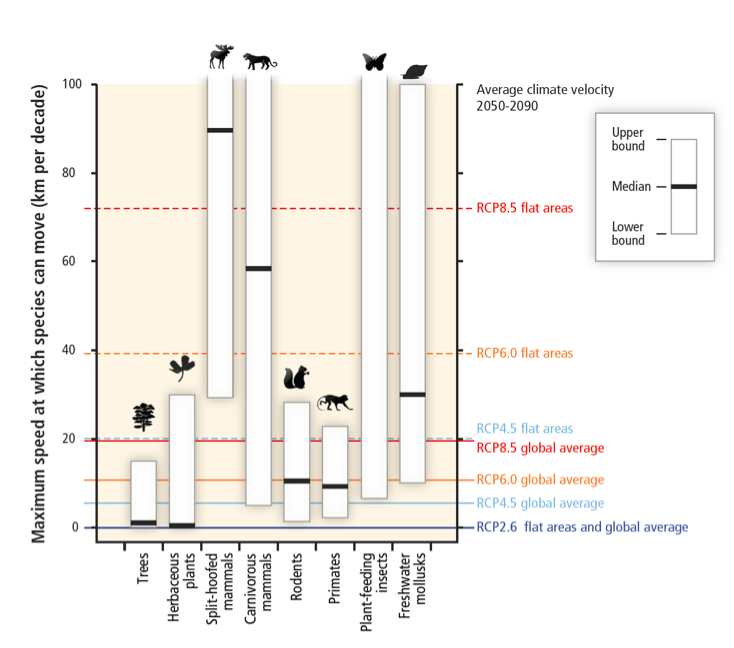
Within this century, magnitudes and rates of climate change associated with medium- to high-emission scenarios (RCP4.5, 6.0, and 8.5) pose high risk of abrupt and irreversible regional-scale change in the composition, structure, and function of terrestrial and freshwater ecosystems, including wetlands (medium confidence). Examples that could lead to substantial impact on climate are the boreal-tundra Arctic system (medium confidence) and the Amazon forest (low confidence). Carbon stored in the terrestrial biosphere (e.g., in peatlands, permafrost, and forests) is susceptible to loss to the atmosphere as a result of climate change, deforestation, and ecosystem degradation (high confidence). Increased tree mortality and associated forest dieback is projected to occur in many regions over the 21st century, due to increased temperatures and drought (medium confidence). Forest dieback poses risks for carbon storage, biodiversity, wood production, water quality, amenity, and economic activity.