- Diversity protects against pests and diseases, especially when it is needed most.
- Amateur enthusiast cracks chicory biodiversity.
- Conservation Agriculture With Trees; it’s the new big thing in Africa.
- Saving the last orange grove in Orange County from destruction.
- Shepherds of the world; a slideshow from The Guardian.
- And — Oh Boy! — you can jump through some hoops to get a newsletter on the International Treaty of Plant Genetic Reso0urces for Food and Agriculture.
Nibble: South Sudan seed fair, Seed cinema, Dandelion diversity, Nature’s value graphic, Cocaine synthesis, Livestock farming, Visualizing conservation trade-offs, Vertical farms, Sequence fungi
- A seed fair in South Sudan. Good idea, but why only certified seed?
- Maybe they should watch Seeds of Freedom. Well, maybe.
- Genetic diversity is important! Settle down, we’re talking dandelions.
- Nature’s value includes crops. Phew. Dandelion is a crop, isn’t it?
- Talking about value… She don’t lie, she don’t lie, she don’t lie…
- And again. Award-winning research on livestock farming’s value to developing countries. And its dark side.
- Both of which could of course be usefully visualized by the people involved.
- Vizualise this! Nightmare skyscraping vertical farms, for real.
- Today’s jetpack request comes from Sophien Kamoun, stimulated by ravishing fungi.
Nibbles: Aquatic mapping, Biofortified millet, Indian agriculture, African agriculture, Restoration, Online flora, Farm Bill, Right to Food, Elk farming, Forestry fellowship, Breadfruit, Foods and climate change
- OBIS maps marine organisms. But does it include this data from China?
- Private sector delivers biofortified millet. But will it make it to the wiki for Indian agriculture?
- New paper by APRODEV and PELUM on why CAADP should follow IAASTD. Glossary not included. And more on African agriculture from Gates. Not like this, though.
- Millennium Seed Bank in ecosystem restoration. And a study on ecosystems that are actually going to require less restoration than others.
- Monsanto supports online world flora. What could possibly go wrong? Meanwhile, in the public sector…
- Olivier de Schutter’s recent Right to Food shpiel for IFPRI. LOTS of words. I guess you had to be there.
- Small-scale elk farming primer. Not as crazy as it sounds, but pretty crazy.
- And if you’re a young scientist, from sub-Saharan Africa, and interested in forest genetic resources, well, here’s a fine forestry fellowship opportunity.
- The Bounty Redux. The whole bringing-breadfruit-to-the Caribbean thing seems to be going more smoothly this time.
- Huffington slideshow on the world’s endangered foods.
Mashing up the Global Forest Disturbance Alert System
So here’s how I’d like that Global Forest Disturbance Alert System I blogged about a couple of day ago to work, eventually. Or even this. Or this, for that matter.
But anyway. Say you’re reading about rattans in West Africa and you get interested in, say, Eremospatha barendii, which is kind of rare and probably perhaps sort of endangered, maybe. So you head on over to GBIF to get a better idea of its geographic distribution, but you come up blank. But then you do some more digging and you realize that there’s a new taxonomic revision, describing in minute detail the morphology and ecology of all the African species, with nice drawings and lists of specimens and identification keys. 1 And, by golly, it has pretty maps too.
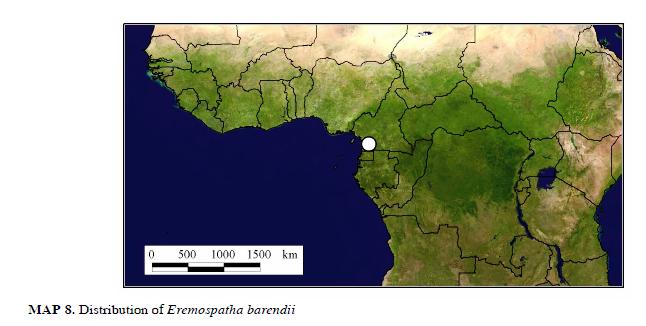
Pretty, but unusable. The damn things are in a PDF, not the nice Google Earth files you would have got from GBIF. But the coordinates of all the specimens 2 are given in the text, so you extract them from the PDF and plonk them into Google Maps. It’s the little green arrow in southern Cameroon shown below.
But you also want to know to what extent that area is threatened. So you head on over to the Global Forest Disturbance Alert System and you look at the latest data on where there is forest disturbance happening in Cameroon, which are the little red dots here.
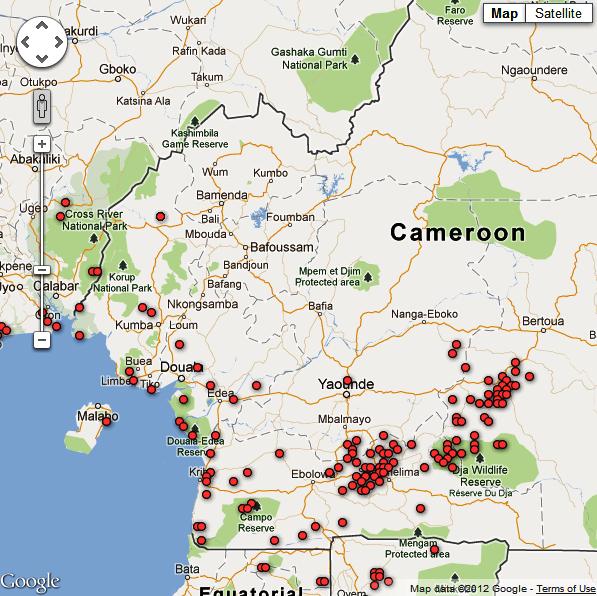
Now you can see if that population of yours is perhaps threatened. Well no, you can’t do that now, not easily, because there’s no way to export the little red dots to Google Maps, or import the little green arrow into the Global Forest Disturbance Alert System. But I’m sure you will be able to do that one day. And then you could actually visit 3.066667 N 10.716667 E, and check out that Eremospatha barendii population, assuming it is still there, what with you spending so long mashing up the data and all, and also ground-truth any disturbance that the Global Forest Disturbance Alert System might have, er, alerted you to; maybe even describe its causes. And annotate the little green arrow and the little red dots with your observations.
Wouldn’t that be nice?
Nibbles: Maize genome, Mapping plants in the US, Sixth extinction, Finding species, Korean dog, IUCN guidelines, Ginkgo evolution, Churro sheep, Malaysian trees, Nutrition training
- Maize diversity sliced and diced to within an inch of its life.
- Mapping invasives sometimes = mapping crop wild relatives. Compare and contrast.
- Red List hits 20,000 species.
- And yet we keep finding new ones, even in Europe.
- Reconstructing a Korean dog breed.
- You too can help IUCN with its genebank guidelines.
- Video history of ginkgos. “Are we watching them as they evolve, or are they watching us?”
- Video history of Navajo sheep. Touching.
- Malaysian forest tree genebank at work. Any ginkgos in it?
- Hurry! You have 2 days to apply for a Training course on Food Systems: From Agronomy to Human Health, in Benin.