- Genetic diversity in European men and one of the organisms they exploit. And another.
- CIAT cassava entomologist rings warning bell.
- ILRI boffins point out why they don’t have enough money. Yeah, but what’s to be done about it?
- Malnutrition in Kenya and Guatemala. Are school gardens an/the answer? FAO thinks so.
A tale of genetic erosion narrowly averted
What causes genetic erosion? People in our business are way too fond of making lists of all the things that can possibly lead to a farmer abandoning a variety. But sometimes it’s just down to an accident. Take my mother-in-law. Please. No, but seriously, this is an interesting example of the law of unintended consequences. Bear with me. The mother-in-law grows some hybrid maize on her spread in the Limuru highlands of Kenya. Here she is with a bag of the stuff, which she likes, despite the recurrent cost, because of the large cobs.

But she also grows a local landrace which she says goes back to before independence. It doesn’t yield as much, but it has thick juicy stems, and she needs that for her cows. So she grows both the hybrid and the landrace, not mixed up in the same field, but often side by side. Would be interesting to look at the geneflow that’s been happening up there over the years, but that’s not the point of this story.
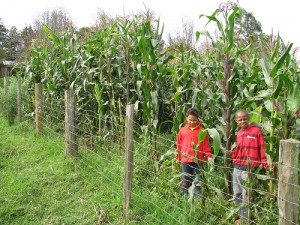 The point of the story is in fact that she almost lost the landrace recently. What happened is that last year she came to visit us in Rome for a few months, and left the farm in the otherwise quite capable hands of her daughter-in-law. Problem is, Violet, unaware of the preciousness of the landrace seed, went and fed most of it to the family. Fortunately, a handful or so survived, and quickly went into the ground for multiplication when grandma returned. You can see it here above. A close-run thing indeed. She says she would have been very upset if she had lost that seed, and asked me whether I could get it into Svalbard. After all, is that not my boss holding some seeds in front of the Vault? Well, yes, but…
Nibbles: Kiss apple, Cryptic variation, Brewing yeast history, Sandalwood genebank, Large chile, Red dye, Grassland, Fish eco-labeling, Radiation
- Koreans breed bite-sized apple for breath-freshening. Why can’t I find a picture?
- Climate change bad for genetic diversity too. Tell that to taro in Cameroon.
- Lager yeast came from South America. Thank you, Argentina! And more on long-distance microbe movement.
- Field Gene Bank of Threatened Plants from the Western Ghats threatened.
- Man’s 16-inch chili may be a record. Get your mind out of the gutter.
- The source of Turkish Red.
- “The proper use of native grasslands is to use them as grasslands…”
- Something fishy about eco-labeling.
- Japanese boffins trying to breed radiation-tolerant rice. Maybe they should look at this map in their search for parents for their crossing programme.
Nibbles: Mongolian pastoralists, Kenya pastoralists, UK meadows, Specialty crops, Adaptation
- And we’re back: Desertification threatening Mongolia. Will Biden talk about that on his 6-hour visit today? No, I don’t think so either. Fortunately some people are trying to do something.
- Life not great for pastoralists in Kenya either. But some people are looking to camel milk to see them through. Alas, the latest effort to boost food security research in E. Africa doesn’t have much for livestock-keepers.
- Kew tries to reform UK native grassland seed business. Hope they are taking latest figures on species migration speeds into account.
- Specialty Crops for Pacific Islands book out. Alas, it includes coffee.
- But don’t worry, adapting to climate change is easy.
Nibbles: Pests & Diseases, Nutrition Actions, Famine, GM Maize, Breeding, More breeding, India’s monsoon, Vegetable undernutrition
- Need a new pest or disease? Here’s the latest list from CAB Abstracts.
- WHO’s e-Library of Evidence for Nutrition Actions. No food, as such, that I could see.
- Is “famine” partly the result of a fixation on maize?
- Nah, course not. At least, I think not … “Drought persuades Kenya to import GM maize“.
- CIAT and partners toast new BREAD project. (FX: Groan.) It’s about breeding cassava and banana.
- Plant Breeders Without Borders. Read more here. Could do with a snappier title, I reckon.
- India’s long-range weather forecast looks bad.
- Modern vegetables are less nutritious.