Really, who’d be a livestock keeper these days? In Mongolia, Russia, or Pakistan.
LATE: Ok, maybe in Canada?
Agricultural Biodiversity Weblog
Crops, livestock, microbes, pollinators, wild relatives, agroecosystems, foodways …
Absolutely nothing material has changed in the circumstances surrounding the possible destruction of the Pavlovsk Experiment Station, which we first blogged about in April. The hearing date — when courts will decide whether the land should be bulldozed to make way for private houses, destroying the world’s largest genebank of fruits and berries — has come closer, of course. It is scheduled for 11 August, next Wednesday. And this morning the Global Crop Diversity Trust put out a new press release highlighting the imminent court case and adding to its public campaign to persuade the Russian Bear that berries are better than bungalows.
So, naturally, Pavlovsk is now in the news, for The Economist blogs, the BBC, Agence France Press, the NYT blogs, Bioversity International and bits of the blogosphere.
My absolute favourite bit of the stories is this quote from the Trust’s Press Release:
In a bit of Kafkaesque logic, the property developers maintain that because it contains a “priceless collection,” no monetary value can be assigned to Pavlovsk Station, so, therefore, it is essentially worthless. Furthermore, the Federal Fund of Residential Real Estate Development has argued that the collection was never officially registered and thus it does not officially exist.
Against this level of sophistry, what hope can mere letters, tweets and petition signatures have? Having said which, it would be nice to pleasantly surprised on Wednesday, or shortly thereafter. 1
The BBC’s story echoes a point made by Sergey Alexanian of the Vavilov Institute, that as the land is for sale, one way to save the collection would be for the Vavilov Institute to simply buy the sites.
“It’s a huge amount of money,” [Alexanian] said. “Right now, it’s not the best time for the Russian science, financially speaking, so buying it would be ideal – but it’s impossible.”
How about one of those newly-minted philanthrocapitalists making the impossible possible?
One final point. Many people out there are referring to Pavlovsk as a seed bank. This is not quite the whole truth. It is a field genebank, in which almost all the varieties are stored as living plants in the ground. This is necessary because most of the varieties do not breed true from seed. So the only way to maintain the varieties is as plants. Seeds would store the entire genetic diversity of the population, it is true, and could be easily moved, but seeds cannot be used to regenerate the specific package of associated genes that makes up a variety. It is those varieties that have been studied and characterized over the decades at Pavlovsk. It is the studies and the varieties to which they are attached that make the collection so important.
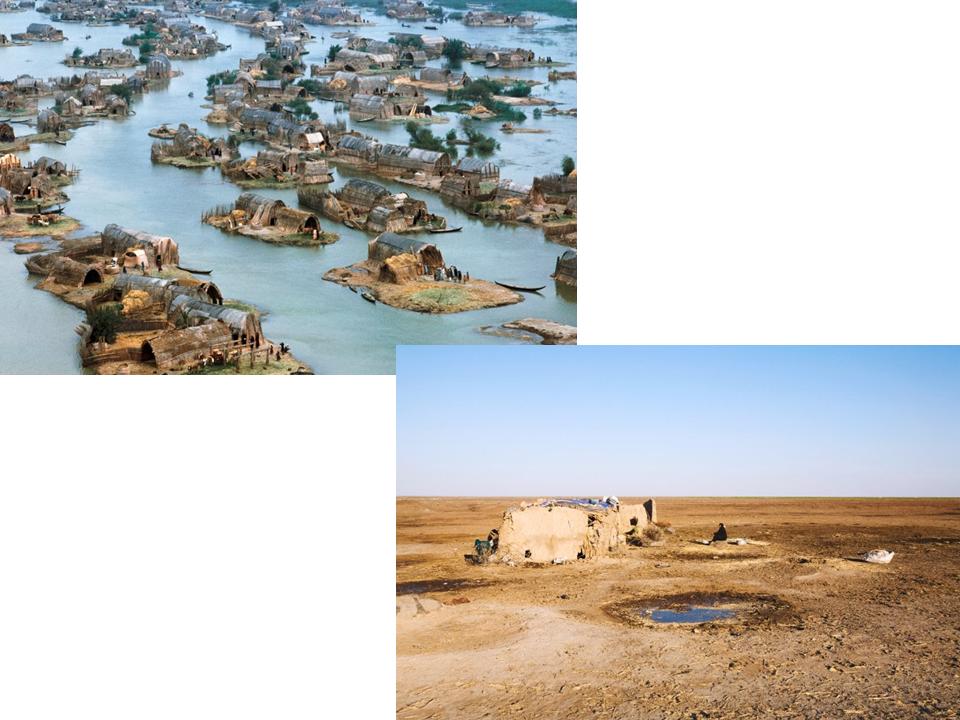
We blogged over a year ago about the re-flooding of the Iraqi marshes, but fairly briefly, and it’s great to see a long piece about this restoration process in Der Spiegel today. The slideshow which accompanies the article provides the best visual summary I’ve seen of what happened to the marshes — and their inhabitants, with their crops and livestock. I’ve put the “before” and “after” shots side-by-side below:
Apart from its inherent interest, the Der Spiegel article also gives me the excuse to mention that a detailed map of the world’s river systems has just been made available, by Bernhard Lehner at McGill University in Montréal, Canada. Is anyone keeping track of the proliferation of such global geographic dataset? Google? ESRI? The CGIAR’s Spatial Information Conundrum? Anyone?