- Adam Forbes updates us on his travels in Ethiopia and Peru in search of seeds. Check out his pix too.
- “…sea cucumber populations across the globe, from Asia to the Galapagos, are increasingly in trouble.” Oh dear.
- Satellites help reindeer herders by looking for snow melt. Sounds very cost-effective.
- IFPRI says agriculture will be “dramatically” affected by climate change. Oh dear.
- Keeping bees in cities.
- All you ever wanted to know about taro diseases. With pic goodness! Via.
- Walking London’s markets.
- Navarre: “276 varieties of autochthonous apple tree have been described.”
Agrobiodiversity stays in Vegas
From Jacob van Etten, our Man on the Strip.
The Association of American Geographers held its annual meeting this week in Las Vegas, of all places. I went there to participate in a series of sessions of agrobiodiversity. Last year these sessions had been very successful, according to others, and this year there were three of them. The mandarins of US social research on agrobiodiversity were there, as well as a crew of Young Turks with interesting new studies.
The sessions were kicked off with two talks about the importance of agricultural geography (Kimberlee Chambers) and the contributions that the discipline and related ones have made to understanding agrobiodiversity (Karl Zimmerer). Laura Lewis explained that crops don’t produce systematically more outside their cradle area. There is a theory that says that crops can escape from co-evolved enemies and diseases when brought to other environments. Laura worked out the statistics. Well, it’s not so simple: some crops produce more, some produce less.
In a second session, the good old CGIAR was very well represented. Yours truly explained ongoing work on improving the geographical aspects of genebank databasing and identifying geographical gaps in collections. I also talked about exciting new modeling techniques that can be used for crop genetic diversity work. I got very a positive response from the audience. Keyu Bai explained how Bioversity uses GIS to target genetic resource management interventions in Asia to specific communities to achieve impact.
Matthew Hufford from Davis showed his findings from the field on teosinte in Mexico, a wild relative of maize. He had cool maps on the genetic structure of teosinte and explained why barriers to gene flow occurred. He then addressed one possible gap in genebank collections: the Road Bias. He explained, however, that with a few samples near the road he captured almost all the diversity present. So the “asphalt eater strategy” to germplasm collection may not be so bad after all. Matthew also cited Garrison Wilkes’ call for in situ conservation initiatives for teosinte. Wilkes expects that teosinte will go extinct fairly soon. Matthew pointed out the difficulties to conserve teosinte in the changing landscapes of Mexico. One reason is that teosinte is a noxious weed. He talked with a farmer, however, who thought that teosinte introgression into maize made it mas fuerte — stronger. Perhaps in situ conservation should be done by massively introgressing teosinte into maize, one participant candidly suggested.
Leah Samberg’s talk in the third session had beautiful photographs of Ethiopian landscapes. She pointed out how farmers in one part of Ethiopia get a lot of their barley seeds from different markets, yet mostly from people from the same area and not from the long-distance traders. Studying the circulation of seeds in markets should give exciting new insights in the geography of plant genetic resources. Kraig Kraft used word clouds to communicate some insights in pepper production and diversity in Mexico. For some reason, dried peppers tend to be traditional, but fresh peppers are all hybrids in Aguascalientes, Mexico. Kraig is going to find out why for us. Steve Brush presented the work of one of his students on tortillas in Mexico. One salient aspect is the amount of wood used to make them and the health problems the smoke produced by wood burning causes.
In another session on the Green Revolution, someone said that agricultural geography has suddenly become “hip and coolâ€. It has always been, of course.
Not at all scary
“We don’t want to suggest that the sky is falling, but major losses could occur if the right set of conditions converges,” Mundt said. “This is something that we shouldn’t take a chance on. It’s already spread to Iran, and the new research shows that its global spread may be about to pick up speed.”
Scientists have been studying the spread of airborne diseases, like UG99 rust disease of wheat.
Should we stay in darkness?
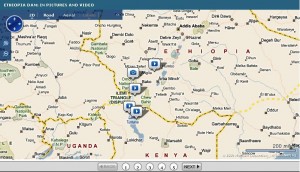
The Gibe III dam on the Omo River in southern Ethiopia will be the tallest of its kind in the world. It will generate a lot of much-needed electricity, but there are fears for its impact on the environment and (agro)biodiversity, and on the pastoralist and fishing lifeways of the peoples living downstream of it. Richard Leakey has come out forcefully against the project. The BBC puts it all beautifully in context on a map.
Saving an apple a day
The Renewing America’s Food Traditions alliance organized a Forgotten Fruits Summit on March 19th at the University of Wisconsin Arboretum, Madison. According to Gary Nabhan, it was
…the first full gathering of America’s most accomplished back-country fruit explorers, veteran orchard-keepers, horticultural historians, pomological propagators, natural-born nurserymen and hard cider-makers concerned with the destiny of Malus x domestica, the single fruit most imbedded in the American identity.
The scary numbers:
- There were once 14,000 named varieties in American nurseries.
- Only some 1500 remain.
- 30 fruit nurseries are lost every year, since the late 1980’s.
Gary Nabhan and Jenny Trotter’s Forgotten Fruits Manual & Manifesto – Apples, which sets out “a plan of action to restore apple diversity to our farms, backyard orchards, restaurants and home tables” was on the table for discussion, and one of the objectives of the gathering was to develop “a strategy to assist those individuals who are doing the most to preserve American apple heritage.” The Manifesto is a very sensible mix of in situ and ex situ, NGO and government, private and public sector, young and old.
It will be interesting to see what the final strategy looks like, and to what extent it will be applicable elsewhere around the apple world. Gary does provide some hints about the direction the discussion took on his blog:
This spring, one of our honored participants, Creighton Lee Calhoun, will teach a workshop entitled “Grafting for the Future” from which each of the students will take home a tree grafted from one of the 400 varieties growing in the Southern Heritage Apple Orchard at Horne Creek Living Historic Farm near Pinnacle, North Carolina. On March 19th at Harvest Restaurant, founded by Chef Tami Lax in downtown Madison, we sampled some of the first world class hard ciders to come out of the new cideries flourishing in Great Lakes region, many of which are using heirloom apples that had once lost their markets. And we mentored a new generation of urban tree farmers and permaculturists that are bringing apples back to inner city landscapes that had altogether lost them over the last century.
I hadn’t come across the term hard cider before but it just means the alcoholic kind. Sounds like a fun meeting.