Shepherds and their flocks trek through Europe

Evelyn Mathias of the League for Pastoral Peoples and Endogenous Livestock Development just posted an interesting piece on DAD-Net. Unfortunately I was not able to find a web page to link to, so I take the liberty of reproducing the post in full here.

They are good-natured, produce tasty meat, and their wool gets turned into sweaters. Everyone knows so much about sheep. But few people know about the benefits that sheep provide through grazing. As they move from place to place, mobile flocks maintain the ecology, so conserving many threatened plants, animals and insects. The landscapes they create enhance the quality of life for local people and tourists alike.

Grassland that has been extensively grazed in a controlled way is an excellent water filter. It protects the soil from wind and water erosion, stores a huge amount of carbon, and converts carbon dioxide into oxygen in winter when trees no longer have leaves.

But grassland must be maintained through grazing – otherwise it will be overrun with brambles and scrub, which lack many of the advantages of grasses. Mobile flocks of sheep are an important way to conserve these landscapes.

To raise awareness of the advantages of mobile livestock production, Europe’s shepherds have organized a sheep trek across Germany, Belgium and the Netherlands during the summer of 2010. The trek aims to draw attention to the contribution that mobile herding makes.

“Shepherds all over the world face similar problems”, says Günther Czerkus, spokesman for the German shepherds association. “Too much bureaucracy, and an increasing number of restrictions that make it more and more difficult to maintain a mobile herd.”

Shepherds in Europe also find it difficult to market their products. Wool prices are so low that it is not profitable to shear the sheep. And the market for meat is dominated by imports from New Zealand. Czerkus hopes that the trek will encourage consumers to buy home-grown lamb.

The trek will start in Berlin on 5 June and end at the “Green Land Day” (Grünlandtag) in Trier on 16-17 October. The trek will be a kind of a relay walk, with each flock and shepherd covering a certain distance and then handing over to another flock for the next stage. Accompanying vehicles will manage traffic and distribute information materials.

Special events in Paderborn (1 August), Duisburg (21 August), Brussels (16 September) and Trier (17 October) will highlight the contributions of sheep. Other events may be organized through hout the trek. The trek will provide excellent opportunities for school classes to learn about agriculture and ecology in general, and mobile herding in particular.

A similar but smaller trek took place in Belgium in 2008. The webpage from this earlier trek gives an idea of what a trek might look like.
Nairobi’s International Day of Biodiversity in pictures

Taz, who describes himself on his blog as a Kenyan science writer, was at the National Museums of Kenya on the occasion of the International Day for Biodiversity, and he kindly left a comment to that effect on our short post on that subject. His own description of the event includes some great photos. Any other reports, from Nairobi and elsewhere?

LATER: Susan MacMillan of ILRI also has some photos from the Nairobi celebrations on her Facebook page.

The Three-hundred-variety mango of Malihabad

Another reflection on a remarkable Indian mango tree from our friend Bhuwon Sthapit of Bioversity International.

It is hard to believe that a farmer can have as a hobby the grafting of multiple varietal scions of interesting and unique mango diversity on to a single tree. I certainly did not believe it. Until I saw the orchard of Haji Kaleem Ullaj Khan in Malihabad. There he maintains several trees with many varieties grafted onto them as sources of scions for his mango nurseries. A good and reliable source of scions is essential to run a successful and credible mango nursery, but to have a conventional scion block is expensive in terms of maintenance and land.

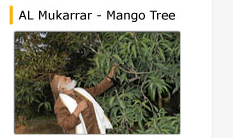
The son of the magician grafter, Najmi, showed me two very remarkable mango trees. One is said to be 100 years old and is named Al-Muqarrar. It has had more than 300 varieties of mango skilfully grafted onto it by Najmi’s father father. The other, younger tree has more than 150 mango genotypes grafted on to it. Each branch looks like a different tree! Both trees are bearing fruits of different colour, shape and size, and at different times.

Born in 1945, Haji Kaleem Ullaj Khan does not have any academic horticultural degrees, but he is widely renowned in India for his skills and knowledge in multiple grafting on a single tree. He was awarded the title of Udhyan Pandit (Professor of the Orchard) by a former President of India. He has also presented a mango tree bearing 54 varieties to the current President for the premises of the Mughal Garden of Rastrapati Bhavan. He has been acknowledged by many high-profile visitors from abroad and also decorated with the Padamashri award. His name is recorded in the Guinness Book of World Records for his grafting feats.

Abdullah Nursery is famous in Malihabad and throughout India for Haji Kaleem Ullaj Khan’s innovations, and markets saplings of commercial varieties to such distant places of Bhutan, Nepal and Bangladesh. Unlike government research stations, Haji Kaleem Ullaj Khan uses ground layering for his propagation for most commercial saplings, and veneer or wedge grafting in special cases. He has also grafted a guava tree that flowers and fruits all year round, which is another attraction for the nursery.

This innovation borne out of local need is a promising way for nurseries to maintain many scions at relatively low cost. However, this can be a high risk practice, because many varieties depend on one mother tree’s survival. It is thus important to have adequate safety duplication or maintain some scion material trees separately. Multiple variety grafting can also be used as an attraction in agrotourism, and for innovative marketing of diversity in urban and home gardens. This will create a new market for nursery growers and raise public interest in the diversity of mangoes. This activity has been conceptualized in the context of the UNEP/GEF project Conservation and Sustainable Use of Tropical Fruit Tree Diversity in India.