- Whole-genome landscape of Medicago truncatula symbiotic genes. There’s always something else.
- Genebank genomics highlights the diversity of a global barley collection. IPK’s, that is, and that’s 22,000 strong. Let the GWAS begin. Including for whisky-related traits, of course.
- A polyploid admixed origin of beer yeasts derived from European and Asian wine populations. And beer-related.
- Genetic diversity and population structure of a mini-core subset from the world cowpea (Vigna unguiculata (L.) Walp.) germplasm collection. There are three broadly geographic clusters, and the mini-core is representative of overall diversity, in Africa at least.
- Identification of candidate domestication‐related genes with a systematic survey of loss‐of‐function mutations. Fancy methods lead to doubling of possible domestication genes in soybean to 110.
- Social Valuation of Genebank Activities: Assessing Public Demand for Genetic Resource Conservation in the Czech Republic. Willingness to pay is $9 per sample. But this is unpacked in a guest post by Nik.
- Gene bank scheduling of seed regeneration: Interim report on a long term storage study. Maybe someone can tell me what’s new here?
- Functional phenomics: An emerging field integrating high-throughput phenotyping, physiology, and bioinformatics. Again, what exactly is new here, apart from the word pheme?
- Xanthomonas Wilt of Banana (BXW) in Central Africa: Opportunities, challenges, and pathways for citizen science and ICT-based control and prevention strategies. Technology is not enough.
- Beyond individuals: Toward a “distributed” approach to farmer decision‐making behavior. And even if it were enough, adoption is a whole ‘nother thing…
- Dietary Diversity: Implications for Obesity Prevention in Adult Populations: A Science Advisory From the American Heart Association. As currently defined, dietary diversity does not necessarily mean healthy eating.
- Modern Wheat Varieties as a Driver of the Degradation of Spanish Rainfed Mediterranean Agroecosystems throughout the 20th Century. Under traditional organic management, older varieties have similar yields to modern varieties, plus more biomass both above and below ground, making for better soils.
- Peculiarly pleasant weather for US maize. Adaptation to warmer climates accounts for 28% of yield increases since 1981. It won’t last, see below.
- Increase in crop losses to insect pests in a warming climate. Losses to insects will increase by 10 to 25% per degree Celsius of warming for wheat, rice, and maize.
- Metabolite variation in the lettuce gene pool: towards healthier crop varieties and food. Tasty lettuce is possible.
- Genome sequences of two diploid wild relatives of cultivated sweetpotato reveal targets for genetic improvement. Carotenoid biosynthesis alleles identified.
- Climate change stimulated agricultural innovation and exchange across Asia. Climate models suggest that about 3,500 years ago Central Asia and Tibet cooled, and 2,000 years ago China followed suit, in both cases leading to shifts in crops.
- Intensification for redesigned and sustainable agricultural systems. Depends on building social capital first.
Czeching the social value of crop diversity
Our friend Nik Tyack explains his paper Social Valuation of Genebank Activities: Assessing Public Demand for Genetic Resource Conservation in the Czech Republic. I think we included it in Brainfood recently, with the usual pithy summary, but it’s always nice to get it at greater length, and from the horse’s mouth to boot. Thanks, Nik.
Most attempts to put a value on genebank activities and the conservation of crop diversity have focused on specific uses of conserved materials. For example, Brennan and Malabayabas (2011) calculate that varietal improvement efforts using (among others) genetic resources from the genebank of the International Rice Research Institute (IRRI) yielded a high internal rate of return of 28%. Economists have also examined farmer preferences for the conservation of genetic diversity, like Poudel et al. (2009), who find that Nepalese rice farmers were willing to pay about $2 per year for ex situ conservation and $4 per year for in situ conservation of rice varieties. However, the total economic value of a properly conserved collection of crop diversity is not restricted to direct observed use or farmer preferences for conservation, but also includes a broader set of social values provided to the public, including option value, bequest value, insurance value, and existence value.
In this recent analysis, we take the case of the Czech Republic and use stated preference methods to generate an estimate of the social value of Czech crop diversity – focusing on elicited public preferences for crop diversity conservation at the national level. Using a properly managed online panel, we surveyed a nationally representative sample (n=1037) of Czechs (as well as a smaller sub-sample of 500 respondents from the agricultural region of South Moravia) to determine how much they would be willing to pay (WTP) to conserve a given number of crop varieties over the next ten years (using a double-bounded dichotomous choice model).
We find that Czechs, on average, were willing to pay about $9 (223 Czech crowns) for a crop diversity conservation program in general, regardless of the number of varieties conserved. This WTP estimate was about 12% larger for the average number of varieties offered in the valuation experiment (18), and about 24% more for the maximum number of varieties (35).
Aggregated across the Czech population (aged 18-69), we find that Czechs were willing to pay in total about $70 million for crop diversity conservation – 4.6 times more than the total conservation costs for the entire Czech agrobiodiversity conservation programme. Based on these results, we argue that the Czech Republic could safely expand their crop diversity conservation efforts given the public demand for these activities. As shown in the table below, our estimates of aggregate nation-wide WTP were consistently more than twice the conservation costs regardless of the model used.
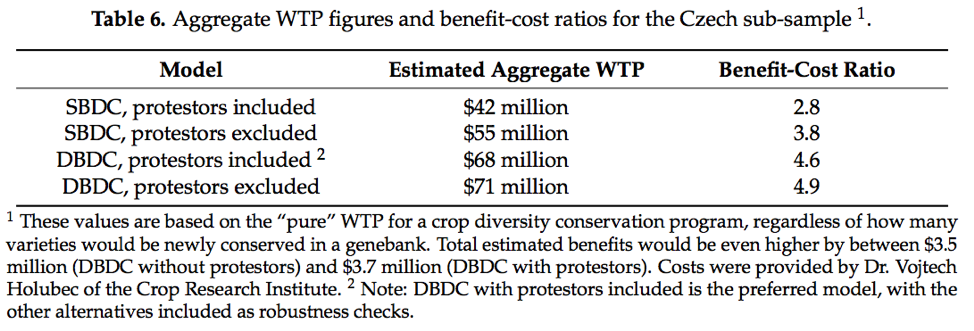
The basic idea of the paper is that public decision-making about how much to spend on crop diversity conservation should include a consideration of how much the public cares about conservation, and in addition should acknowledge that a national collection of crop diversity does not just ensure the availability of material for plant breeders, but also provides a whole set of other values such as those provided by a national park system or public museums. For example, just as an individual may be willing to pay something to ensure that their children and grandchildren will have an opportunity to visit Yosemite, they may also be willing to pay something so that their descendants will have the chance to eat a favorite fruit variety.
The estimates we provide represent an approximation of this social value of crop diversity conservation for the case of the Czech Republic. The study illustrates an empirical approach of potential value for policymakers responsible for determining funding levels for genetic resource conservation, and similar empirical work may be used to potentially provide justification for increased spending on the conservation of crop diversity worldwide.
Brainfood: Climate resilient crops, Food system limits, Phenotyping double, Sweet sorghum, Melon history, Paying4data, Beercalypse, Village chickens, Breeding 4.0, European maize, Brachiaria ROI
- Are agricultural researchers working on the right crops to enable food and nutrition security under future climates? No. Well, kinda.
- Options for keeping the food system within environmental limits. You need to pursue several. Including those discussed above, presumably.
- Deep Learning for Plant Stress Phenotyping: Trends and Future Perspectives. 3D CNN architectures applied to hyperspectral imaging is the future, apparently.
- Dealing with multi‐source and multi‐scale information in plant phenomics: the ontology‐driven Phenotyping Hybrid Information System. You’re going to need a fancy system to keep track to the data from the above.
- Sweet Sorghum Originated through Selection of Dry, a Plant-specific NAC Transcription Factor Gene. Could be applied to other cereals?
- Repeated domestication of melon (Cucumis melo) in Africa and Asia and a new close relative from India. Once was not enough.
- Paying for Digital Information: Assessing Farmers Willingness to Pay for a Digital Agriculture and Nutrition Service in Ghana. Cheaper is better. There’s a shocker. Oh, and women are more careful with their money.
- Decreases in global beer supply due to extreme drought and heat. 32% decrease in consumption in Argentina, 193% increase in price in Ireland. But clearly the authors have never heard of sorghum beer.
- The role of local adaptation in sustainable production of village chickens. Location, location, location.
- On the Road to Breeding 4.0: Unraveling the Good, the Bad, and the Boring of Crop Quantitative Genomics. Beyond breeding on predicted phenotypes, it’s sort of breeding for predicted environments.
- Maize yields over Europe may increase in spite of climate change, with an appropriate use of the genetic variability of flowering time. You don’t even need Breeding 1.0, if you deploy existing diversity optimally.
- Got forages? Understanding potential returns on investment in Brachiaria spp. for dairy producers in Eastern Africa. Definitely worth a flutter.
Brainfood: Quinoa boom, Diet affordability, Insect boom and bust, Organic & pests, Maize agroforestry, Landraces, Wheat roots, Conservation costs, Sustainable intensification, Defences & domestication, Polyploid niches, Mexican CWR, Danish apples, Diversity proxies, Grassland nutrient hotspots
- Foods and fads: The welfare impacts of rising quinoa prices in Peru. Modest.
- Measuring the Affordability of Nutritious Diets in Africa: Price Indexes for Diet Diversity and the Cost of Nutrient Adequacy. Maybe they could try quinoa.
- Impacts of climate warming on terrestrial ectotherms across latitude. Insects are in trouble in the tropics, but will make up for it at higher latitudes, which will be really bad for crops there, 10-25% more bad.
- Evidence that organic farming promotes pest control. Something for farmers in those higher latitudes to think about.
- The global distribution of Bacillus anthracis and associated anthrax risk to humans, livestock, and wildlife. 63.8 million rural poor livestock keepers are at risk. No word on effect of climate change.
- Do open-pollinated maize varieties perform better than hybrids in agroforestry systems? Maybe in Rwanda, but in Ethiopia not so much.
- More than Yield: Ecosystem Services of Traditional versus Modern Crop Varieties Revisited. Landraces are liked for yield stability in marginal environments, and for cultural reasons.
- Root and shoot traits in parental, early and late generation Green Revolution wheats (Triticum spp.) under glasshouse conditions. Modern wheat have smaller roots.
- Standardized reporting of the costs of management interventions for biodiversity conservation. Behind a paywall, so can’t tell whether includes genebanks. But I bet it doesn’t. Tell me I’m wrong.
- Global assessment of agricultural system redesign for sustainable intensification. Apparently 30% of farms and 10% of agricultural land worldwide, which is both more and less than I would have guessed.
- Genetic homogeneity of North-African goats. The Berber breeds are different, everything else is a big mixed up mess.
- Plant domestication decreases both constitutive and induced chemical defences by direct selection against defensive traits. In cabbage, even the tissues that are not eaten are more edible than in the wild relative.
- Polyploid plants have faster rates of multivariate climatic niche evolution than their diploid relatives. Relevant for domestication?
- An Initiative for the Study and Use of Genetic Diversity of Domesticated Plants and Their Wild Relatives. In Mexico.
- Population structure, relatedness and ploidy levels in an apple gene bank revealed through genotyping-by-sequencing. There’s a lot of inter-relatedness in the Danish collection.
- Biases induced by using geography and environment to guide ex situ conservation. “Although geographic and environmental diversity have proven to be reliable predictors of allele frequency differences and ecotypic differentiation across species ranges, they appear to be poor predictors of allelic diversity per se.” At least for 3 species.
- Examining the spectra of herbarium uses and users. Herbaria mostly used by taxonomists shock.
- Ancient herders enriched and restructured African grasslands. Shit. You heard me.
Brainfood: Rye genus, Purple carrots, Breed conservation contracts, Livestock breeding, USDA sweetpotatoes, Apple breeding, Olive breeding, Landrace nutrition, Trade and SDG 2.5, Medicinal legumes, Tea in China, Non-rhizobia, Fungal cryo, Barcoding NUS
- Phylogeny and genetic structure in the genus Secale. The perennial species is different from the annuals, which are divided into an Asian and a non-Asia group and show all kinds of introgression.
- Consumers’ acceptance of a local landrace: the case of purple carrots. Sure, if produced locally.
- Saving the breeds: German Farmers’ preferences for Endangered Dairy Breed conservation programs. Sure, if they get paid.
- Analysing innovations among cattle smallholders to evaluate the adequacy of breeding programs. Intensification will need more than selection within the local breed. But it’s a start.
- Genetic diversity and population structure of the USDA sweetpotato (Ipomoea batatas) germplasm collection using GBSpoly. 4 clusters: Central American, North American, South American, and others.
- Updated review of potential medicinal genetic resources in the USDA, ARS, PGRCU industrial and legume crop germplasm collections. 22 species have potential.
- Apple (Malus spp.) Breeding: Present and Future. It’s bright, apparently.
- Strategies for Olive (Olea europaea L.) Breeding: Cultivated Genetic Resources and Crossbreeding. There’s an International Olive Council, and it has a Network of Germplasm Banks.
- Genetic flow among olive populations within the Mediterranean basin. Separate Syrian and Algerian genepools.
- Traditional farmers’ varieties: a valuable source of genetic variability for biofortification programs. Back to the future.
- SDG 2.5: How Policies Affecting Trade and Markets Can Help Maintain Genetic Diversity. It’s possible, but not automatic.
- Concept and protection of traditional knowledges in agricultural heritage system: a case study of Pu’er Traditional Tea Agrosystem. Based on 269 pieces of traditional knowledge, and in trouble.
- Mining alfalfa (Medicago sativa L.) nodules for salinity tolerant non-rhizobial bacteria to improve growth of alfalfa under salinity stress. They work even on their own.
- Frozen fungi: cryogenic storage is an effective method to store Fusarium cultures for the long‐term. I guess will also work on the above?
- DNA barcoding to promote social awareness and identity of neglected, underutilized plant species having valuable nutritional properties. Familiarity breeds contentment.