- High Royal Jelly-Producing Honeybees (Apis mellifera ligustica) (Hymenoptera: Apidae) in China. China supplies 90% of the global market?
- Taking Advantage of Natural Biodiversity for Wine Making: The WILDWINE Project. Back to the future, via yeast diversity.
- Conservation of Landrace: The Key Role of the Value for Agrobiodiversity Conservation. An Application on Ancient Tomatoes Varieties. Fancy maths shows farmer maintaining heirloom tomato variety in Perugia could be charging more.
- Are changes in global oil production influencing the rate of deforestation and biodiversity loss? Less oil production, more agricultural expansion, more biodiversity loss.
- Grazing vs. mowing: A meta-analysis of biodiversity benefits for grassland management. Grazing. Probably. The data sucks.
- Maize diversity associated with social origin and environmental variation in Southern Mexico. Ethnicity trumps altitude in genetic patterning. Morphology is all over the place.
- Genetics in conservation management: Revised recommendations for the 50/500 rules, Red List criteria and population viability analyses. One we missed. 100/1000 is the new 50/500. Multiply by 10 for census population sizes to avoid inbreeding and retain evolutionary potential, respectively.
- Advances in genomics for the improvement of quality in Coffee. We’ll need to sequence the wild species too.
Nibbles: Banana trouble, Celebrating Ethiopia, Potato nutrition, Kenyan veggies, Coffee history, Twitty book, Biodiversity loss vid
- The musapocalypse gets an infographic.
- Celebrating agricultural biodiversity in Ethiopia.
- High calcium potato wild relatives in the news. No, really.
- NY Times catches up with the Kenyan leafy green revolution.
- The world’s prettiest (only?) coffee genealogy poster.
- The great Michael Twitty’s long-awaited book on African-American foodways is out.
- Nice video on biodiversity loss actually opens with Svalbard Global Seed Vault.
Call for articles: Valuing underutilised crops
We are looking for stories that analyse how underutilised crops have been revalued. We seek examples of communities that continued growing and processing them contrary to dominant trends. What were the successful strategies and the challenges to reviving the knowledge and the use of the underutilised crop? How did production, processing and preparation of food change? What role did markets, policy, research or local food and farmers’ movements play? What changes did this bring to rural and urban communities? What was the role of youth?
Nibbles: Value edition
- Peru to give value to its biodiversity.
- Germany already has, 500 years ago.
- Cavendish bananas have a lot of value, but that won’t save them.
- The UK’s vegetables genebank is very valuable.
- But you can always add more value to genebank collections if you evaluate them, like IRRI’s going to do in an expensive new building.
- I’m not sure what the value of Gold Rush-era heritage trees might be, but I think it’s really cool that someone’s looking for them.
- The value of genetic engineering for drought tolerance is just around the corner.
Genebanks are valuable, even without climate change
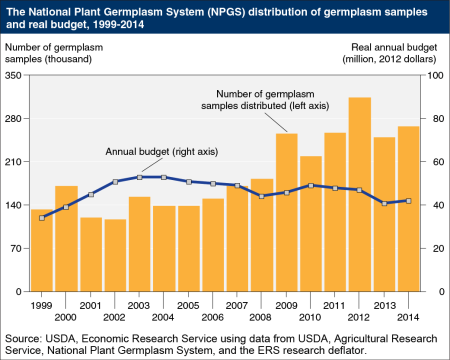
As agriculture adapts to climate change, crop genetic resources can be used to develop new plant varieties that are more tolerant of changing environmental conditions. Crop genetic resources (or germplasm) consist of seeds, plants, or plant parts that can be used in crop breeding, research, or conservation. The public sector plays an important role in collecting, conserving, and distributing crop genetic resources because private-sector incentives for crucial parts of these activities are limited. The U.S. National Plant Germplasm System (NPGS) is the primary network that manages publicly held crop germplasm in the United States. Since 2003, demand for crop genetic resources from the NPGS has increased rapidly even as the NPGS budget has declined in real dollars. By way of comparison, the NPGS budget of approximately $47 million in 2012 was well under one-half of 1 percent of the U.S. seed market (measured as the value of farmers’ purchased seed) which exceeded $20 billion for the same year.
Couldn’t have put it better myself, though admittedly I’m more likely to have done it for the CGIAR genebanks than for the NPGS. The diagram, and the sentiment, derive from a USDA publication that came out back in April: Using Crop Genetic Resources to Help Agriculture Adapt to Climate Change: Economics and Policy. We did blog about it at the time, but USDA seem to be plugging it again, and I see no reason why we shouldn’t too.