- The Use of Crop Wild Relatives in Maize and Sunflower Breeding. In maize, unlike sunflower, it just hasn’t been worth it. Yet.
- Securing sustainable and nutritious food systems through mainstreaming agricultural biodiversity: an interdisciplinary study. What works in Brazil won’t necessarily fly in India.
- Duplication assessments in Brassica vegetable accessions. Half of 13 accession pairs/triplets with identical names from VIR and NordGen turned out to be morphologically identical.
- Beans (Phaseolus ssp.) as a Model for Understanding Crop Evolution. 7 independent domestication “events” spread across 5 species and 2 continents makes for some interesting natural experiments.
- A Mesoamerican origin of cherimoya (Annona cherimola Mill.). Implications for the conservation of plant genetic resources. Compare and contrast with above.
- Highly productive forage legume stands show no positive biodiversity effect on yield and N2-fixation. Sometimes diversity doesn’t add much.
- Genetic Resources of Pearl Millet: Status and Utilization. 22,888 accessions from 51 countries. Indian landraces: earliness, high tillering, high harvest index and local adaptation; African: bigger panicles, large seed size, and disease resistance.
- Use of natural diversity and biotechnology to increase the quality and nutritional content of tomato and grape. Both are needed.
- Rhubarb (Rheum species): the role of Edinburgh in its cultivation and development. From China, via Russia, with love.
- Will phenotypic plasticity affecting flowering phenology keep pace with climate change? If the change is smaller than about 13 days.
- Seed dispersers help plants to escape global warming. Because they move seed >35 m per decade uphill.
Nibbles: Wheat-barley hybrid, Father of Wheat Revolution, Medieval bread, Tomato history, SOWP2, Domestication, Red Data, Taro benefits, Hummus!, Textile book, Healthy rice, Avocado Wars
- Tritodendrum hits the market.
- DS Athwal would have approved. RIP.
- Medieval bakers too, I bet.
- Want some cherry tomatoes on your bread? No? Try these then.
- Lots of crop wild relatives among newly discovered plants. See (some of) them on the new State of the World’s Plants report from Kew. And no, Kew, none of them are “miserable.”
- Early farmers unintentionally produced vegetables with larger seeds simply by cultivating them. And cereals too.
- Head of IUCN Red Data List Unit in impassioned plea for IUCN Red Data List process.
- What is taro good for? I’m glad you asked.
- I missed International Hummus Day? How could this happen?
- Textilia Linnaeana! What do you mean I’ve just had my birthday?
- Lowering the glycemic index of rice for the Chinese market.
- Fighting for avocados. Literally.
Brainfood: Canola model, Saline dates, High rice, Perennial wheat, European cowpea, Mesoamerican oil palm, Seed viability, Citrus identity, Poor cassava, Horse domestication, Wild tomatoes, Tea genome, Veggie breeding, Classical brassicas
- Development of a Statistical Crop Model to Explain the Relationship between Seed Yield and Phenotypic Diversity within the Brassica napus Genepool. Look for primary raceme area.
- Screening of Date Palm (Phoenix dactylifera L.) Cultivars for Salinity Tolerance. In Oman, Manoma and Umsila are particularly tolerant.
- Genetic structure and isolation by altitude in rice landraces of Yunnan, China revealed by nucleotide and microsatellite marker polymorphisms. Geneflow is horizontal, adaptation vertical.
- Breeding Perennial Grain Crops Based on Wheat. By adding a wild genome.
- European cowpea landraces for a more sustainable agriculture system and novel foods. 24 of them, no less. But you have to start somewhere, I suppose.
- Genetic diversity of Elaeis oleifera (HBK) Cortes populations using cross species SSRs: implication’s for germplasm utilization and conservation. From 532 palms in 19 populations to 34 individuals.
- Large-Scale Screening of Intact Tomato Seeds for Viability Using Near Infrared Reflectance Spectroscopy (NIRS). Good-bye germination tests?
- Genetic identification of ‘Limau Kacang’ (Citrus sp.), a local mandarin cultivated in West Sumatra by sequence-related amplified polymorphism (SRAP). It’s a ponkan.
- Cassava haplotype map highlights fixation of deleterious mutations during clonal propagation. Cassava is decaying genetically, but breeders are helping.
- Ancient genomic changes associated with domestication of the horse. The ancient DNA of immediate post-domestication horses suggests that the stallion bottleneck happened later.
- Genetic Diversity and Population Structure of Two Tomato Species from the Galapagos Islands. They mirror island formation.
- The Tea Tree Genome Provides Insights into Tea Flavor and Independent Evolution of Caffeine Biosynthesis. It evolved caffeine independently of coffee but not cacao. And flavour is down to a whole genome duplication.
- The contribution of international vegetable breeding to private seed companies in India. It can still make one, but for traits rather than varieties.
- Domestication, diversity and use of Brassica oleracea L., based on ancient Greek and Latin texts. Their use as a hangover cure has a long and august pedigree. No word on their raceme area.
Assyria in Gatersleben
I’m not sure if I said here that I visited IPK, the German national genebank, a few weeks ago. I did on Instagram.
Great facilities, great people, great work: but, though bigger and better resourced than average, in most ways like many other genebanks around the world. Except, that is, for the Assyrian relief in the entrance hall.
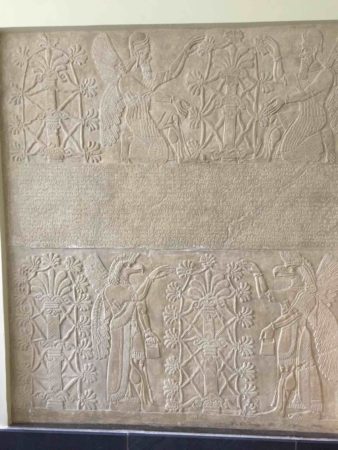
Well, the plaster cast of the Assyrian relief anyway. Nobody seemed to know where the original was, but there was general agreement that the copy was there because it depicted plant breeding. Of course, I took that as a challenge, and after a few minutes playing around with Google’s image search feature, I ran it to earth at the Met.
Each register of imagery shows a pair of supernatural figures flanking a stylized “sacred tree.” Further sacred trees can be seen to the left, and similar imagery continued around the room from which this slab came. The tree is thought to represent the prosperity and agricultural abundance of Assyria, and perhaps on one level the state itself. The supernatural figures are protective, and similar to those shown at larger scale throughout the palace. The gesture performed by the bird-headed figures with bucket and cone has been much discussed. One suggestion is that it symbolizes the fertilization of the land through the imagery of artificial date-palm fertilization, in which male date-spathes are used to fertilize female plants. The Assyrian term for the cone, however, seems to be “purifier,” and it is therefore likely that the symbolism has as much or more to do with magical protection.
So, maybe plant breeding, maybe not, but well worth having in the entrance lobby to a plant breeding institute containing a genebank.
But in locating the stela I ran across an article on Mesopotamian agriculture from the Oriental Institute that mentioned something called the Philadelphia Onion Archive.
No way to let that go either, naturally. It turns out that the Philadelphia Onion Archive really does consist of an archive of material on onions, kept in Philadelphia in the unwieldy shape of numerous clay tablets inscribed in cuneiform in the Akkadian language. Fortunately, there’s a translation online. Which means we know how many types of onions were grown during the reign of King Shar-Kali-Sharri, over 4,000 years ago.
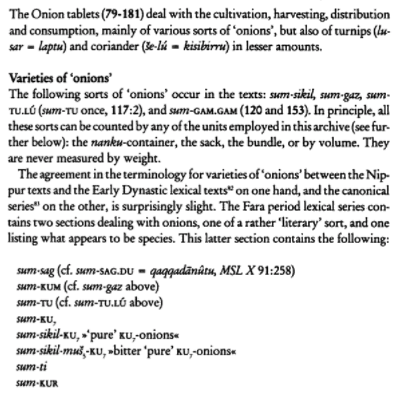
And for how many places around the world can we say that even now?
Brainfood: Dope diversity, Potato chips, Conservation costing, Island breeding systems, Indus civilization cereals, Drone phenotyping, Wild rice in Asia, Wild rice & Native Americans, Pearl millet temperature, Climate change & fruit/veg
- Cannabis Domestication, Breeding History, Present-day Genetic Diversity, and Future Prospects. The traditional landraces are being contaminated and need urgent collection and evaluation by dedicated professionals.
- Cold sweetening diversity in Andean potato germplasm from Argentina. 5 out of 48 Andigena landraces make good chips.
- Considering cost alongside the effectiveness of management in evidence-based conservation: A systematic reporting protocol. Here comes the metadata. No excuse now.
- Self-compatibility is over-represented on islands. 66% vs 41% in Asteraceae, Brassicaceae and Solanaceae. Any crop wild relatives in the list?
- Cereals, calories and change: exploring approaches to quantification in Indus archaeobotany. Millet may not have been as important as is generally thought.
- High-Throughput Phenotyping of Sorghum Plant Height Using an Unmanned Aerial Vehicle and Its Application to Genomic Prediction Modeling. A near-infrared, green and blue (NIR-GB) camera on a drone gives pretty good results compared to a person with a tape measure, and is much more fun.
- Asian wild rice is a hybrid swarm with extensive gene flow and feralization from domesticated rice. No such thing as completely wild Asian rice.
- The dispute over wild rice: an investigation of treaty agreements and Ojibwe food sovereignty. Not wild rice at all, but what’s been happening to it might be a violation of the White Pine Treaty with the Ojibwe.
- Quantifying pearl millet response to high temperature stress: thresholds, sensitive stages, genetic variability and relative sensitivity of pollen and pistil. The problem is the pistils.
- Effect of environmental change on yield and quality of fruits and vegetables: two systematic reviews and projections of possible health effects. Bad for yield, good for nutritional quality.