- What is it with the English and their orchards?
- Wild wheat relatives, their status in Armenia.
Nibbles: China, Andean roots and tubers, pigs, greenhouse gases, locavores, drought, mapping horticulture, 2010 Growing Green Awards, canker, World Bank, threats, cashmere
- China’s role in food price spikes. Books sounds worth reading.
- Dutch chefs easily fascinated. Just show ’em an Andean root or tuber.
- Much more on that pig domestication story.
- Global Research Alliance on Agricultural Greenhouse Gases agrees its agenda. In New Zealand. Jeremy avoids snarky remark.
- New York Times debates locavorism. Someone has to.
- Monsanto, DuPont Race to Win $2.7 Billion Drought-Corn Market. Africa says Yay!
- If you have an horticultural development project, Horticultural CRSP and GlobalHort want to hear from you.
- More environmental awards handed out. Recipients asked to blog.
- Chestnuts out of fire?
- Data!
- Really, who’d be a farmer?
- Chinese clone woollier cashmere goats. Why not just clone the wool directly, cut out the middleman?
- Tales of maize and tomato hybrids.
Protecting edible orchids around the world
Well, national parks may not be all that great at conserving crop wild relatives, but a fascinating article in the latest newsletter of the SADC Plant Genetic Resources Network, which is unfortunately not online, alerts me to the fact that a Tanzanian national park was set up a few years back to protect edible orchids.
Last year, WCS released a report documenting how the region’s orchids were being exploited by local people, who exported the plants into neighboring Zambia, where they are eaten as a delicacy. The report says that up to 85 orchid species are being harvested for use in chikanda or kinaka, a delicacy in which the root or tuber of terrestrial orchids is the key ingredient in a type of meatless sausage.
Chikanda is an unsustainable industry in Zambia itself. Edible orchids are also big in Malawi. And they’re sought after in other parts of the world as well, notably Turkey, where their use in making a delicious traditional desert is endangering them. I couldn’t find any reference to protected areas in Turkey being set up specially for them, but the commercial export of the orchids has been banned since 2003.
Wild rices in the Protected Area of the Week
Those happy few, that band of brothers, who follow us on Twitter will know that the Tropical Rainforest Heritage of Sumatra is IUCN’s Protected Area of the Week. It is actually three protected areas: the Gunung Leuser National Park, the Kerinci Seblat National Park and the Bukit Barisan Selatan National Park. Great for Indonesia’s largest mammals, apparently, and I asked the question in my tweet whether they are equally good for wild rices.
Quick as a flash, Nora Castaneda at CIAT produced a map of wild rice accessions from Sumatra, based on IRRI data. Turns out two accessions of Oryza officinalis have been collected from the Gunung Leuser National Park. That’s the northernmost of the three protected areas, shown in pink.
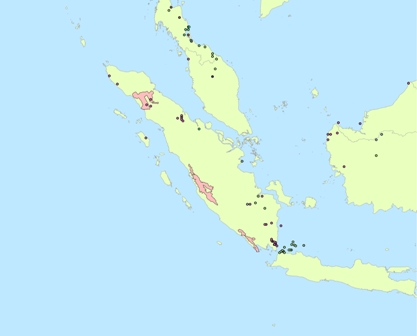
GIBF doesn’t add much, unfortunately. But there could well be a number of other wild rice relatives in these parks. That we don’t know, or at any rate that it is pretty difficult to find out, is really an indictment of the disconnect between the agrobiodiversity and nature conservation communities.
Nibbles: Heirloom store, Leaf miners, Mongolian drought, GPS, Coca, Ag origins, Aquaculture, Lice, Bud break in US, IFAD livestock, biofuels, Pig history
- “Housed in the towering old 1926 Sonoma County Bank, it’s hard to miss the Seed Bank.” And who would want to anyway.
- Of apples, leaf miners and bacteria. Great story.
- Best synthesis and analysis of the Mongolian dzud story so far.
- Visualize your GPS data! Not agrobiodiversity, I know, but I don’t have another blog.
- Coca myths debunked. Sniff sniff.
- “Crop domestication and the first plant breeders” book charpter online.
- Rebranding Asian carp. Hard row to hoe. Thanks, Don.
- 190,000 year old clothes had lice. 190,000 year old humans had clothes?
- More citizen science stuff, this one on effect of climate change on plant phenology in the US.
- IFAD publishes bunch of livestock-related papers. ILRI, are you listening?
- “It’s 36 percent more efficient to grow grain for food than for fuel.” Good to have a number.
- Boffins do their aDNA thing on Chinese pigs, find continuity, multiple domestication, sweet and sour sauce recipe.
- Soil Association begs to differ on that whole
UKworld-needs-to-double-food-production thing.