 The Indiana Joneses of domestication are better served by a DNA sequencer than a bullwhip, but they’re digging up stuff that’s every bit as exciting as a crystal skull. 1 Latest case in point, a paper published online in Nature Genetics today by Takeshi Izawa and colleagues at the National Institute of Agrobiological Sciences in Tsukuba, Japan. 2 They’ve discovered that a single mutation — the loss of just 1212 DNA code letters — was a fundamental step in the domestication of rice.
Agroarchaeologists have always had a fun time sitting in armchairs, waving their arms and saying things like “and then people would select for larger grains”. But really, how much heritable variation is there in grain size in a variety? Not a lot, given that 100-seed weight is sometimes sufficiently invariable as to be a diagnostic characteristic.
Domesticated rice definitely has larger grains, and more of them, than Oryza rufipogon, the ancestor of both indica and japonica modern rices. There’s still some argument over whether the two types were truly independently domesticated, but if not they have certainly been evolving separately since domestication. So Izawa et al. crossed Nipponbare (that’s it, below), a large-grained japonica, and Kasalath, a thin-grained indica, and looked for genetic differences associated with differences in the width of the rice seeds.
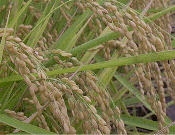 They found several, of which one, called qSW5, because it is a quantitative trait locus for seed width on chromosome 5, explained almost 40% of the natural variation in seed width. They then created a variety that contained the crucial bit of Kasalath chromosome 5 in a background of Nipponbare genes. That revealed a greater number of rows of specialized cells in the outer glume, a known determinant of grain size. Cloning the gene and putting it into thin-grained Kasalath resulted in larger grains.
They also looked for the qSW5 gene in more than 100 japonica and indica landraces, and found a clear link between the Nipponbare version of the gene, with the deletion, and wider grains.
A final piece of evidence. In a field trial, Nipponbare with the Kasalath gene yielded 10% less, while Kasalath with the Nipponbare gene had heavier grains.
All of which leads Izawa to comment that “qSW5 is a domestication-related gene in rice” and to suggest “the possible use of the defective qSW5 allele for a breeding program of new indica cultivars”.
The deletion in the qSW5 gene that results in fatter grains is a functional nucleotide polymorphism (FNP). It is good to see the researchers refer to it as “defective” even though we don’t actually know how it might be selected against in the wild-type population. In a neat coda to the main study, the researchers looked at two other FNPs associated with domestication, one that controls the taste and texture of cooked rice grains and one that keeps the rice grains attached to their stalk. 3 With the wild rice alleles for comparison, they examined 142 rice landraces to see which varieties had the old — i.e. unselected — version of each of the three FNPs.
Most of the indica landraces carried the original alleles. A distinct group of japonica varieties had all three FNPs. This supports the idea of two independent domestications. 4 And among the japonicas, there were some landraces that had only one or two of the FNPs, suggesting that there are true “heritage” varieties with a longer independent history. I’m sure those are properly conserved in genebanks.

 I haven’t read