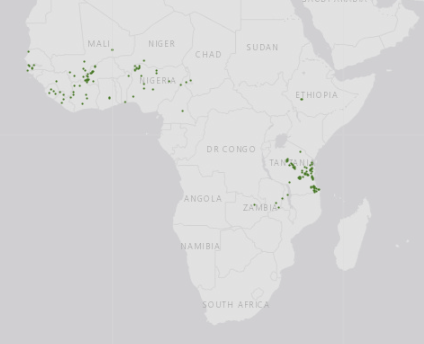
- The genetic ancestry of American Creole cattle inferred from uniparental and autosomal genetic markers. Out of Africa…
- Tracing the genetic origin of two Acacia mearnsii seed orchards in South Africa. For one of the orchards, the origin is unknown, but it’s distinct to all the other, known provenances.
- Genetic Characterization of Apulian Olive Germplasm as Potential Source in New Breeding Programs. Ok, but unclear what all this means for Xylella resistance, which presumably was the main reason for doing the work?
- Whole-genome resequencing of Cucurbita pepo morphotypes to discover genomic variants associated with morphology and horticulturally valuable traits. The two subspecies were domesticated and evolved independently.
- Mapping the effects of drought on child stunting. Lower precipitation is bad for kids.
- Governing Seeds in East Africa in the Face of Climate Change: Assessing Political and Social Outcomes. Wealthier, more food secure households are more likely to grow maize hybrids. Cause? Effect? But in any case the commercialization agenda has left sorghum behind.
- Exploiting genetic variation in nitrogen use efficiency for cereal crop improvement. Back to the genebank. Just one of a whole issue on genetic variation in physiological traits.
- Black Sigatoka in bananas: Ecoclimatic suitability and disease pressure assessments. The high yield areas are most at threat.
- Fats of the Land: New Histories of Agricultural Oils. Hidden histories are the best histories.
- Food Provisioning Services Via Homegardens and Communal Sharing in Satoyama Socio-ecological Production Landscapes on Japan’s Noto Peninsula. Sharing promotes diversity. Kinda beautiful.
- Cow Sharing and Alpine Ecosystems: A Comparative Case Study of Sharing Practices and Property Rights. The jury is out on whether it contributes to conservation, but it still seems pretty cool.
- Horse phenotyping based on video image analysis of jumping performance for conservation breeding. Judges don’t know what they’re talking about.
- Preserving the nutritional quality of crop plants under a changing climate: importance and strategies. Mainly due to eCO2. Need to breed for it under the new conditions. Or try other crops.
Brainfood: Rice roots, Avocado genome, Sicilian greens, Mexican & Colombian cacao, US diversity, Cassava photosynthesis, Intense dairy, Bourbon, Grape rootstocks, Heirlooms, Ancient pastoralism, Onion polyploidy, Toxic compounds, Technology adoption
- Root anatomical traits of wild-rices reveal links between flooded rice and dryland sorghum. Mine the rice G genome for sorghum-like root traits.
- The avocado genome informs deep angiosperm phylogeny, highlights introgressive hybridization, and reveals pathogen-influenced gene space adaptation. 2 polyploidy events in its evolution; the Hass is Guatemalan introgressed into Mexican material, recently.
- Wild leafy plants market survey in Sicily: From local culture to food sustainability. You can cultivate and market them, but people do like collecting them from the wild themselves.
- A History of Cacao in West Mexico: Implications for Mesoamerica and U.S. Southwest Connections. Associated with the cult of the sun deity Xochipilli.
- Cacao breeding in Colombia, past, present and future. Breeders only recently turned to local material, and are now reaping the whirlwind. No word of the involvement of deities.
- The impact of agricultural landscape diversification on U.S. crop production. Maize and wheat yields increase with the number of agricultural land use categories in a region.
- Protein Cross-Interactions for Efficient Photosynthesis in the Cassava Cultivar SC205 Relative to Its Wild Species. Domesticated cassava is more C4 than its wild relatives.
- Routes to achieving sustainable intensification in simulated dairy farms: The importance of production efficiency and complimentary land uses. Not for the first time, crop-level diversity provides the win-win.
- Assessing the impact of corn variety and Texas terroir on flavor and alcohol yield in new-make bourbon whiskey. It’s the benzaldehyde.
- Genetic diversity and parentage analysis of grape rootstocks. 39% of the genetic background of 26 rootstocks derived from 3 accessions, admittedly of 3 different species.
- Pursuing the Potential of Heirloom Cultivars to Improve Adaptation, Nutritional, and Culinary Features of Food Crops. Look beyond yield.
- The Rise of Pastoralism in the Ancient Near East. Couldn’t have done so without sedentary communities.
- Polyploidy promotes species diversification of Allium through ecological shifts. Largely edaphic shifts, in fact.
- Assessing Specialized Metabolite Diversity in the Cosmopolitan Plant Genus Euphorbia L. Toxic diterpenoids are more structurally diverse where pressure from herbivores is strongest.
- Rethinking technological change in smallholder agriculture. Not so much adoption as propositions, encounters, dispositions and responses.
Brainfood: Clean vines, Wild maize diversity, Heirloom beans, Domestication, Cryptic variation, African rice evaluation, Fall armyworm, Food prices, Human pathogens, Farm biodiversity, Microbiome, Infographics, Tea diversity, Mekong dietary diversity, Women & NUS
- Efficiency of insect‐proof net tunnels in reducing virus‐related seed degeneration in sweet potato. “Seed” meaning vines. And yes, those tunnels work.
- Divergence with gene flow is driven by local adaptation to temperature and soil phosphorus concentration in teosinte subspecies (Zea mays parviglumis and Zea mays mexicana). Genetic differences between the two subspecies is maintained by adaptive divergence despite gene flow.
- Agronomic Performance and Nitrogen Fixation of Heirloom and Conventional Dry Bean Varieties Under Low-Nitrogen Field Conditions. Not much difference, which is actually interesting.
- Evolutionary Insights into the Nature of Plant Domestication. It’s a long process, in which natural selection and interspecific hybridization play an important part, involving many of the same genes across species.
- Cryptic genetic variation accelerates evolution by opening access to diverse adaptive peaks. Add to the above? Ah no, only in bacteria so far.
- Screening African rice (Oryza glaberrima) for tolerance to abiotic stresses: III Flooding. From a collection of >2,000 to 11 better than Asian rice. You’re wondering about I and II, aren’t you?
- Understanding the factors influencing fall armyworm (Spodoptera frugiperda J.E. Smith) damage in African smallholder maize fields and quantifying its impact on yield. A case study in Eastern Zimbabwe. Differences among maize varieties, but weeding, tillage and intercropping also have an effect. Have yield losses been overestimated, though? Maybe.
- Natural selection contributed to immunological differences between hunter-gatherers and agriculturalists. But the evidence seems to be that the pathogen burden was higher for the hunter-gatherers, which goes counter to everything we’ve been taught by Jared Diamond.
- Increasing crop heterogeneity enhances multitrophic diversity across agricultural regions. More crops means more biodiversity in general.
- More Than the Sum of Its Parts: Microbiome Biodiversity as a Driver of Plant Growth and Soil Health. More microbes mean better plant growth.
- Science–graphic art partnerships to increase research impact. Free your inner artist.
- Genetic diversity, linkage disequilibrium, and population structure analysis of the tea plant (Camellia sinensis) from an origin center, Guizhou plateau, using genome-wide SNPs developed by genotyping-by-sequencing. Four groups: pure wild type, admixed wild type, ancient landraces and modern landraces.
- The Relative Caloric Prices of Healthy and Unhealthy Foods Differ Systematically across Income Levels and Continents. …and at least partially explain differences in undernutrition and overweight in adults. Here’s the infographic.
- Household-level drivers of dietary diversity in transitioning agricultural systems: Evidence from the Greater Mekong Subregion. It’s complicated and context-specific, but dietary diversity seems to generally increase with agricultural “development,” i.e. market orientation, specialisation, and intensification. Somewhat surprising? I’ve lost track, frankly.
- Potential role of neglected and underutilized plant species in improving women’s empowerment and nutrition in areas of sub-Saharan Africa. So is increasing cultivation of orphan crops a driver or a consequence of agricultural development? See what I mean? Anyway, useful review.
A USDA legend retires
Marty Reisinger, who knows a thing or two about genebank documentation systems himself, has just sent in this appreciation of retiring USDA genebank database manager Quinn Sinnott. We all wish Quinn a long and happy retirement, and thank him for his important contribution to the field.
Quinn Sinnott, the database manager for GRIN, is retiring from the USDA Agricultural Research Service’s Database Management Unit (DBMU) on August 31, 2019.
Quinn is one of the founders and early builders of GRIN, having served the project since it was initiated in 1983. GRIN started as an ARS project funded through a cooperative agreement with the University of Maryland.
GRIN went live in late 1983 on a PR1ME minicomputer with only a few megabytes of memory and 300 MB disk drives. The drives were the size of a low filing cabinet. Backups were made on large 9-track tape reels; at one point, it took 15 tapes to back up the database. The software was coded in FORTRAN for a CODASYL database. There was no SQL query capability. Instead, there was a program called DISCOVER that could do queries. They would often take hours to complete.
During Quinn’s tenure, GRIN’s hardware and software evolved a great deal. New hardware was purchased in 1992 for approximately $500,000 after a lengthy procurement process. In late 1994, GRIN was moved to a relational Oracle database running on a Unix system. The entire system was rewritten to work with Oracle Forms and SQL. The GRIN hardware was originally housed in the USDA National Agriculture Library, but sometime in the mid-90’s it was moved to the attic of Building 003 on USDA’s Beltsville, Maryland campus.
In 2008, Crop Trust supported a project to rewrite the GRIN system so that it could be run on either a personal computer or network and be maintained by the world genebank community as open source software. The database and interfaces were designed to accommodate commercial and open-source programming tools and be database-flexible. The DBMU selected Microsoft SQL Server for the USDA National Plant Germplasm System’s database engine; Quinn was instrumental in ensuring that the robust GRIN schema and functionality could be emulated in the new GRIN-Global platform.
Quinn is among those who have made GRIN/GRIN-Global the highly regarded system that it is. Genebanks around the world have excellent, continually improving tools to manage their collections and data, thanks in part to his efforts over more than 35 years.
Quinn will continue to assist the National Germplasm Resources Laboratory as a volunteer and help with GRIN/GRIN-Global matters occasionally as needed. A tremendous thanks to Quinn for his outstanding 35 years of service to ARS, the National Plant Germplasm System, and the global genetic resource community.
Guide to a well trodden path
The International Seed Federation has a handy brief Guide to Genetic Resources online. It covers why plant genetic resources are important, and what arrangements are in place for access and benefit sharing 1 — not surprisingly, perhaps, mainly from the point of view of crop breeders.
Breeders work mostly with modern varieties, the so-called “elite” genetic resources. Sometimes they look beyond modern varieties to develop a valuable attribute, such as resistance to new pests or diseases, nutritional content, or flavour. They might use nonelite varieties, such as landraces, heirlooms, or crop wild relatives, which come mostly from public or private gene banks.
The conservation of genetic resources is like having an insurance. By having a larger pool of genetic resources, plant breeders are more likely to find solutions that farmers and others need. This means that efforts to conserve genetic resources are critically important. These genetic resources may contain the traits that future generations will need.
There’s a page on genebanks, focusing on the international collections of CGIAR.
It’s ok as far as it goes, I guess, but I would have liked to see more on the role of national and regional genebanks, information sources such as Genesys and WIEWS, and traits beyond productivity.