- Genetic Cryopreservation of Rare Breeds of Domesticated North American Livestock: Smithsonian & SVF Biodiversity Preservation Project. 106,109 “units of germplasm” from 39 breeds.
- Interspecific hybridization facilitates niche adaptation in beer yeast. Chimerization is not a word I thought I would ever see in a beer context. Anyway, thank goodness for feral yeasts and their propensity for miscegenation.
- Predicted climate shifts within terrestrial protected areas worldwide. PAs in temperate and northern high-latitude will have high area proportions of novel climate conditions by the end of the century.
- Crop Genomics Goes Beyond a Single Reference Genome. Looks like we’ll always need another genome.
- Morphometric approaches to promote the use of exotic germplasm for improved food security and resilience to climate change: A kura clover example. Fancy maths used to describe the hell out of a small collection of an underused clover.
- Global distribution of earthworm diversity. Peaks at higher latitudes, but higher overall in the tropics.
- Natural genetic variation in photosynthesis: an untapped resource to increase crop yield potential? Sounds like it.
- Increasing Photosynthesis: Unlikely Solution For World Food Problem. Ok, maybe not.
- What role should randomized control trials play in providing the evidence base for conservation? A bigger role that currently, but watch out.
- Brown Rice, a Diet Rich in Health Promoting Properties. Mill less.
- Loss of diversity and accumulation of genetic load in doubled-haploid lines from European maize landrace. DH not a panacea.
- Maize agro-food systems to ensure food and nutrition security in reference to the Sustainable Development Goals.
- Using phenotypic distribution models to predict livestock performance. Niche models + performance.
The sweetest things
There’s been a lot of action on the cucurbit domestication front lately. Hot on the heels of a comprehensive Tansley review of all the crops in the family in New Phytologist 1 now come two papers out of the Chinese Academy of Agricultural Sciences focusing on the melon and watermelon:
- Zhao, G., Lian, Q., Zhang, Z. et al. A comprehensive genome variation map of melon identifies multiple domestication events and loci influencing agronomic traits. Nat Genet 51, 1607–1615 (2019) doi:10.1038/s41588-019-0522-8.
- Guo, S., Zhao, S., Sun, H. et al. Resequencing of 414 cultivated and wild watermelon accessions identifies selection for fruit quality traits. Nat Genet 51, 1616–1623 (2019) doi:10.1038/s41588-019-0518-4.
There are press releases on each of these, of course. But the more interesting take is provided by some IPK researchers 2, who mash up the two studies. 3 And provide a nice graphic to summarize the whole thing.
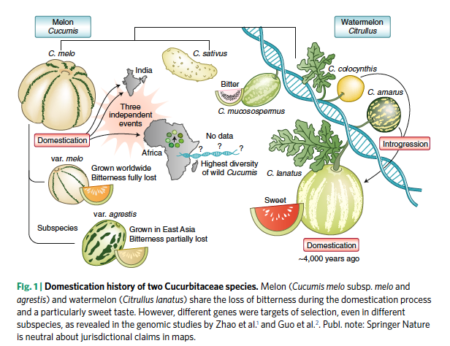
The bottom line(s)? The two different subspecies of melon acquired sweet flesh through different mutations, independently but probably both in India; there was a third domestication event in Africa, but the authors had too little material at hand to say much about this. Melon and watermelon lost their bitterness through convergent evolution, and the latter has benefitted from introgression from two wild relatives, one of which was separately domesticated for its seeds.
One-man root and tuber breeding show comes to town
Welcome to Cultivariable! My name is William Whitson and I breed plants. Cultivariable is my business, where I sell the plants that I breed and, miraculously, seem to be making a living at it. I breed plants for fun, because I am interested in discovering the possibilities. I’m not changing the world here. My discoveries are not going to feed the starving masses, save us from climate change, or expand the frontiers of science, but they might feed you if you grow them. This is mostly a one-man show, meaning that I do everything from weeding to stuffing envelopes alongside the actual breeding work.
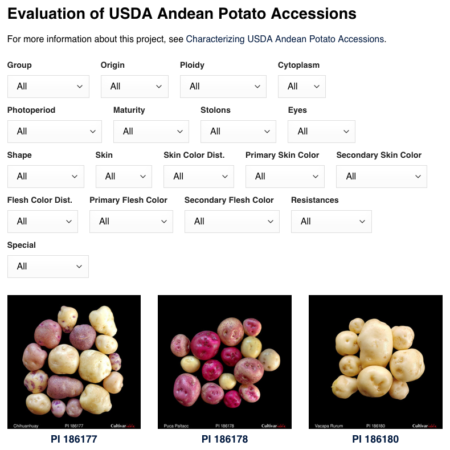
William also put together a pretty nice website, from which you can order his stuff. Particularly impressive is his single-minded determination of fully characterize the USDA potato collection. Well worth supporting.
Brainfood: Tree SDM, TR4 in Colombia, Genebanks double, Pacific ag, Gums, Defaunation, Oil palm, Agroforestry, Moldy cheese, Ecosystem services, Meat, Desert ag, Maize evolution
- Species distribution modelling to support forest management. A literature review. Embrace the uncertainty.
- First report of Fusarium wilt Tropical Race 4 in Cavendish bananas caused by Fusarium odoratissimum in Colombia. Inevitable.
- Seed Banking as Future Insurance Against Crop Collapses. “Although the basic technology of seed- (gene-)banking is relatively simple, there are nonetheless significant costs involved in effectively managing seed- (gene-)bank collections.” Elevator pitch desperately needed.
- Rapid loss of seed viability in ex situ conserved wheat and barley at 4°C as compared to −20°C storage. Colder the better.
- Origin and Development of Agriculture in New Guinea, Island Melanesia and Polynesia. Maybe 5-6 distinct stages since 7000 BP.
- Exotic eucalypts: From demonized trees to allies of tropical forest restoration? Maybe.
- Quantifying the impacts of defaunation on natural forest regeneration in a global meta-analysis. Forests need vertebrates. No word on where eucalypts stand.
- Market-mediated responses confound policies to limit deforestation from oil palm expansion in Malaysia and Indonesia. Bans are not enough…
- The ‘Capitalist Squeeze’ and the Rise and Fall of Sumatra’s Krui Agroforests. …you need active forest conservation too.
- Rapid Phenotypic and Metabolomic Domestication of Wild Penicillium Molds on Cheese. Wild molds adapt to cheese, can eventually make camembert.
- A global synthesis reveals biodiversity-mediated benefits for crop production. Need species richness for pollination, biological pest control and final yields.
- Animal source foods: Sustainability problem or malnutrition and sustainability solution? Perspective matters. Let them eat meat.
- The vitality of fruit trees in ancient Bedouin orchards in the Arid Negev Highlands (Israel): Implications of climatic change and environmental stability. Recycling centuries-old infrastructure in the desert.
- The Genomic Basis for Short-Term Evolution of Environmental Adaptation in Maize. Significant shift in adaptation of tropical landrace to temperate conditions in 10 generations with little loss of genetic diversity.
Genebanks everywhere on NPR
Just realized that my last two stories involved gene banks. Shouldn't there be some sort of award for that?
— Dan Charles (@DanCharlesNow) October 31, 2019
I’m all for it, but judge for yourselves. Here are the two stories involved:
- From Culinary Dud To Stud: How Dutch Plant Breeders Built Our Brussels Sprouts Boom. By looking into their genebanks, of course, to find less bitter varieties.
- Most U.S. Dairy Cows Are Descended From Just 2 Bulls. That’s Not Good. But fortunately there’s heritage semen in the fridge.