A thoughtful Twitter threat about grazing.
DOI DIY
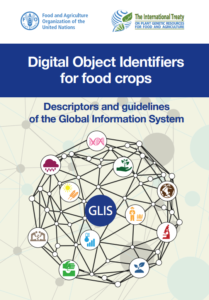 Remember when we told you that you could comment on the draft guidelines for the use of DOIs in plant genetic resources conservation and use? Well, I hope you did, because now they’re out, thanks to the Seed Treaty’s work on developing a Global Information System. Here’s one of the authors, in case you were wondering. And on the same website, that of the Genebank Platform, you can also find out about how his, and the other CGIAR genebanks, are implementing DOIs.
Duty Calls: Forgotten Root Vegetables Edition

It’s a sickness, I know, but when I read the Grauniad article Luigi just nibbled — Salsify: Waitrose brings back ‘forgotten’ Victorian vegetable — I knew I couldn’t rest or, indeed, eat lunch, until I’d set matters straight.
The article says:
The vegetable will be available at Waitrose in the black variety, grown in Cambridgeshire and Norfolk, as well as a small amount of white salsify, which is grown in the sandy soils of Ayrshire in Scotland.
A reasonable person might imagine that there are indeed two varieties of a single crop. An unreasonable one, me, would take to his keyboard in a huff, explaining that the vegetable occasionally known as black salsify, is also known as scorzonera, and is botanically Scorzonera hispanica, while salsify is Tragopogon porrifolius. Admittedly both are in the same family (Asteraceae) but they are not varieties of a single crop, unless that crop is forgotten Victorian root vegetables.
Adding insult to injury, the Guardian’s photograph of Tragopogon porrifolius is captioned “Scorzonera hispanica (salsify) roots with tendrils. Photograph: Dorling Kindersley/Getty Images/Dorling Kindersley”. Right common name, wrong Latin name.
I traced it back to the original. The page itself has vanished, but thanks to the Internet Archive a version has been captured, and though it lacks the image, it does state clearly that it is Tragopogon porrifolius.
Somewhere along the line, probably when Getty Images acquired it from Dorling Kindersley, things got messed up. Certainly Getty’s gallery of salsify images is a jumble of the two species, with Scorzonera predominant.
I’ll go and get my lunch now.
Dutch go wild
Nice little video from CGN on collecting the wild relatives of asparagus and other vegetables.
Brainfood: Climate resilient crops, Food system limits, Phenotyping double, Sweet sorghum, Melon history, Paying4data, Beercalypse, Village chickens, Breeding 4.0, European maize, Brachiaria ROI
- Are agricultural researchers working on the right crops to enable food and nutrition security under future climates? No. Well, kinda.
- Options for keeping the food system within environmental limits. You need to pursue several. Including those discussed above, presumably.
- Deep Learning for Plant Stress Phenotyping: Trends and Future Perspectives. 3D CNN architectures applied to hyperspectral imaging is the future, apparently.
- Dealing with multi‐source and multi‐scale information in plant phenomics: the ontology‐driven Phenotyping Hybrid Information System. You’re going to need a fancy system to keep track to the data from the above.
- Sweet Sorghum Originated through Selection of Dry, a Plant-specific NAC Transcription Factor Gene. Could be applied to other cereals?
- Repeated domestication of melon (Cucumis melo) in Africa and Asia and a new close relative from India. Once was not enough.
- Paying for Digital Information: Assessing Farmers Willingness to Pay for a Digital Agriculture and Nutrition Service in Ghana. Cheaper is better. There’s a shocker. Oh, and women are more careful with their money.
- Decreases in global beer supply due to extreme drought and heat. 32% decrease in consumption in Argentina, 193% increase in price in Ireland. But clearly the authors have never heard of sorghum beer.
- The role of local adaptation in sustainable production of village chickens. Location, location, location.
- On the Road to Breeding 4.0: Unraveling the Good, the Bad, and the Boring of Crop Quantitative Genomics. Beyond breeding on predicted phenotypes, it’s sort of breeding for predicted environments.
- Maize yields over Europe may increase in spite of climate change, with an appropriate use of the genetic variability of flowering time. You don’t even need Breeding 1.0, if you deploy existing diversity optimally.
- Got forages? Understanding potential returns on investment in Brachiaria spp. for dairy producers in Eastern Africa. Definitely worth a flutter.