A Sardinian grasspea is recognized

Congratulations to the Italian company Sa Laurera for receiving the 2016 Arca Deli Award for its Sardinian grasspea variety Inchixa.

In 2016, the SAVE Foundation announced the Arca Deli Award which is dedicated to products derived from the cultivation of local rare or endangered varieties that were recovered and maintained on a farm and are appropriately valued. We chose to compete with our Inchixa.

At the annual meeting of the foundation held in Metlika, Slovenia in September the SAVE jury met to evaluate products that had entered the competition.

A few weeks ago, we were informed that we are among the six winners! Sa Laurera is the only Italian company to have won the Arca Deli Award 2016, and our grasspea is the first Sardinian pulse to receive international recognition.

​From a toxic plant, contraindicated for human consumption, to an interesting crop that deserves to be reassessed for its nutritional and nutraceutical features: It is particularly rich in protein, containing around 30g of protein per 100g of edible seeds, and seems to have positive effects for the prevention of cardiovascular diseases and osteoporosis.

The Inchixa example shows that small-scale farm work can be a starting point for the recovery and development of forgotten foods.

Preparing grasspea to eat is hard work, so “recovery and development” of this “forgotten food” must have been quite a challenge. But not an insurmountable one, apparently.

In Sardinia, new generations and urban dwellers, who are increasingly sensitive to issues related to health, food and local gastronomic traditions, not only appreciate the legume but actively seek it out.

I couldn’t find Inchixa in any of the usual databases, but “the name comes from from the Catalan word Guixa,” and there are lots of accessions of things with this name in the Spanish genebank.

Other Sardinian local names for grasspea are Denti de bècia, Piseddu, Pisu-faa, Pisu a tres atzas. Propagation material used to start the recovery of landrace derives from small-scale cultivations of our relatives, who have mostly cultivated this crop for self-consumption.

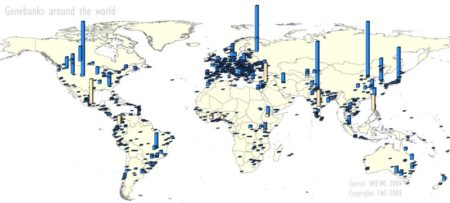
Piseddu is the only one of these which I found on Genesys, collected in Sardinia and conserved in Germany. Thank goodness for those relatives, but I hope they put all of these landraces in a genebank somewhere. Perhaps ICARDA’s? They have very little from Italy, but lots from the rest of the area of the crop (click to enlarge the map).

Brainfood: Potato changes, Anti-carcinogenic kava, Horizontal barley, Genebank use, Lotus diversity, Rubber soul, CWR breeding, Andean PGR, Distribution modelling

All things tropical forages

Great article on improved tropical pastures by Dan Charles on NPR’s The Salt yesterday. Here’s the money quote:

According to Michael Peters, who leads CIAT’s research on tropical grazing, pastures made up of these grasses can support three times more cattle, compared to typical tropical pastures today. The animals also gain weight twice as quickly. It translates into a six-fold increase in production per acre, and a dramatic cut in greenhouse emissions.

“These grasses” are Brachiaria species, but of course there’s much more than just those in CIAT’s forages genebank. And then there’s ILRI’s forages genebank too. And a global strategy to rule them all. And a newsletter to subscribe to if you want to keep up to date.

Mapping pests the old fashioned way

The collaborative project “Predicting climate change-induced vulnerability of African agricultural systems to major insect pests through advanced insect phenology modeling and decision aid development for adaptation planning” was led by CIP and implemented in collaboration with the International Centre of Insect Physiology and Ecology (icipe) and the International Institute for Tropical Agriculture (IITA). In the project, pest risk assessments under potential future climates were conducted for a number of important insect pests of agricultural and horticultural crops in Africa (i.e., potato, sweetpotato, vegetables, maize, cassava, and fruit). Results of these assessments are presented in the Pest Distribution and Risk Atlas for Africa (Pest Risk Atlas for Africa, for short).

And here it is, covering 3 potato pests, 5 for sweetpotato, 4 for vegetables and 5 for maize. For each pest, there’s a lot of information on detection and identification, biology, impact, and control, as well as a detailed geographic analysis of distribution and severity, now and in the future, at various scales.

Check out, for example, what’s going to happen to sweetpotato whitefly (Bemisia tabaci) in Africa (there are also global and country maps, in this case).

This shows the absolute change in potential population growth between 2000 and 2050. Note the bad news for Central Kenya, which will be interest the mother-in-law, who rents out some bottomland for sweetpotato. And she’ll have plenty of Chinese company, by the looks of the global maps.

At least, I guess so. It’s difficult to be sure when all you have are maps in the form of images. I do hope they’ll be available on Google Earth in due course, for researchers (and indeed farmers) who want to drill down a bit.