- Chloroplast heterogeneity and historical admixture within the genus Malus. Three genetic networks within the genus, with the cultivated species in one of them.
- Subgenomic Diversity Patterns Caused by Directional Selection in Bread Wheat Gene Pools. Five subpopulations, dividing the European from the Chinese material. Some parts of the genome more in need of diversity than others.
- Biodiversity of Lactuca aculeata germplasm assessed by SSR and AFLP markers, and resistance variation to Bremia lactucae. Some race-specific resistance in the wild relative in Israel-Jordan, but nothing extraordinarily efficient.
- Using Multi-Objective Artificial Immune Systems to Find Core Collections Based on Molecular Markers. Very fancy math not only picks populations to maximise diversity, but also potentially at the same time minimises distance from the office.
- Assessment of ISSR based molecular genetic diversity of Hassawi rice in Saudi Arabia. It’s not just one thing.
- Minor Millets as a Central Element for Sustainably Enhanced Incomes, Empowerment, and Nutrition in Rural India. Holistic mainstreaming pays dividends.
- Minimum required number of specimen records to develop accurate species distribution models. Depends on prevalance, but 15 is a good rule of thumb.
- Microsatellite Analysis of Museum Specimens Reveals Historical Differences in Genetic Diversity between Declining and More Stable Bombus Species. Species which declined less diverse than species which did not.
The secret to human intelligence?
Not potatoes, that’s for sure. But there’s other things, Daily Mail.
Organic space lettuce
Fresh food grown in the microgravity environment of space officially is on the menu for the first time for NASA astronauts on the International Space Station. Expedition 44 crew members, including NASA’s one-year astronaut Scott Kelly, are ready to sample the fruits of their labor after harvesting a crop of “Outredgeous” red romaine lettuce Monday, Aug. 10, from the Veggie plant growth system on the nation’s orbiting laboratory.
And I’m pretty sure you’ll be able to watch them do it.
As for Outredgeous, you can buy it online. It was bred by Frank Morton, as Matthew Dillon of the Organic Seed Alliance told me on Facebook:
The varieties that University of Wisconsin researchers recommended they grow were bred by Frank Morton, an organic farmer with no formal training in genetics, but one of the more successful vegetable breeders of our time. Farmers as seed innovators, even in space.
You can find his story online in various places.
His varieties are grown in many countries and even in space: Outredgeous, one of his most popular lettuces—so named for leaves so red that the botany students who first saw it didn’t recognize it as lettuce—is being grown on the International Space Station. (It grows quickly, has a high concentration of antioxidants, and is highly bacteria-resistant—a concern for astronauts eating raw food.)
But why not let him tell it?
My education as a plant breeder has been through several stages. The first one, just described, was based primarily on direct experience with the repeated life cycles of plants and their insect cohorts. I also read the twenty volumes of Luther Burbank’s life and work, which does not really qualify as an education in breeding these days (“Can you learn anything reading those?” one well known breeder asked). But Burbank was inspiring beyond belief, and made me believe anything was possible, given enough tries. Persistence pays.
Many happy returns

A very happy birthday to MS Swaminathan, Father of the Green Revolution in India. How many people get a hashtag on their birthday?
The impact pathways of international genebanks
This analysis does not attempt, in any manner, to undermine the significance of the exotic germplasm material received by India during the course of time, irrespective of the source. India is a recipient of a large amount of germplasm over the period of time from multiple donors including CG genebanks and other national genebanks.
That, you may possibly remember, is from a paper on the flow of genebank material out of India. Our commentary on that paper also brought into play a compilation of data by researchers at Bioversity which quantified the movement of germplasm from India and other countries not only outwards into the CGIAR genebanks, but also in the other direction. This turned out to be just as extensive. But, of course, national programmes like India’s do not just benefit from the CGIAR genebanks through the direct access they have to the material they conserve. They also benefit from the crop improvement programmes of CGIAR centres, which churn out breeding lines and varieties using the raw materials found in their genebanks, and make them freely available to national breeders.
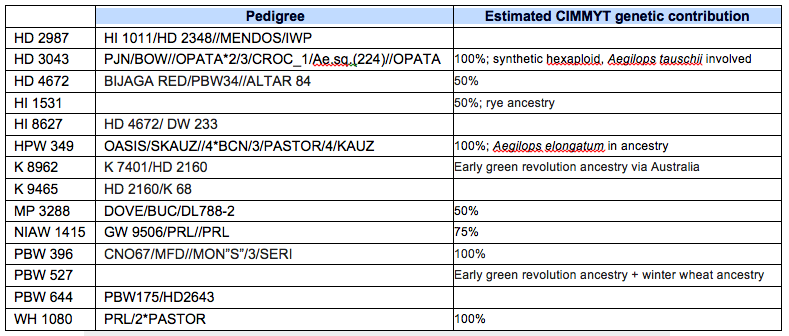
We actually saw an example of that recently when India published a list of drought and flood resistant varieties of various crops that had just been released. Through the magic of Wheat Atlas, and some expert knowledge, for both of which we’re very grateful, we can actually work out the contribution of, say, CIMMYT, to the wheat varieties on that list. Here it is, at a first, rough approximation:
Along the same lines, a recent blog post from IRRI says that
Seventy percent of all varieties released in the Philippines were strongly linked with IRRI between 1985 and 2009.
I’m sure India, and the Philippines, would agree that those international genebanks, and the crop improvement programmes they feed, are well worth having. Maybe even worth paying for.