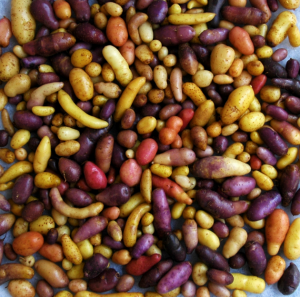
 The contents of a potato genebank? Nope: “…a maximum of two alleles per locus contributed to this variation.” That’s because this tuberous cornucopia is what the authors of a recent essay in the American Journal of Botany 1 got when they selfed a diploid potato clone which was itself derived from a cross between a completely homozygous parent and one that was very nearly so.
 What does this mean for genebanks? Basically, that they can’t rely on morphological variation, in even a whole set of traits, as a proxy for overall genetic diversity. So long, old-fashioned core collections. What you really need to do is sequence everything. Music to DivSeek ears, I’m sure. But that’s not all. You also have to make sure that the resulting better diversity information gets to farmers in a way that helps them support the processes that “create and maintain useful variation for functional traits and to develop strategies to identify and select valuable phenotypes.” Or on-farm conservation, to you and me.