- Indian plant germplasm on the global platter: an analysis. There’s a lot of it out there. But there could be more. And the total number of accessions in Genesys is mis-quoted by an order of magnitude. The message obviously resonates back home, though.
- Signal-processing tools for core-collection selection from genetic-resource collections. Fancy maths lets you combine data types to make better core collections.
- Impact of nutritional perceptions of traditional African vegetables on farm household production decisions: A case study of smallholders in Tanzania. People grow them because they think they’re nutritious.
- Can the Global Adoption of Genetically Improved Farmed Fish Increase Beyond 10%, and How? Through more public breeding, training and benefit-sharing. Well that sounds familiar.
- Phenotypic or Molecular Diversity Screening for Conservation of Genetic Resources? An Example from a Genebank Collection of the Temperate Forage Grass Timothy. Both.
- The alignment of agricultural and nature conservation policies in the European Union. It “remains a challenge.” Which means there isn’t any.
- Mapping opportunities and challenges for rewilding in Europe. Yeah, but see above.
Jeremy Cherfas to make rare public appearance
You anywhere around Trinity College Dublin next Friday? If so, will you be in need of soup and bread? If so, would you mind very much listening to Jeremy while you eat? Ok, then, read this.
They’re wild, Jim, but not as we know it
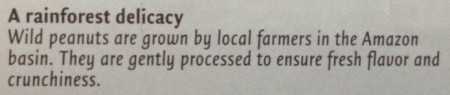
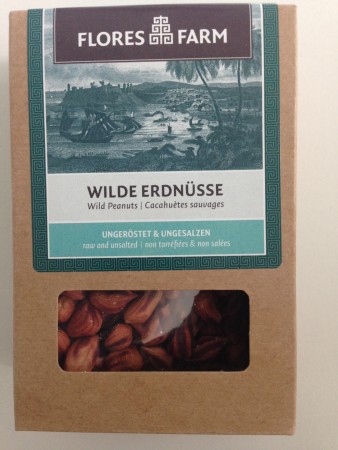 Look, I’m all for stripy, Fairtrade, organic, gently-processed fastigiata peanuts from Ecuador being sold to European hipsters for more money than their less cool cousins. But why call them wild? I mean, unless they mean wild-looking.
Keeping good crops down
https://twitter.com/GrantBrooke/status/603892676249915394
My sentiments exactly. This is the kind of thing that keeps nutritious, locally-important, traditional crops underused. Quite apart from messing with the livelihoods of farmers.
The ins and outs of Indian crop diversity
 Staff of India’s National Bureau of Plant Genetic Resources (NBPGR) recently published a very thorough analysis of the state of conservation of Indian crop diversity outside India. 1 One of the take-home messages was as follows. Yes, India has not yet formally declared what material “under its management and control” (which in the jargon means basically the National Bureau of Plant Genetic Resources) is in the Multilateral System of the Plant Treaty. But the fact is that a lot of Indian material is already in it, via other genebanks, largely (though not exclusively) the international collections managed by the CGIAR centres. And also in Svalbard.
That’s fair enough. But it’s only half the story, as the authors themselves readily admit:
This analysis does not attempt, in any manner, to undermine the significance of the exotic germplasm material received by India during the course of time, irrespective of the source. India is a recipient of a large amount of germplasm over the period of time from multiple donors including CG genebanks and other national genebanks.
Fortunately, we have data on both sides of the equation. Among the papers in support of next week’s third meeting of the Plant Treaty’s Ad Hoc Open-ended Working Group to Enhance the Functioning of the Multilateral System of Access and Benefit-sharing (sic) may be found “Twenty five years of international exchanges of plant genetic resources facilitated by the CGIAR genebanks: a case study on international interdependence,” a contribution from Bioversity. That includes the following table listing the 25 top countries providing germplasm to, and receiving germplasm from, the CGIAR centres over the period 1985-2009.
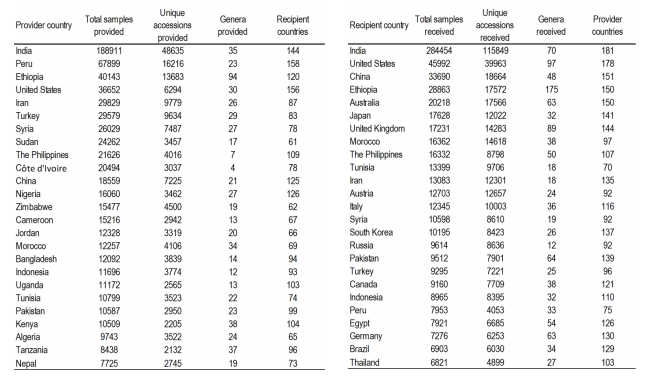
So India has contributed significantly to germplasm flows over the years — and also benefitted significantly. As has every other country on earth, I’m willing to bet. No getting around the fact that we’re all massively interdependent for crop diversity. (Stay tuned for more on that, there’s something in the works from our friend Colin Khoury that will approach the problem of quantifying interdependence from another angle…) Which is not to say that the functioning of the benefit-sharing side of the system cannot be improved upon. 2 And that of course is the task of the aforementioned Ad Hoc Open-ended Working Group, and we wish them luck with the last round of deliberations that have been going on for over a year now. If you want to get an idea of which way their thinking is going, you could start with the draft of the resolution they would like the Governing Body of the Treaty to consider passing at their next big meeting in October.