- Camelina as a sustainable oilseed crop: Contributions of plant breeding and genetic engineering. It will help that it’s close to Arabidopsis.
- Sustenance and sustainability: maximizing the impact of school gardens on health outcomes. You need proper experimental design if you’re going to say that such an impact exists. But such an impact probably exists, sometimes.
- Consumer preferences for agricultural products considering the value of biodiversity conservation in the Mekong Delta, Vietnam. Consumers are willing to pay extra for crane-friendly rice. Or at least they say they are.
- An Analysis of Social Seed Network and Its Contribution to On-Farm Conservation of Crop Genetic Diversity in Nepal. Fancy software shows farmers exchange seeds, and it’s important.
- Spatial Distribution of Trait-specific Diversity in Indian Wheat Collections. From 5930, 3973 are geo-referenced, showing where more collections need to be made. Unless of course they are among those 1957 and nobody can tell.
- Walk on the Wild Side: Estimating the Global Magnitude of Visits to Protected Areas. 8 billion visits per year (80% in Europe and North America), generating $600 billion per year in direct in-country expenditure and $250 billion in consumer surplus. Remember that we spent $10 billion per year worldwide in safeguarding protected areas.
- Allele Mining in Solanum Germplasm: Cloning and Characterization of RB-Homologous Gene Fragments from Late Blight Resistant Wild Potato Species. 17 gene fragments from 11 wild potato species could be useful in breeding for late blight resistance.
- Genetic diversity of the world’s largest oil palm (Elaeis guineensis Jacq.) field genebank accessions using microsatellite markers. Extreme West Africa group, West-Central-East Africa group and Madagascar group, with the last quite distinct.
- Progress in genetic engineering of peanut (Arachis hypogaea L.) — A review. Our jetpacks are in the mail.
Prioritizing FAO’s food composition work
Via the International Network of Food Data Systems (INFOODS) discussion list we hear from FAO’s Ruth Charrondiere that:
…FAO’s “Medium Term Plan 2014-17 (reviewed) and Programme of Work and Budget 2016-17” … states on p.21: “Nutrition: in realigning and strengthening work on nutrition in follow-up to ICN2, 1 reduce work on nutrition education curricular development and some food composition work.” (emphasis added)
This came as a surprise, apparently, because
…the evaluation of FAO’s role and work in nutrition of 2011 recommended exactly the contrary: see p.14 and recommendation 7.
Part of that recommendation was for
…FAO to build capacity at the regional and sub-regional levels, encourage regional collaboration to support countries (especially focal countries) to collect and analyse food composition data that is demanded by end-users for ensuring the nutrition sensitivity of policies and programme interventions.
Which seems very sensible. A good part of the food composition data work, of course, has focused on within-crop diversity in nutritional quality, which is why this proposed reduction is of interest to us here. Or maybe the powers that be at FAO are simply declaring victory, having decided that they have achieved what they wanted in this area. Anyway, you get to have your say, because
In order to know which part of our work is the least relevant for countries, and thus could be de-emphasized, I designed a survey which I hope many of you will complete ASAP. Please disseminate it widely also to colleagues who work on food composition.
International Year of Quinoa officially over
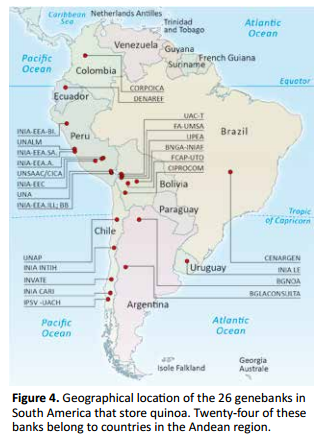 FAO has just published a very glossy volume, somewhat unnecessarily prosaically entitled “State of the art report on quinoa around the world in 2013.” I guess it signals the official end of the International Year of Quinoa. There are chapters on all the things you’d expect, including genetic resources, that one authored by some old friends. That’s where we got the figure. I expect this will be the last word on the subject for some time to come.
Brainfood: Biodiversity and health, Medieval cattle, African livestock sustainability, Filipino rice, Coffee breeding, Land-sparing conundrum, Scrapie resistant goats, Ass-like equid evolution, GS in livestock breeding, Eucalypt diversity & drought, Ecosystem services of organic ag
- Relationships between agrobiodiversity, dietary diversity and nutritional status in Tanzania. It’s really complicated.
- Microsatellite genotyping of medieval cattle from central Italy suggests an old origin of Chianina and Romagnola cattle. DNA from a couple of cattle breeds from central Italy shows remarkable similarities with that from thousand-old bones from an archaeological site in the same area.
- Strategies and approaches to sustainable livestock production in Sub Saharan Africa. It will depend on women.
- Strategies and initiatives on rice genetic resources conservation and research for climate change adaptation. Among the 1506 traditional rice varieties in the Philippines genebank are 3 which could be drought tolerant and 9 collected from really saline areas. They’re being sequenced for gene discovery.
- Next generation variety development for sustainable production of arabica coffee (Coffea arabica L.): a review. Local breeding, plus international networking.
- Why biodiversity declines as protected areas increase: the effect of the power of governance regimes on sustainable landscapes. Modelling shows land-sharing may outperform land-sparing in the long run. Most interesting consequence of the insights derived is that perhaps protected areas should be placed near agricultural frontiers rather than where biodiversity or cost-effectiveness highest.
- Biodiversity and selection for scrapie resistance in goats: genetic polymorphism in “Girgentana” breed in Sicily, Italy. Resistance gene more common in this weird breed than in the one that’s usually used in breeding.
- Reassessing the evolutionary history of ass-like equids: Insights from patterns of genetic variation in contemporary extant populations. I urge you to read the abstract yourselves and marvel at the author’ success in using the word ass-like the maximum possible number of times.
- Opinion paper: emerging markets, emerging strategies under the genomic revolution. Genomic selection is an organizational revolution as much as a technological one. At least in animal breeding.
- Genetic diversity of Eucalyptus camaldulensis Dehnh. following population decline in response to drought and altered hydrological regime. It stayed the same, I guess because of gene flow.
- Significance and value of non-traded ecosystem services on farmland. Value of biological control of pests and nitrogen mineralisation provided by organic agriculture of peas, beans, barley and wheat (extrapolated from 20 fields in NZ to whole of temperate zone) was greater than global costs of insecticides and fertilizers, even if only 10% of global arable area was converted to organic.
The cost-benefit of Australian genebanks
We’ve now received a copy of the 2007 report to the Steering Committee of Australia’s National Genetic Resource Centre entitled “Benefit-cost analysis of the proposed National Genetic Resources Centre,” as trailed in an earlier post. That’s the one that was said to posit a return on investment of 119:1 for the Australian pastures genebank. It makes for interesting reading, and we’ll try to summarize the main points here.
First, some clarifications, though. It in fact does not posit a return on investment (ROI) of 119:1 for the Australian pastures genebank. Sorry we gave that impression earlier. That is the ROI for the whole Australian National Genetic Resources Centre (NGRC), of which the pastures collection is just a part. Let me back up a bit. The Primary Industries Ministerial Council of Australia agreed in 2006 that the 5 existing, separate state-run genebanks (managing something like 180,000 accessions in total) should be amalgamated into a single (but actually two-node), national facility.
This was seen as an important pre-requisite for meeting Australia’s obligations under the International Treaty of Plant Genetic Resources for Food and Agriculture. As part of that process, The Allen Consulting Group was asked to consider the situation of no agricultural plant germplasm being conserved in Australia, work out how much the NGRC would be worth to Australia if that counterfactual were not in fact true, and compare that to the projected cost of setting up and running the NGRC.
The cost side of things was not that difficult to work out. It was estimated that the 2-node (crops and pastures) NGRC would cost about A$ 590,000 to set up, and A$ 3.5 million a year to run thereafter (compared to A$ 3.705 million a year for the 5-genebank system). Over 30 years, discounted at 6% real (whatever that means), that’s an outlay of A$ 51.7 million.
To get to the value of the system, it was necessary to make some assumptions:
- Continued access to germplasm held in Australia would enable historic trends in the growth of farm productivity to continue.
- Holding no germplasm in Australia would mean growth of productivity due to plant genetic enhancement would continue, but at a slower rate. Productivity gains due to other things would stay the same.
- The share of productivity gains due to plant genetic enhancement varied from 5% (sheep farming) to 30% (field crops).
- The share of productivity gains from plant genetic enhancement due to access to germplasm collections in Australia was 30%.
Put all that into your spreadsheet and you get a total of A$ 5 billion net present value to the productivity of Australian agriculture over the next 30 years. Add another A$ 1.2 billion in assorted benefits not associated with increased productivity (things like water quality, public health etc.), and you get A$ 6.2 billion (that’s an annuity benefit of A$ 364 million), which divided by the 30-year cost gives you that 119:1 ratio.
How confident are The Allen Consulting Group in their results? Well, they identified two key uncertainties: the annual discount rate and the share of genetic gain attributable to access to germplasm in Australia. Tweak the 6% and 30% values of these two things, respectively, and you get a range of productivity benefits over 30 years of A$ 1.2-14.7 billion around the canonical A$ 5 billion.
But when you think about it what the study actually did is work out the return to Australian agriculture of those 180,000 accessions being conserved, somewhere. The material could be held in places other than Australia, after all, and still be available under the International Treaty. Ah, but the study also figured that the cost of servicing demand by Australian breeders would be 20% higher if the average 14,000 yearly seed samples they requested had to come from genebanks outside the country, rather than the NGRC (because of stuff like quarantine etc.). So there were efficiency gains, which were factored into the benefits side of the equation.
So there you have it. Put another way, each accession maintained in the Australian systems will cost the Australian taxpayer A$ 21 a year over the next 30 years, and return A$ 194 a year to the Australian economy. I think: I get confused, but I think that’s right. That sounds pretty good, though I guess one should compare it with other sorts of investments the Australian government could make. Anyway, it seems the powers that be thought it was a bet worth making. And it’s not only Australians that should be grateful for that.