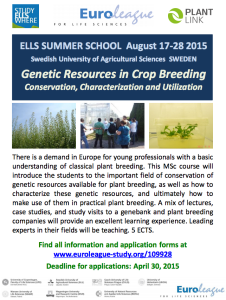
 A course on genetic resources for plant breeding is being organized at the Swedish University of Agricultural Sciences (SLU), Alnarp, Sweden. The person responsible is Prof. Rodomiro Ortíz, who has a huge amount of experience in the field, with a wide variety of crops. It’ll be in August, and the deadline for applications is April 30.
UC Davis Plant Breeding Symposium coming soon
 The 2015 UC Davis Plant Breeding Symposium will take place on April 10. The topic is “Challenges in Plant Breeding: Past, Present, and Future.” There’s an interesting lineup of invited speakers, and “[t]his year is the first time that students have the chance of presenting their research during the symposium.” We’ve been promised a summary post when it’s done. But that shouldn’t stop you going, if you can, or following the webinar.
Australia’s very valuable new pastures genebank
A video has just surfaced about the Australian Pastures Genebank, courtesy of the Grains Research and Development Corporation (GRDC), starring my mate Steve Hughes. Here are the headline numbers: 70K accessions, 2K species, collected over 60 years, ROI 119:1. Say what? Return on investment in a genebank of over 100 to 1? How come I’ve never come across this before? Well, it’s from a 2007 report to the Steering Committee of Australia’s National Genetic Resource Centre entitled “Benefit-cost analysis of the proposed National Genetic Resources Centre.” And I can’t find it online. But Steve has promised to send it. Stay tuned…
Confused? You will be!
There is a nice set of presentations online on what it means in practical terms for a plant germplasm collection to be Nagoya and International Treaty compliant, in this particular case in the UK. I especially like the one by Penny Maplestone, Chief Executive of the British Society of Plant Breeders:
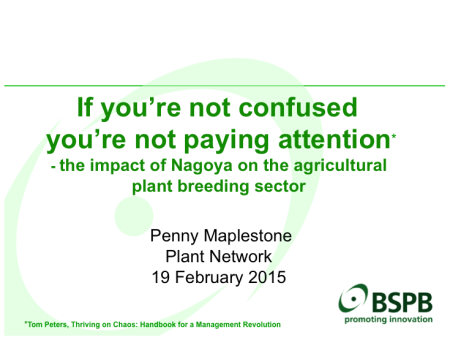
If you’re still confused, you might like to turn to Carolina Roa’s post on the SMTA.
Brainfood: Identifying accessions, Evaluating yeasts, Using CWR, Wild grapes, Bushmeat and nutrition, Rice evaluation, Tomato characterization, Sugarcane CWR, Nordic livestock, Conservation optimization, Moringa development, Albanian olives
- High-throughput genotyping for species identification and diversity assessment in germplasm collections.. 9% of random Brassicaceae samples from Australian Grains Genebank misidentified to species, with some interspecific hybrids.
- Methodology for enabling high-throughput simultaneous saccharification and fermentation screening of yeast using solid biomass as a substrate. Everything is now, now, now these days.
- Utilization of wild relatives of wheat, barley, maize and oat in developing abiotic and biotic stress tolerant new varieties. Useful summary table at the end.
- Patterns of SNP distribution provide a molecular basis for high genetic diversity and genetic differentiation in Vitis species. Different grape species are really different.
- Disentangling the relative effects of bushmeat availability on human nutrition in central Africa. Both rational use of some wild mammals for nutrition, and conservation of more vulnerable species, are possible, though in different places.
- Blast Resistant Genes Distribution and Resistance Reaction to Blast in Korean Landraces of Rice (Oryza sativa L.). Conventional evaluation of landraces is useless; you really need to look at the genes.
- Characterization of a collection of local varieties of tomato (Solanum lycopersicum L.) using conventional descriptors and the high-throughput phenomics tool Tomato Analyzer. Brave new world.
- Phylogenetic analysis of Saccharum s.l. (Poaceae; Andropogoneae), with emphasis on the circumscription of the South American species. Allopolyploid, with 2 species belonging in a different genus.
- Utilization of farm animal genetic resources in a changing agro-ecological environment in the Nordic countries. Need to phenotype and genotype everything. Now where have I heard that before?
- Multi-objective optimization for plant germplasm collection conservation of genetic resources based on molecular variability. Lots of data plus fancy maths can tell you which individuals you should add to an ex situ collection to maximize conserved diversity.
- Actual and Potential Applications of Moringa stenopetala, Underutilized Indigenous Vegetable of Southern Ethiopia: A Review. Potential as a source of drugs, but you need to learn to grow it.
- Olive in the story and art in Albania. There are old olive trees around castles.