EURISCO is a search catalogue providing information about ex situ plant collections maintained in Europe. It is based on a European network of ex situ National Inventories (NIs). Currently, EURISCO comprises passport data about 1.1 million samples, representing 5,929 genera and 39,630 species from 43 countries.
Between 2003 and 2014, EURISCO was hosted and maintained by Bioversity International, Rome, Italy. Since 15th April 2014, these responsibilities are being moved to the Leibniz Institute of Plant Genetics and Crop Plant Research (IPK), Gatersleben, Germany. After adapting to a new IT infrastructure, important medium-term actions and objectives will be strengthening the network activities and incorporating phenotypic information about the collection, to name a few.
EURISCO is maintained on behalf of the Secretariat of the European Cooperative Programme for Plant Genetic Resources (ECPGR), in collaboration with and on behalf of the National Focal Points for the National Inventories.
That’s from the welcome screen of the new Eurisco interface. Of course I had to have a go. Bad decision.
First, I just used the “Search” interface, but it turned out that if you want to search on more than one thing at once (say, crop AND country of origin), you have to go to the “Advanced search” screen. I searched for Hordeum landraces from Armenia: No data found.
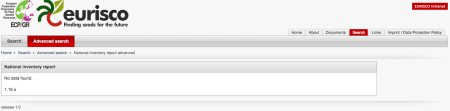
Strange. Try Genesys, which includes Eurisco data: 232 accessions. Ouch. What happened?
To cut a long story short, here’s the problem. The new Eurisco interface forces you to choose “Yes”, “No” or “Unknown” for both “MLS Status” AND “AEGIS” status. You can’t just ignore these descriptors, as you can in Genesys. That means that if you want to just know about barley landraces from Armenia, irrespective of whether they’re in the MLS or in AEGIS, you basically have to do nine searches, i.e. every combination of the three states in each of those two descriptors. Not ideal, I submit.
Over to you, IPK.