- Genetic characterization of local Criollo pig breeds from the Americas using microsatellite markers. 17 populations from 11 countries derive from 11 ancestral populations, with geographic clustering in some places but not in others.
- Physicochemical characterisation of four cherry species (Prunus spp.) grown in China. They’re all different.
- Extra-virgin olive oil production sustainability in northern Italy: a preliminary study. Not quite there yet.
- Genetic diversity of East and West African Striga hermonthica populations and virulence effects on a contrasting set of sorghum cultivars. Most of the variation in the parasite is within populations, but the most virulent populations are from Sudan.
- Assessing diversity in Triticum durum cultivars and breeding lines for high versus low cadmium content in seeds using the CAPS marker usw47. Durum accumulates toxic Cd more than other cereals, but some varieties are better than others, and there are DNA markers to tell you which they are.
- The Potential for Utilizing the Seed Crop Amaranth (Amaranthus spp.) in East Africa as an Alternative Crop to Support Food Security and Climate Change Mitigation. There is some.
- Development of a core collection for ramie by heuristic search based on SSR markers. 22 accessions is all you need to represent 108. Which doesn’t seem particularly useful given the total collection is over 2000.
- Morphological and genetic diversity among and within common bean (Phaseolus vulgaris L.) landraces from the Campania region (Southern Italy). There is a bit, some of it even in agronomic traits.
- Forage Breeding for Changing Environments and Production Systems: an Overview. Summary of 4th International Symposium of Forage Breeding. If you want to include all trending topics in one study, apply genomic selection to breeding for persistence.
CWR inventory of the United States wins prize
Congratulations to our friend and occasional contributor Colin Khoury and to his co-authors on the paper “An Inventory of Crop Wild Relatives of the United States.” The paper has been named “Outstanding Paper on Plant Genetic Resources in 2014″ by the Division C-8 Plant Genetic Resources of the Crop Science Society of America. Richly deserved. The data on which the paper is based can be found on the Crop Wild Relatives and Climate Change webpage.
Action for Nutrition at last, maybe
The Second International Conference on Nutrition (ICN2) drew to a close yesterday, having promulgated the Rome Declaration on Nutrition and endorsed a Framework for Action. From the latter, let us all applaud Recommendation 10 (of sixty):
Promote the diversification of crops including underutilized traditional crops, more production of fruits and vegetables, and appropriate production of animal-source products as needed, applying sustainable food production and natural resource management practices.
FAO is putting its (donors’) money where its mouth is by establishing an Action for Nutrition Trust Fund.
Twice per year the PCU will make a Call for Proposals based on the size of the Fund at the time. The SC will decide which proposals will be funded based on the recommendations from the PCU.
With sixty recommendations to choose from the Programme Coordinating Unit (PCU) will have its work cut out for it.
Have your say on international agricultural research priorities
(The) CGIAR is/are making a big push to elicit input on the new Strategy and Results Framework (SRF). You know the drill: a barrage of surveymonkeys, blogposts, tweets, Facebook posts, targeted emails, webinars, e-consultations, you name it, is coming your way. For all I know they’ll be knocking on doors in carefully selected neighbourhoods around the world. I’m always a little ambivalent when research organizations ask for help in prioritizing their work. On the one hand, it’s always good to ask. On the other, you’d have thought they would know by now.
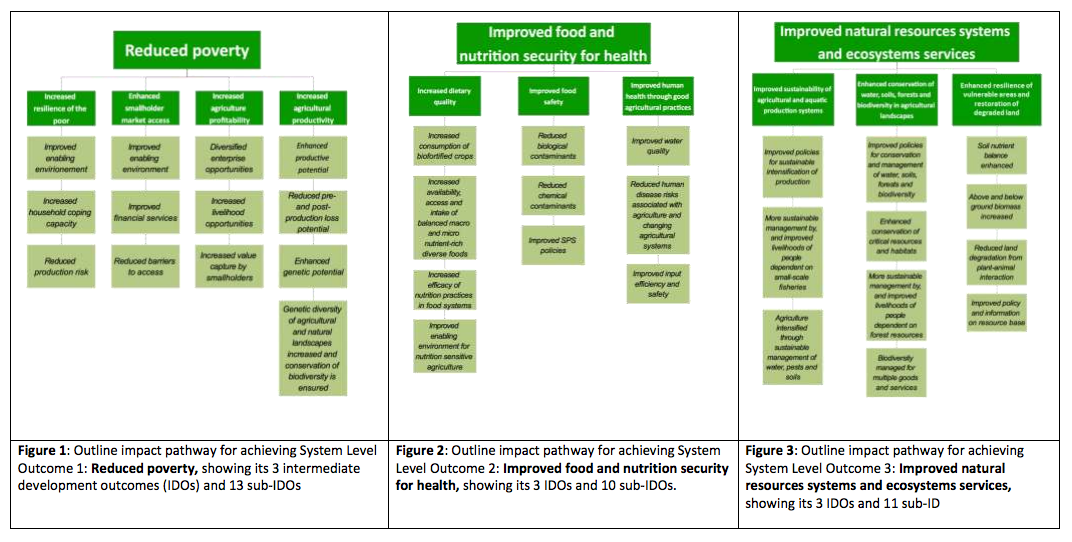
Anyway, the outcomes of CGIAR’s work are now listed as:
1. Reduced poverty
2. Improved food and nutrition security for health
3. Improved natural resources systems and ecosystems services
And it is good to see the importance of the international genebanks in achieving these system-level outcomes recognized in the section of the SRF describing the particular niche of CGIAR:
The CGIAR community holds in trust globally unique genetic resources for a subset of agriculturally significant species of central importance to sustaining and advancing productivity and yield stability for the world’s smallholders in the 21st century.
Less good, however, to note that use of genetic diversity is thought to only contribute to the reduced poverty outcome, and then only via increased agricultural productivity. Sorry about the poor quality of the image showing this below, click on it to improve it a bit, but it wasn’t that much better in the original document:
There are “cross-cutting topics of global importance — women and youth; climate change; and capacity development — [that] will systematically strengthen and build coherence in research across all domains and Intermediate Development Outcomes (IDOs).” Should not conservation and sustainable use of agricultural biodiversity be one of these? Maybe I’ll respond to one of those tweets from @CGIAR.
What should be the priorities for International Agricultural Research for Development? http://t.co/OPWbKjFciV #ag4dev pic.twitter.com/ftQfg5WOAf
— CGIAR (@CGIAR) November 21, 2014
Moroccan medicinal mint tea
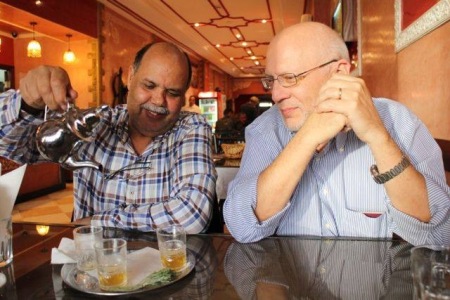
That’s me on the right in Rabat last week, having a post-prandial drink with Dr Ahmed Amri, head of the ICARDA genebank. I post the photo (taken by my colleague Charlotte Lusty) by way of explanation for the lack of blogging lately, and also as an excuse to link to the beta version of Kew’s Medicinal Plant Names Service, which I have just become aware of. You see that bit of greenery on the tea tray? It’s a plant that’s sometimes added to mint tea in Morocco during the winter. It’s called “absinthe” there. If you want to know the Latin name, you can look it up here.